Role of the Content Strategist vs. Content Manager in Modern Teams
Strategists plan what content matters; managers ensure it ships on time and hits its goals.

Content strategist and content manager are separate roles. They do two separate jobs, one picks what content to create and its purpose, the other makes sure it’s produced and published on schedule, and confusing them leads to a schedule packed with unwanted posts. When roles are unclear, companies may find themselves with overlapping responsibilities—one person focused on strategic planning while another maintains the content calendar. That's less a hiring error and more a problem with the role, one that slowly builds up until someone wonders why organic traffic can plateau.
When roles overlap, the resulting issues are so predictable you could set your watch by them. Content ships without a defined audience. Unclear briefs make writers guess, an expense at scale. The calendar stays packed, because ideas are plentiful, while organic growth stalls, since sheer volume wasn't the problem. A strategist may create a detailed plan, but without clear ownership, it risks going unused. These two jobs really do overlap, it's not just made up. Both deal with planning. Both review performance metrics. Writers hear from both about missed deadlines on Tuesday afternoons. Given this real overlap, a single job title won't differentiate the roles; instead, this piece uses mode, decision scope, and time horizon to define the split, not weekly word count.
What a content strategist actually owns, day to day
The strategist acts early, before any sentence is written. It’s figuring out what to create, who needs it, why it’s worth doing, and how success is measured. It sounds abstract until you see the deliverables: audience segments showing what an early prospect needs versus someone far into sales, topic pillars and keyword clusters designed to dominate a category over months not just rank this week, and governance like style guides, tone rules, taxonomy, and accessibility standards that stop a content library from becoming a junk drawer.
Set up success metrics upfront, no back-fitting results later, plus routine checks on the content stash to spot what stays, gets freshened, combines, or dies, and briefs sharp enough that the team knows exactly what to build, not just how it should feel. Job descriptions rarely mention the most valuable thing a strategist does weekly: saying no. Blocking low-value ideas can save significant time for writers.
This role's KPIs show a big-picture view: organic growth in topic groups, share of voice in key searches, content conversion rates for signups or demos, B2B pipeline impact, and basic content ROI versus waste. Strategists usually rank high on the org chart, often reporting to a digital head or C-level executive while collaborating with UX, IT, and business strategy owners. Their timeline spans quarters and years, not next Tuesday’s post. Their skills are analytical, covering research like competitor audits and trend tracking, strong SEO, and, often overlooked, explaining complex content bets to a CFO who just wants to know when they pay off, not about keyword clusters.
What a content manager actually owns, day to day
The manager takes over right where the strategist left off. They have to make a written plan into a steady publishing schedule that works every week without last-minute saves. It means truly managing the editorial calendar, where deadlines are not just goals but the basis for performance evaluations. They coordinate writers and editors, give clear briefs, handle feedback, and manage file versions to prevent outdated edits.
It involves constant work within the CMS: publishing, metadata, internal linking, images, schema markup, all the unglamorous essentials that make a website run. Quality control means editing drafts for clarity, tone, and SEO before publishing, and doing ongoing work like updating old posts, fixing links, and merging similar content. Checking page stats is hands-on: which one’s hitting goals, which one’s due for a refresh.
The manager's defining accountability is blunt. If content doesn’t get published, the manager is fully responsible, because their whole job is making it happen. The KPIs show the manager's focus: how many pieces ship each month, quality metrics like time on page and scroll depth, SEO basics like indexation and post-update gains, speed from brief to publish, and minimizing bottlenecks or last-minute rewrites. On the org chart, this job typically answers to a marketing director or CMO and collaborates with social media, SEO experts, and similar colleagues, per Yardstick's role analysis. They look at this week and month, not next year's cluster map.
Skills that matter most: editorial judgment (spotting what's confusing or just filler, not just fixing commas), solid project management instincts, real CMS fluency, some comfort with marketing automation tools, and the patience to coordinate writers, designers, and developers while a stakeholder asks for "one small change" at 4:45pm on a Friday. Many companies lump strategy and delivery into a "Content Marketing Manager" job that covers calendars, gated assets, case studies, email content, and "collaborating on content direction." This isn't a clear definition of either role, it's just a practical compromise due to budget constraints, and it's the kind of blur that causes this mess.
The clearest way to hold both roles in mind at once
The architect draws up the plans. No one expects the architect to mix concrete, or the builder to change the floor plan halfway through just because the framing crew lost interest.
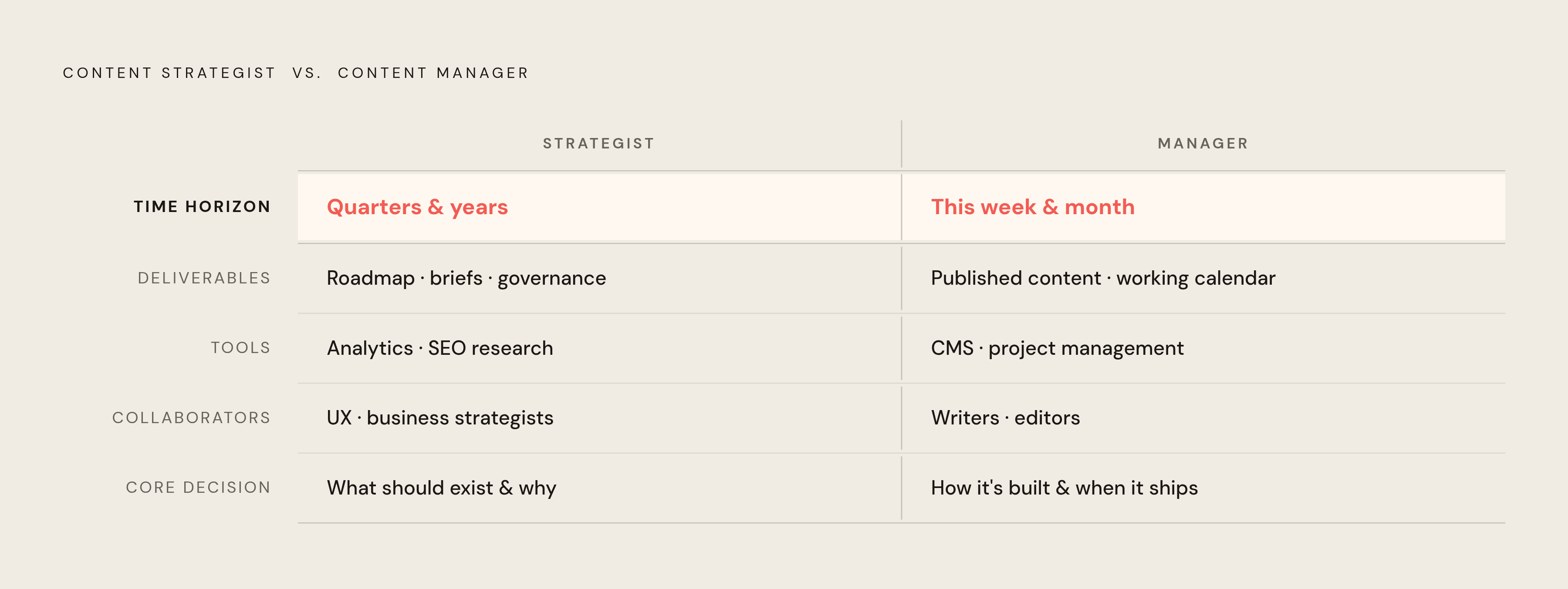
A tighter shorthand, courtesy of Yardstick's role breakdown: strategists own the why and the how of content, content marketing managers concentrate on the what and the where. Compare the two roles directly, and the difference becomes clearer. The main emphasis is long-term vision and planning against shorter production and campaigns. Main deliverables: a roadmap, briefs, and governance frameworks compared to published content and a working calendar. Each uses different tools: analytics and SEO research for strategists, a CMS and project management apps for managers. They talk to different people daily (UX and business strategists for strategists, writers and editors for managers), and each role's key decisions are distinct: what should exist and why, versus how it's built and when it ships.
One question clears up most confusion quicker than any org chart: who handles direction, and who handles delivery? Both could end up writing something. Their titles don't depend on word count.
Where the roles genuinely overlap and why that space gets mismanaged
It’s not just in your head. They both plan calendars, gauge content effectiveness, regularly converse with writers, and help decide what to update or remove from old material. Assuming a clear divide between them is still an error.
Disputes often arise when a strategy is written down, but a manager's daily decisions quietly alter its course. Nobody's acting in bad faith. Deadlines don’t pause for strategists to join every decision, so direction shifts slightly each week, leaving the roadmap and actual output looking nothing alike. The opposite mistake seems different but ends up the same: after creating a plan, the strategist stops tracking real progress, the manager improvises to maintain productivity, and the plan becomes irrelevant.
Mismanagement here compounds in a specific, traceable way. A missing handoff point means the strategist is pulled into "can you just approve this brief real quick" production issues, losing crucial thinking time for their role. The manager, left hanging, starts posting on the fly, an empty schedule feels worse than a plan that’s a little off. The solution is simple, though it’s seldom documented: identify the handoff artifact. That's the specific document, like an approved brief, signed content pillar, or finalized framework, marking where strategy's job ends and management's begins. Whoever owns that artifact owns accountability up to that line, and not past it. The roles differ in focus: strategists emphasize long-term planning, while managers handle execution.
Where each role sits in a fully built content team
A fully staffed content team may include multiple layers of responsibility. At entry level, Content Marketing Coordinators often assist with content creation and execution. Content Marketing Specialists may oversee content initiatives and collaborate with other teams. Senior Content Marketing Strategists often handle broader responsibilities and long-term planning.
Above that, a A VP of Content may oversee major initiatives and align them with executive priorities. The The Chief Content Officer typically sets the overall content strategy.
Yardstick's analysis shows career paths for each role diverging early and staying that way: a typical strategist's progression is from Content Writer to Content Manager to Content Strategist to Director of Content Strategy. Managers usually progress from Content Writer to Content Marketing Specialist, then to Content Marketing Manager and Director of Content Marketing. Also worth mentioning: some teams now include a content engineer, who sets up and maintains the tools, automation, and frameworks that scale strategy and management, according to recent discussions of emerging content roles. It's still uncommon. But it covers ground that neither role was built for, which matters for anyone looking ahead to where content teams are going, not just where they are now.
What the salary gap between the two roles actually reflects
This number usually shuts down the "aren't these the same job" debate: Glassdoor shows content strategy pays notably more, while content manager pays considerably less, a meaningful five-figure difference. That's not noise. The strategist role usually gets more pay because it requires more experience and decision-making power.
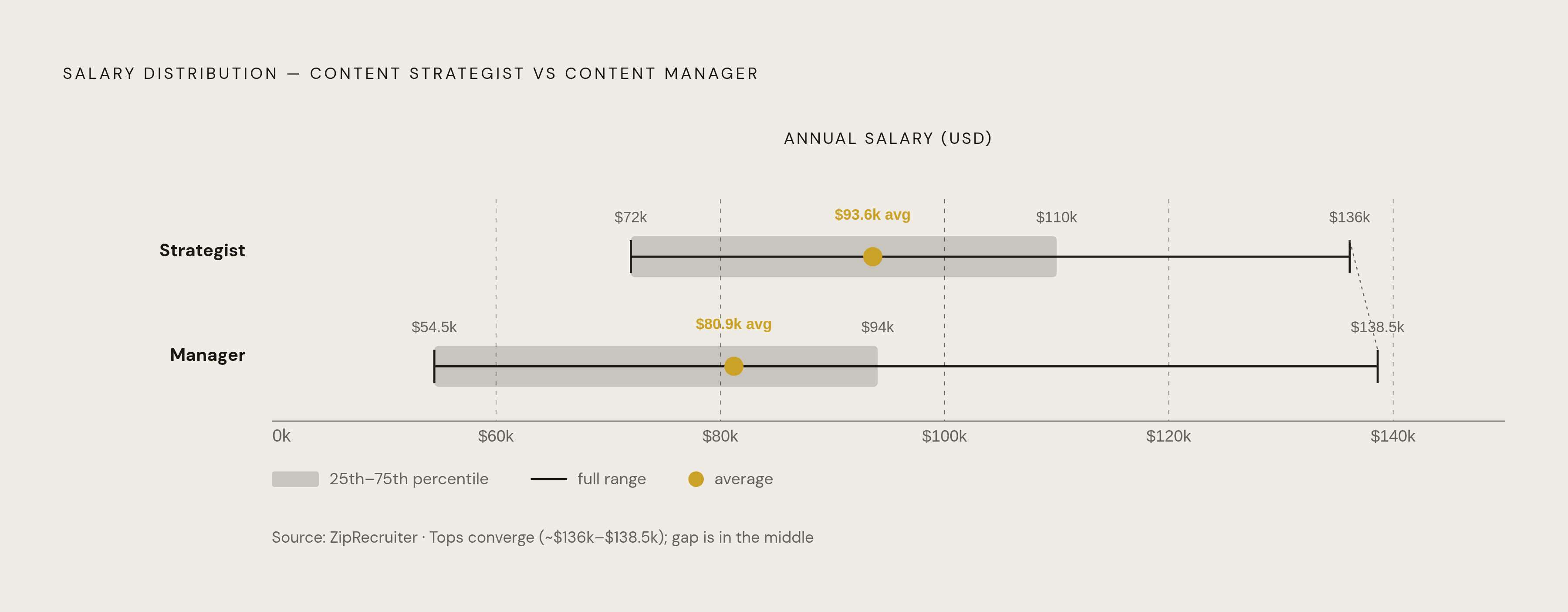
Break it down by source and the range gets textured. Indeed reports an average annual salary of $83,182 for content strategists, drawn from 337 job posting salaries over the last 36 months (updated July 18, 2026). ZipRecruiter's figure runs higher at $93,586 as of July 25, 2026, with the 25th to 75th percentile spanning $72,000 to $110,000 and top earners at the 90th percentile hitting $136,000. On Glassdoor, the average is $108,912, with the highest median total pay in Information Technology at $117,247, then Financial Services at $113,398, Telecommunications at $111,225, Retail and Wholesale at $101,094, and Pharma and Biotech at $99,018.
Content managers have a comparable range but a lower top median pay. Indeed's average is $84,150, based on 722 salaries, while ZipRecruiter lists an average annual pay of $80,932 for content managers. with a 25th to 75th percentile range of $54,500 to $94,000 and top earners at $138,500. Glassdoor reports an average of $105,371, with Financial Services topping the list at $121,008, followed by Information Technology at $96,237, Healthcare at $91,911, Management and Consulting at $90,605, and Telecommunications at $84,432.
Zoom out further and the market seems to be pricing strategic content skill higher over time. A November 2025 look at about 8,000 Indeed job posts for content marketing showed senior roles at $161,500 median, a 54% jump, and non-senior roles at $80,000, up 29%, with top pay rising fast too. The top-end numbers show that top performers in both roles can reach a similar maximum, around $136,000 to $138,500. The true difference appears in the median pay and which industries will pay for strategic scope, not in a fixed limit on a manager’s earnings.
How to decide which role to hire first, and when you need both
Ask yourself plainly: what’s currently not working on the team? If the content lacks focus and no one knows what each piece should achieve, get a strategist first. Lacking guidance, a manager only speeds up chaos, making matters worse. If you have a strategy written down but still miss deadlines, get unclear briefs, and see inconsistent quality, the issue is execution, hire a manager. If both functions are staffed yet things remain slow, costly, or too reliant on one person's memory and voice, that's a systems problem, more like content engineering than either classic role.
Teams keep getting this wrong: they hire a writer when they really need a strategist. When leadership can't nail down the audience, offer, category, and next step for readers, hiring a writer just churns out confident, polished confusion.
Small teams face this struggle every day. Many content teams operate with small staffs, often under 10 people. At that size, one person frequently holds both functions whether the org chart admits it or not, so the real question shifts from "which title do we hire" to "which operating mode needs more hours this quarter." Somewhere around 20-plus people, the case for dedicated depth over generalist breadth gets hard to argue against. Regardless of talent, generalists touching everything but owning nothing eventually stop scaling.
Tools shift the balance but don’t remove the roles. Good workflow tools help managers keep quality up as output grows, while sharp analytics speed up a strategist’s reviews and decisions. Letterstory, an end-to-end content marketing platform, automates topic curation and publishing to keep both roles aligned. Teams that use AI or workflow software to replace role clarity, rather than boost it, usually get neither advantage, just quicker confusion. Any leader aiming for organic growth without relying on luck needs to cover both roles somehow: with two dedicated people, one person plus strong tools, or a small team where automation handles routine tasks. What matters is the coverage. The title on the org chart is mostly decoration.
How AI is shifting what each role actually does, without replacing either one
It's not a niche question anymore. Many marketers now use AI in their content workflow, which means the live question isn't whether AI touches these two roles, it's how it's reshaping what each one is actually responsible for.
AI’s quickest wins for content managers are the easy, repeatable tasks, writing first drafts, simple formatting, tagging metadata, and some CMS grunt work. It doesn't reduce the role much, but instead shifts the manager's time to decisions that require judgment, like editing for tone and accuracy, fixing a model's confident mistakes, and deciding what to publish this week.
For the strategist, AI isn’t about writing but about speeding up research, doing quicker competitor scans, faster initial content audits, and spotting patterns in a large library that would take days to review manually. AI hasn't touched the core judgment calls: determining which patterns are significant, which audience segment to focus on this quarter, and what a business aims to achieve through its content. Humans still make the final call, no matter what software sorts the data.