Content Operations Maturity Stages for Growing Teams
Most teams are stuck between reactive chaos and siloed processes, not where they think they are.

Maturity in content ops shows if decisions follow documented process and data, or individual memory and gut instinct. Many teams here just dress up a governance issue as a tool issue, and adding software is like using a bigger umbrella on a roof that leaks. This mistake - buying a tool to fix the wrong problem - runs through every section below, and it's worth calling out early since almost nobody does before getting the bill.
Cathy McKnight at Seventh Bear describes content operations as the overall view of all content tasks: strategy, creation, governance, measurement, ideation, and management combined into one system rather than five separate roles. It's important to distinguish this from two terms often used interchangeably. Content strategy decides the what, who, and why of creation. Content operations handles the reliable execution, workflows, tools, governance, and measurement, needed to make it happen. One layer beyond content operations, marketing ops manages the revenue-focused systems (automation platforms, attribution models, campaign infrastructure) content operations provides. Mix them up, and a team thinks a shared calendar plus three freelancers is all it takes. Recent trends show content demand has grown significantly in the past year, and teams using ad hoc processes are the ones getting overwhelmed, not those with a structured system of people, workflow, and technology like Letterstory for end-to-end content automation.
What maturity actually measures, and what it does not
Company size is a red herring. The first and most common mistake is to assume that a larger team means greater maturity. One freelancer with a good system can beat a 200-person team stuck in Slack, and MarketMuse's model shows big companies often get stuck early, despite their size. What, then, does maturity measure? It’s simpler and less flattering: content decisions throughout the lifecycle are made either by documented process and data or by whoever shouts the most that day.
Earley Information Science divides this into five capability dimensions that should be assessed separately because teams rarely progress at the same rate in all of them: content operations (the entire creation-to-retirement process), information architecture (the taxonomies, metadata, and content models that enable later findability), technology integration (how well systems interoperate), user proficiency (whether people use the tools correctly), and governance (who makes decisions and how quality is enforced).
A team might excel at governance but fail at organizing information, or vice versa, and that's often where next year's budget should focus. Two common traps keep appearing in that gap, and one happens a lot more than the other. If governance improves but information architecture doesn’t, the outcome is compliance theater: policies appear strict on paper but are unenforceable because nothing is tagged or structured properly for verification. If tech improves but users don't, the pricey system turns into shelfware: a costly expense no one uses past the second training. The second trap is the one that actually costs money, because it shows up on a budget line as "solved" when nothing has been solved at all.
A 2025 study by Content Science, What Makes Content Operations Successful in the Age of AI?, showed 80% of top-performing content teams, and almost 70% of strong ones, work at levels 4 or 5. Maturity isn't optional; it's essential. It separates content functions that grow from those that hit a quiet ceiling, and most teams reading this are nearer to that ceiling than they think.
Where most growing teams actually are right now
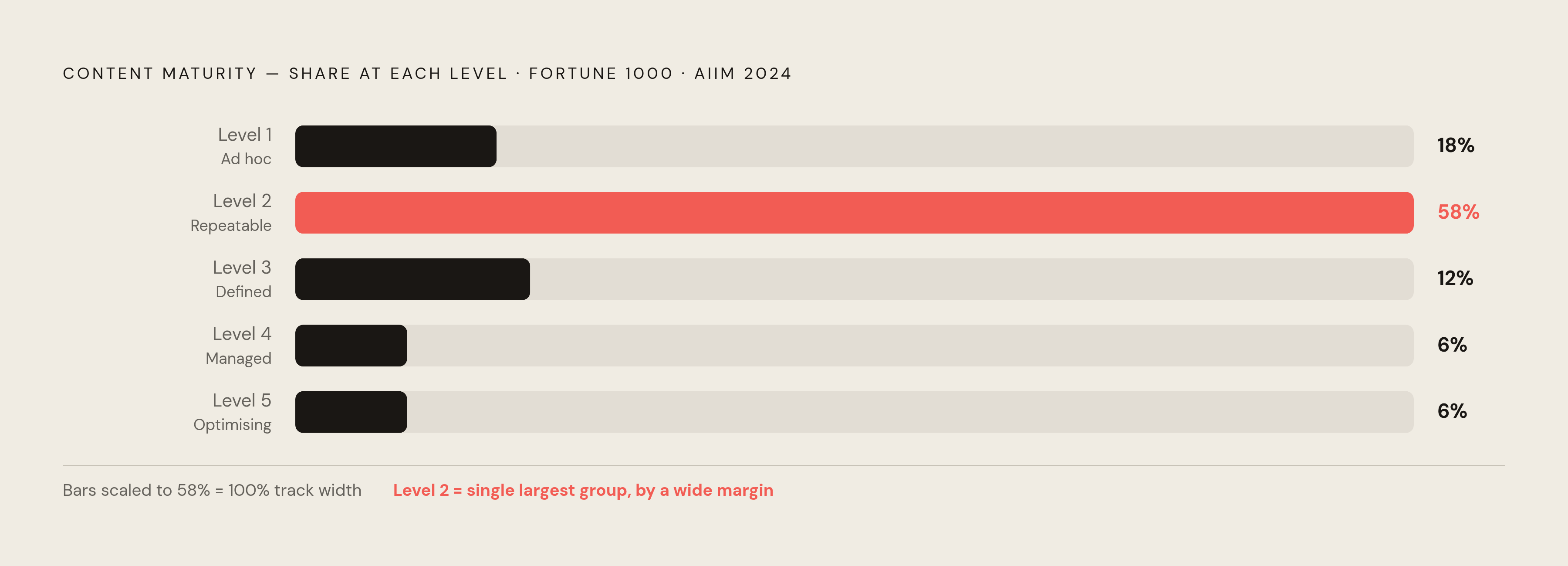
Most teams are in the middle, but most believe they’re further ahead. In 2025, Content Science found 61% of participants were at level 2 or 3. A 2024 AIIM survey of Fortune 1000 companies found similar results: 12% rated their content operations at the top tiers, and 58% were at level 2, by far the biggest group.
Imagine level 2 internally. Tons of content requests get sent via email, Slack messages, and quick chats rather than a main system. Multichannel or multilingual efforts lack a common process. Governance policies sitting in a PDF no one has looked at since onboarding. Tech purchased with no plan for real-world use.
The current landscape doesn't simplify this process. Content Science's 2025 report shows a strong desire to improve content operations, real success with AI tools, and a changing environment that makes it hard for many organizations to build on those wins. The true question for a growing team isn't maturity's value, since its importance is already accepted. It’s whether the team can face its current reality, rather than trusting the org chart or tools alone to show the truth. Many just skip that clear-eyed check. The next five sections exist for that very reason.
Stage 1: Reactive, when everything depends on a specific person
Kapost/Upland estimates say about 15% of organizations are here, and Earley's model limits this stage to around 100 documents and 10 users, small enough for one skilled person to manage everything mentally. This isn’t meant to criticize Stage 1 teams. For a small startup with five people, this stage is usually right, since quality comes from each person's skill, not a system.
Requests arrive through multiple channels, often informally. Tasks go to whoever’s available, not the best person or the most urgent need. The brand guide isn't written down, so tone of voice often remains undocumented, as early-stage models describe. Assets frequently go missing without a centralized system, leading to time-consuming searches.
The breakdown happens like clockwork. One key person causes delays, quality slips unnoticed until clients complain, and if they take time off or quit, the company loses crucial knowledge. CMI frames Stage 1 bluntly: there's no real content function yet, just marketing supporting sales cycles, producing content because demand-gen asked for it by Friday.
A content platform subscription won't fix this; teams trying one now are picking the wrong tool for the stage. The real fix is putting unspoken knowledge on paper, and the quickest win is listing the few things everyone quietly avoids. Smaller task than it sounds, and it's the only bridge to Stage 2 that actually holds weight.
Stage 2: Siloed, the documentation trap
The largest group by a wide margin, the largest share of organizations according to Kapost/Upland, reaching Earley's upper limit of hundreds of documents and 100 users. People feel sure about handling their own tasks. Collaboration breaks down as soon as two departments try to work together.
There's a basic content process, but each department does its own thing. Marketing and product operate with separate processes, never speaking. Reuse is rare, duplication runs high, and everyone made their own template since no one knew one was already three folders away. Those standards are there on paper, but no one uses them, skipping them saves time. Brand guidelines have upgraded from "in the founder's head" to "a slide deck," but a slide deck someone has to remember to open isn't meaningfully different from oral tradition, per Column Five again.
The main problem is confusing writing the process with doing it, and that error needs to be called out: putting the process on paper and actually using it are different things, and Stage 2 teams mostly only do the first. As teams grow within this stage, a puzzling issue emerges: their speed slows down. With more staff and communication methods but no common system, coordination work rises quicker than results. More staff here won't boost output. It adds meetings, and that's the whole diagnosis in one sentence.
CMI’s Stage 2 shows a team that’s there, churns out content when asked, possibly handles a blog or newsletter, yet tracks success only by basic stats like page views without any unified plan across departments. Teams that react to a Stage 2 diagnosis by expanding their style guide are addressing the symptom, not the cause, and more documentation doesn't fix bad habits. What really helps is putting enforcement into the tools, making the right way the easy way instead of relying on people’s willpower.
Stage 3: Defined, where governance enters and the hardest transition begins
According to Kapost/Upland's data, a significant share of organizations are in this stage, where teams take a purposeful approach to content, despite ongoing challenges with visibility and measurement. If things go well, teams actually use the content lifecycle, not just document it. Important use cases have multi-dimensional content models. Reuse begins to occur semi-automatically across systems rather than through manual copy-paste. Metadata doesn’t change from team to team, it holds steady the whole way through.
Governance becomes real here, with funding, named owners, and regular reports, so policy no longer relies on one individual's recall. CMI names this stage Content Orchestration since a governance layer now oversees production, and the organization must settle a real political question: who shares decision power, and what decisions do they make? This makes it tricky, which is why CMI identifies this as a particularly challenging transition. Moving from Stage 2 to Stage 3 requires addressing governance and decision-making challenges, and org charts don’t handle these power talks well.
Here, content strategy and performance measurement become more structured. Decisions begin to incorporate data more systematically. Muse AI’s take highlights a twist: teams often pick up DAMs, PM platforms, and creative automation here. It's necessary, but teams that buy tools without the governance to use them just end up with costly software they don't use, and many Stage 3 teams encounter this challenge. That leads to the awkward question many teams reading this should ask themselves: has the org purchased Stage 3 software but still makes Stage 2 decisions? This mismatch happens so often, we’ll name it later in the piece under failure modes.
Stage 4: Integrated, when operations stop being reactive to anything
In Stage 4, measurement shifts from acting like a report card to serving as a steering wheel. Tracking content effectiveness means the data now drives what's created, not merely what's reported each quarter. Content frameworks stretch company-wide through every platform, tools share updates automatically, and machines put some pieces together instead of someone starting from scratch.
Collaboration also becomes more mature. Content operations truly links with marketing, IT, legal, and any other stakeholders who were once isolated in separate silos. Governance shifts from a bottleneck to an enabler, letting teams move faster with confidence, as a stewardship function ensures quality, freeing creators from second-guessing every asset. Teams plan for capacity properly, spotting workload spikes ahead of time rather than the same week.
Stage 4 may serve as the stable, long-term fit for most organizations, rather than a mere stepping stone to Stage 5. If content operations matter but aren't the business's competitive edge, Stage 4 is the correct goal, not a mere stop, and chasing Stage 5 after this wastes money a team needs elsewhere. Pursuing Stage 5 when it isn’t necessary can strain budgets without delivering proportional value. CMI calls Stage 4 the Integrated Media Operation, where orchestration stretches past owned content into paid, earned, and community channels too, so everything runs off the same playbook regardless of where it appears.
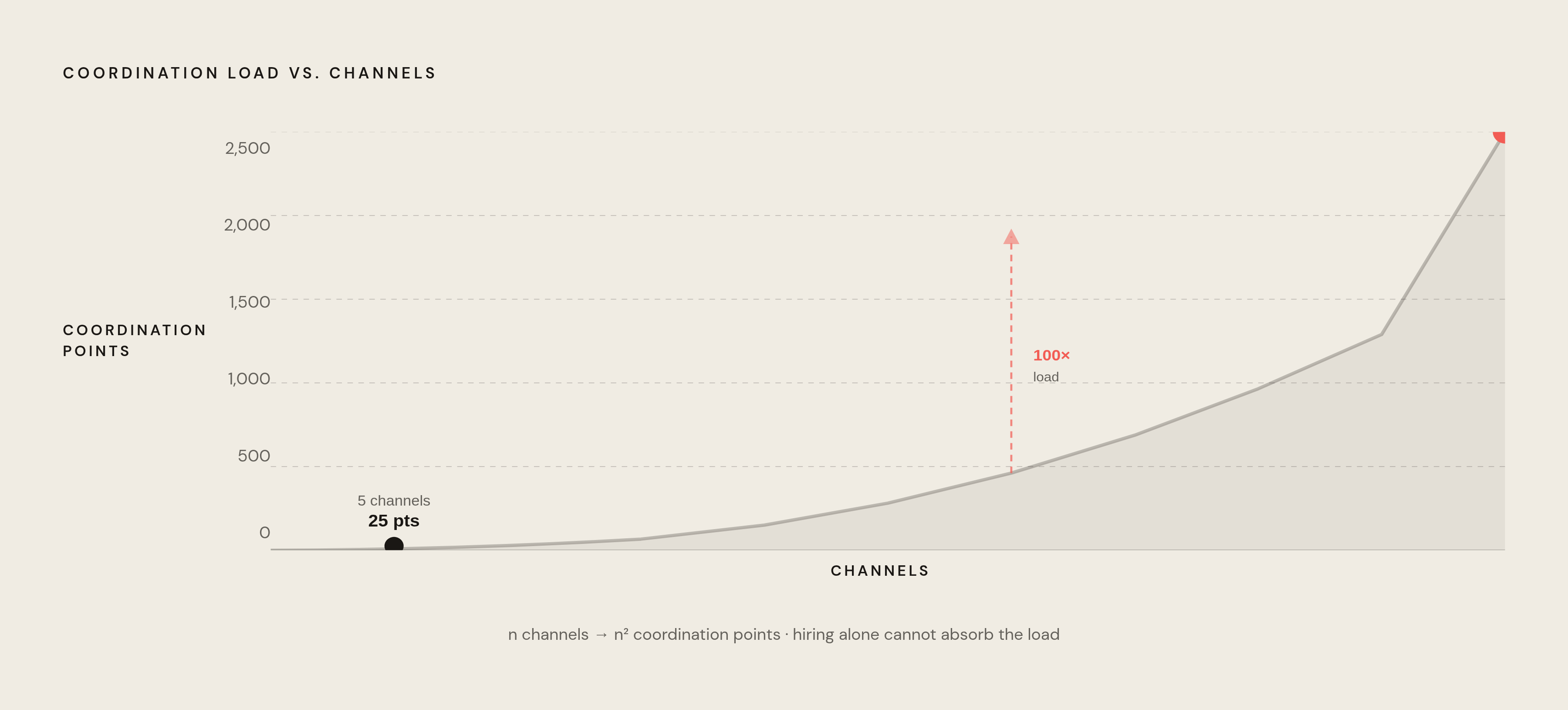
Earley argues more strongly: Level 4 is the lowest standard for enterprise AI that truly runs in production, not like AI that shines in demos but fails quietly after three months without a system to keep its content updated. The math on complexity shows why this infrastructure is important. Muse AI's analysis shows that managing 5 channels involves about 25 coordination points, and scaling to 50 channels increases this to over 2,500. Quadratic growth looks like a staffing issue, but hiring more people won't solve it. Structural infrastructure alone absorbs it.
Stage 5: AI-native, what "optimized" actually requires
Earley calls Level 5 "AI-Ready" or "Choreographed," and the difference from Stage 4 is small but real: the system not only gets measured, it learns from how it performs and changes. The stuff AI uses isn’t just sitting there, it now shapes the tools running on it, which stay sharp because their guts keep refreshing.
At its highest stage, Column Five's model describes a similar process: the system learns simultaneously from performance and market signals, and brand guidance is so portable that anyone, using any tool or AI, can produce on-brand work without needing constant tone corrections.
Earley raises the question that reveals the true nature of most AI rollouts: who will actually keep the content the AI relies on up to date? Not the model builders or prompt chain creators. Who's still making sure the core data stays right when the product shifts, rules change, and half the team's gone? Most seemingly successful AI pilots succeed for a boring reason: a diligent person manually curates everything backstage. That's not Stage 5, whatever the demo looks like, and calling it Stage 5 anyway is the industry's favorite bit of self-deception. Once they leave, the system falls apart, silently, as expected, and the write-up’s out before anyone spots it.
Digiteins correctly presents Level 5 as a strategic decision, not a one-size-fits-all objective. It’s sensible for organizations that rely on content to compete, not for every blog team, and going after it without that focus wastes effort on the wrong goal, disguised as ambition. When it’s the right choice, the results are measurable: Muse AI finds that organizations with a structured maturity progression see 20x faster time-to-market at launch and maintain 60% efficiency gains in communication as they expand into new markets.
The failure modes that keep teams stuck between stages
Each step on the map needs real change, not just doing the same thing better. Most stuck teams still tried to skip it. Teams usually get stuck because they skip the tough, boring steps, not due to tools or budget issues.
Stage 1 to 2 fails when a team writes the brand guide and treats the document as the finish line. Documentation isn't useful if it doesn't get built into the tools people use when they create things. It ends up as a file that gathers dust.
Teams most often stall between Stage 2 and 3, and it's time to call this out directly: they buy tools meant for Stage 3 (like a DAM or workflow platform), but decision-making still follows Stage 2 habits, with no clear owners, unfunded governance, and policies treated as documents rather than structured rules. The tool gets blamed for the failure, when the actual gap was authority, not software, and no vendor demo fixes an authority gap. This mistake is more misunderstood than any other across the five stages.
Stage 3 to 4 doesn't happen when measurements are just reports, not decision inputs. Many teams have dashboards. Much fewer let the dashboards truly influence what gets made next week.
Stage 4 to 5 stalls when AI deployment is seen as a technical task for IT or vendors, not an operational effort requiring immediate maintenance planning. Start the AI project without deciding who will update its core content, and it will only last months, not years.
Earley's dimension-mismatch problem is the root issue: if one skill grows faster than the rest, it causes chaos, not improvement. Governance outpacing information architecture leads to compliance theater. When technology outpaces user skills, it becomes shelfware. Content Science's 2025 data shows today's shifting business and tech landscape leaves even early AI winners unable to turn quick gains into lasting results.
How to locate your team's actual stage, not your aspirational one
Teams most often go wrong by giving overall maturity a single score, like "we're basically a 3.5", when in fact it's uneven on purpose. A team could excel at Stage 4 governance but lag at Stage 2 in information architecture, taxonomy, metadata, and content findability. That gap is the useful information. A combined score hides problems and makes people complacent, which costs money since it delays needed improvements.
So the real exercise isn't just choosing one stage. You check each of the five areas, content operations, information architecture, tech integration, user skills, governance, one by one and jot the unvarnished truth. Which of the dimensions has the largest gap? The next investment should be made to address that gap, not some target stage number. It’s often not where the loudest person in the budget meeting pushes for, and that’s exactly why it’s overlooked until the coordination issue costs too much to ignore.
Sources
- The Content Operations Maturity Model: Where Are You on the Path to AI-Ready?
- Content Maturity Model: The 7 Stages of a Content System
- Scaling Content Operations: 5 to 50 Channels Maturity Model
- How to measure content operations maturity
- What Is the State of Content Operations in 2025? - Content Science Review
- digiteins.com
- The 4 Stages of Content-Led Marketing Maturity