Content Workflow Automation for Marketing Teams
Automation routes briefs and approvals, letting teams spend judgment where it actually matters.
Content workflow automation is the practice of removing manual coordination work between the stages of producing content. It targets logistics, not editorial decisions. Marketing teams already know their process is fragmented: briefs live in one tool, calendars in another, approvals get chased down over email. Most teams report they don't have proper tools to manage content across departments, and the majority still rely on manual screenshots and disconnected systems to move a single piece from idea to publish. A large share of companies don't even have a dedicated content function, so whoever owns content part-time inherits all of that coordination debt on top of their real job. Demand keeps climbing year over year, and few teams have redesigned their process to match the volume they're now expected to produce, which is why the stakes keep rising.
What content workflow automation actually means — and what it doesn't
Start with the difference between the workflow itself and the automation layer sitting on top of it. The workflow is the sequence: brief, draft, review, approve, publish, distribute, report. Automation is whatever accelerates the steps in that sequence that don't actually need a human brain making a judgment call.
Here's where most people get it wrong, and it took some sitting with the data to see why. A writer opening ChatGPT to brainstorm headlines is an individual using a tool to think faster. That's fine and useful for a single task, but it stops short of a connected operational system. Research finds that the vast majority of marketers actively use AI in some form, but fewer than a third apply it to higher-value work like workflow automation or predictive optimization. The gap between those two numbers is the tell: most teams are stuck using AI the way someone uses a calculator — helpful in the moment, disconnected from everything around it.
So what does the system level actually look like? Briefs route themselves to the right person. Reviews trigger without someone sending a "just following up" email. Distribution stages itself across channels. Performance gets tracked automatically. Nobody has to babysit each handoff.
What automation still can't touch: editorial judgment, brand voice calls, strategy decisions, the slow work of building trust with stakeholders who sign off on what goes out the door. The realistic setup for most teams, once you work through the tradeoffs, is a hybrid one. Drafting stays human-led. SEO tagging, scheduling, and performance tracking get handed to automation. The goal is fewer decisions people have to make about logistics, so that judgment gets spent where it actually matters.
The stages of a content workflow and where bottlenecks actually form
Walk the standard sequence: ideation, briefing, drafting, internal review, approval, SEO and formatting, scheduling, publishing, distribution, reporting. Ten steps, and somewhere between three and five of them are where all the time actually goes missing.
Briefing is the first leak. Without a standard template, every writer interprets a brief differently, which means every draft comes back needing revisions that shouldn't have been necessary in the first place. Approval is worse. Research has found that nearly 90% of marketers go through three or more approval stages before anything gets published, and that's where days disappear, not hours. Distribution has its own drag: Research has found six in ten marketers name manual syndication to channels as a major bottleneck. Reporting rarely closes the loop at all; performance data sits scattered across platforms and almost never makes it back into the next brief.
Line up those numbers and a pattern emerges that isn't obvious at first glance: writing speed was never the real constraint. Coordination is. Nearly three in four teams say content demand has outgrown what used to be a manageable pace, which means every one of these bottlenecks costs more now than it did two years ago. Each stage can be hardened individually, and that's the order the next several sections follow.
Building the briefing layer: making the front end of the workflow do more work
The brief is the single highest-leverage document in the entire pipeline, and it gets treated like an afterthought more often than not. A weak brief doesn't just cause one bad draft; it compounds. Every stage downstream inherits the ambiguity nobody resolved up front.
A structured brief should lock down the target keyword cluster, the audience segment, where the piece sits in the funnel, which sources or subject matter experts are required, brand voice notes, the competitive gaps worth addressing, and how success gets measured. None of that requires creativity to fill in; it requires discipline to define once and reuse.
This is where automation earns its keep at the front end: pulling keyword data automatically, surfacing what's ranking on the SERP already, pre-loading competitive context so the strategist is filling in judgment calls, not doing manual research just to start the brief. Speed here only helps if there's a strategic framework underneath it — a distinction worth sitting with, because automating a bad brief just produces off-brief content faster, which is arguably worse than producing it slowly.
Teams that standardize their briefing process report fewer revision rounds and quicker approval cycles downstream. It's front-loaded work that pays out at every later stage. One practical note that gets missed constantly: the brief template needs to live in the same system where the draft actually gets written and reviewed. A brief sitting in a Google Doc that gets emailed around is functionally the same as no template at all.
Accelerating drafting without losing editorial quality
The time shift is real and worth naming directly: a 1,500-word blog post that used to take 8 to 10 hours from concept to finished draft now takes under 2 hours with AI-assisted drafting layered in. That's not a marginal gain, that's an order of magnitude.
But hold that number up to the light for a second, because it doesn't hold on its own. It assumes a tight brief going in and an editor on the other end who can critically evaluate what the AI produced, not just publish it. AI drafting without a human closing the gap produces volume. Quality is a separate outcome, and the space between those two words is exactly where brand voice and factual accuracy live or die.
Automation handles certain pieces of drafting well: structural scaffolding, intro paragraphs, FAQ sections, meta descriptions, alt text, suggesting internal links. Evaluating whether a source is credible, generating an actual original insight, making narrative judgment calls, or calibrating tone on a topic that requires sensitivity — those are the things it doesn't do well, and probably shouldn't be trusted to do at all. A large share of marketers, 77% by one measure, now use AI-powered automation for personalized content, but personalization at scale only works if someone has already defined the audience segments and the brand rules the AI is working inside of.
Teams using AI for content management report workflows that run roughly 45% more efficiently, and a large majority say content quality actually improved rather than declined. That's worth sitting with for a second, because it cuts against the instinct that speed and quality trade off against each other. Working through it, the gain comes specifically from pairing AI-generated speed with editorial standards enforced on top of it, not from the generation step alone. Build an editing checklist into this stage of the workflow. Automation hands over a draft; a human closes the distance between "draft" and "publishable."
Fixing the approval bottleneck before it kills your publishing cadence
Nearly 90% of marketers sit through three or more approval stages before anything goes live, and separately, a majority of brand managers say keeping brand consistency intact has gotten harder over the past two years. Put those two numbers next to each other and something uncomfortable becomes clear: more approval stages are not producing more consistency. They're producing more friction, because each reviewer is often working off a different standard, in a different tool, with no shared reference point.
So what does automating approval actually mean in practice? Three things, mainly. Routing, so content lands automatically with the right reviewer at the right stage instead of someone chasing it down. Deadlines that actually mean something, with automated reminders and an escalation path so one slow reviewer doesn't quietly stall the whole publishing calendar. And version control: one document everyone reviews, not five email threads with contradictory tracked changes nobody can reconcile.
Underneath all of that sits a governance question that has to get answered before any of it works: who can approve what, and at which stage? That's an organizational decision, not a technical one, and automation can only enforce a decision that's already been made. Research has found that roughly three-quarters of content is now AI-touched in some form, which adds real urgency here. When a team can generate ten versions of an asset in the time it once took to produce one, an approval process that isn't structured collapses under its own volume pretty fast. The practical fix is defining approval tiers, editorial sign-off versus legal or compliance versus brand review, and routing content to the tier it actually needs. Not every blog post needs the same chain a product announcement does.
Automating distribution and scheduling without fragmenting the channel mix
Six in ten marketers say manual syndication across channels is a major bottleneck, which is a little absurd once you notice that distribution is also one of the most automatable steps in the entire pipeline. It's the step everyone agrees is a problem and the step fewest teams have actually fixed.
Distribution automation covers scheduling from a single queue across every channel, adapting format automatically (a long-form article becomes a LinkedIn excerpt, an email snippet, a social card, without someone manually rebuilding it three times), and timing posts based on when each channel actually performs best. The risk worth naming honestly: automating distribution without a governed channel plan just produces noise faster. Sending the same content to every channel in the same format functions as a broadcast rather than a distribution strategy, and broadcasts don't perform the way targeted content does.
Roughly 65% of marketers already automate email marketing, and that's the pattern worth extending outward to every other channel rather than treating email as the one solved problem in an otherwise manual system. The real multiplier here is repurposing: a single piece of content that enters the workflow once and exits in five different formats is where automation pays off most for a team that isn't getting more headcount anytime soon. The publishing calendar still has to be the actual system of record for any of this to work. A spreadsheet sitting outside the workflow tool defeats the purpose before it starts.
Closing the feedback loop: connecting performance data back to content decisions
Here's the gap most teams leave wide open: content publishes, traffic data sits in Google Analytics, and the next brief gets written from instinct rather than evidence. Nobody goes back and checks what actually worked last time.
Automated reporting pulls traffic, engagement, conversion, and ranking data into a dashboard tied directly to the piece that generated it, so the next brief starts from something real instead of a guess. McKinsey's 2025 analysis found productivity gains of roughly 40% specifically in campaign monitoring and performance analysis. That's a meaningful number, but it only means something once it's set against a second, less flattering one: many teams have no formal way to measure whether their AI initiatives are actually producing results. Put the two side by side and the conclusion is hard to avoid — most teams are automating production while flying blind on whether any of it is working.
A working feedback loop does three concrete things. Topics that convert get prioritized for the next calendar cycle. Formats that quietly underperform get flagged before more budget gets committed to producing them again. SEO wins get traced back to the specific workflow decisions that caused them, so the team can repeat what worked instead of guessing. Content Marketing Institute research found teams now publish roughly 3.2 times more content than before; that volume only holds up as a quality strategy if performance data is actually shaping what gets made next. Otherwise it's just a treadmill, and a fast treadmill is still a treadmill.
What a mature automation stack looks like in practice
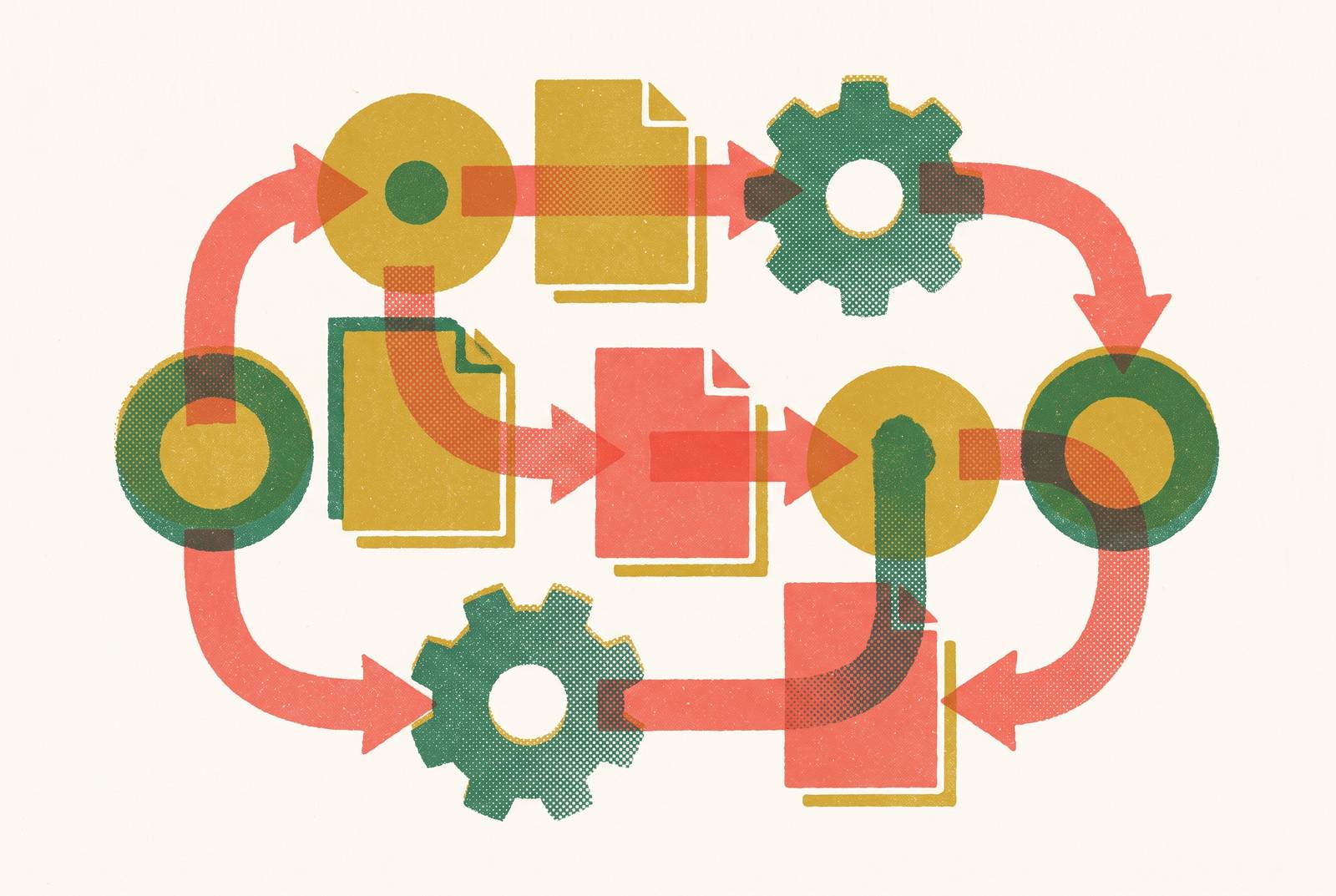
Put all the pieces together and the mature version looks like this: brief generation feeds AI-assisted drafting, which feeds automated review routing, which feeds scheduled distribution, which feeds performance reporting, which feeds back into the next brief. A loop, not a line.
Different tools typically cover different layers of that loop. Project and workflow management software handles task routing, deadlines, and handoff alerts. Content creation tools handle AI-assisted drafting that's aware of brand context, plus SEO integration and editorial review features. Digital asset management covers version control and a searchable, brand-approved library so nobody's hunting for the current logo file. Distribution tools run the multi-channel publishing queue and handle format adaptation. Analytics ties performance dashboards to actual content output, not just raw session counts that don't connect to anything specific.
The thing that makes it a system rather than a pile of tools, once you trace the failure points back far enough: data moving between layers on its own. A tool that needs someone to manually export a CSV and upload it somewhere else is still a bottleneck wearing a nicer outfit. Purpose-built content marketing platforms tend to differ from general project management software here specifically because they build in strategy-first workflows and editorial frameworks, with AI operating inside brand guardrails rather than generating whatever it wants and hoping it's on-brand. Most teams don't build the full stack at once, and they shouldn't try. Start with whichever bottleneck hurts most (usually approval routing or distribution), prove it saved time, then extend from there. A team automating five core workflows can expect to save somewhere in the range of 83 to 135 hours a month, which makes the incremental case pretty easy to argue for even to a skeptical CFO.
The governance decisions that have to be made before automation can work
Automation projects don't usually fail for technical reasons. They fail because someone automated a broken process and got a faster version of the same broken process. Roughly 70% of automation projects fail to deliver the ROI they promised, and the failure pattern tends to look the same each time: the wrong process gets automated first, one person becomes a silent single point of failure the system quietly depends on, and errors don't surface until they've already caused real damage.
Four decisions need to happen before any of the automation described above actually works. Who owns content strategy, meaning not who writes the content but who decides what gets made and why. What the approval tiers are and who sits in each one. What "on-brand" actually means, spelled out clearly enough that an AI system or a brand-new hire could apply the standard without guessing. And what the single system of record is for the content calendar, because "one tool, not three" sounds obvious until someone checks and finds four.
Brand consistency is the sharpest edge here: 62% of brand managers say it's gotten harder to hold onto over the last two years, and tighter human review stacked on top of an already-slow process won't fix that. A documented governance layer that the automation itself enforces will. The operating model worth aiming for is "human-on-the-loop" rather than human-in-every-step: automations generate and stage the work, humans set the parameters up front and review the exceptions that actually need a human eye, rather than signing off on every single piece individually. Practically, the sequence is simple even if the execution isn't: document the workflow as it exists today, find the one stage causing the most delay, automate that stage, measure what changed, then move to the next one.
How to sequence implementation without disrupting the team mid-campaign
The mistake worth avoiding above all others: trying to automate the entire workflow at once before any single stage is proven to work reliably on its own. That's how teams end up mid-campaign with three half-finished automations and no clear system of record for anything.
A phased approach holds up better in practice. Phase one covers brief and calendar: standardize the brief template, consolidate the calendar into one tool, and assign clear ownership over both. Phase two covers review routing: automate the handoffs between writer, editor, and approver, and retire the email thread as a review mechanism entirely. Phase three covers distribution: connect the publishing calendar directly to scheduling tools and automate format adaptation for the two or three channels that matter most. Phase four closes the loop: build the performance dashboard and set an actual cadence for feeding that data back into new briefs, rather than letting it accumulate somewhere nobody checks.
Teams using AI for content management report workflows running about 45% more efficiently, but that number doesn't come from any single tool doing something clever. It comes from the system being connected end to end, each phase built on the one before it, so the whole thing behaves like a loop instead of a pile of disconnected fixes duct-taped together under deadline pressure.