Content Audit Process for Pruning Underperforming Pages
Decide which pages to keep, fix, merge, or delete.

Today, Ninety-six out of every hundred pages inside Google's index earn zero organic traffic. That's not some obscure corner of the internet, either: Ahrefs found 96.55% of indexed pages earn zero organic traffic from Google, which means the number almost certainly describes your content library too. So the real question a content audit answers is whether we should prune." It's "how do we decide, page by page, what to keep, fix, merge, or kill." Most teams get this backwards: they treat pruning as a cleanup chore instead of the routing decision that determines whether the rest of the content strategy even works.
More than deleting, routing is what matters. One Contentful client counted more than 200,000 stale URLs still up on its sites, slowly eroding the buyer confidence and search visibility its marketers had set out to earn. No one set out to let 200,000 stale pages stack up. Teams put out pages for gaps, ads, or keyword spots where a competitor held ranking, and the collection expanded before people circled back and reviewed it. Content work prizes putting out new stuff and rarely prizes revisiting existing pages. That's what the discipline of Pruning was built to fix.
What "underperforming" actually means in 2026
For a long time, light traffic plus poor rankings were all anyone checked. That check matters, yet by itself it misses the bulk of a page's story, so treating traffic like your sole signal leads teams into pruning wrong pages.
Your page might rack impressions through Google Search Console yet stay dead weight without clicks. Hitting Zero impressions means a bigger problem: Google has quit surfacing that page at all. Plenty of pages also end up competing through keyword cannibalization, with three pages chasing the same query and splitting link strength rather than stacking it under a single page. Thin content stands as a separate problem: text so short, or details so light, that a page stops showing what the company offers.
Today, Staleness needs its own category apart from thinness. AI-cited content tends to be fresher than content in traditional organic search results, while ChatGPT leans most on recency: most-cited pages there, 76.4%, carry fresh edits. One page may do well in regular search but still need pruning because it no longer has AI visibility entirely.
Yet the one thing audits rarely catch remains AI displacement. Today an Overview from AI takes care of Informational queries, so the how-to page built to earn those clicks keeps its ranking but stays functionally hidden, pulling zero traffic. Otterly AI found that 33.38% of keywords trigger AI Overviews on Google, and A large share of Google search queries result in zero-click outcomes. Search Console might list impressions for your page that gets zero real visitors, and the data won't warn you.
A clarification first, before deleting: weak organic clicks aren't worthless. Any page can still convert via search ads, traffic from direct visits, or messages, even when organic stats are empty. Look at how each channel converts, not just organic, before deciding it's worth removing.
Duplicate content needs a different fix, not pruning. Mixing these audits up is the wrong step: identical copy at separate URLs needs canonical markup, a fix on the technical side, not a call about content.
Building the inventory: what to pull and where to get it
Begin by pulling every URL. Use Sitebulb or Frog to crawl your domain and get back each page, while Search Console from Google hands back every one it has indexed. Cross-reference both sets, since pages may show up in one but not another, so the gap becomes a diagnostic.
Your URL sheet by itself won't reveal much. For each entry, add facts: 12 months of organic traffic plus impressions pulled via Search Console, conversions across all sources from the analytics tool tracking the website, internal links to that page found through ContentKing or taken from Search Console, backlinks plus unique domains linking via Ahrefs and Majestic, total words, update time, and whether it is indexed, not indexed, or kept away using robots txt.
Include a field people skip too easily, yet it matters: for what purpose was the page built? Rank for a specific keyword, convert a specific audience segment, support a campaign that ran two years ago? Can it still pull that off, or is the task no longer there?
Keep your inventory scoped for content alone. Gracker cites Content Powered's guidance: one pruning audit never adds up to a complete technical review, and bringing in HTTP issues, redirects, plus crawl anomalies only muddies things. Handle that in a distinct technical audit.
Above about 10,000 pages per site, skip an all-at-once inventory. Break it up by content area instead. When you finish, you'll have a single spreadsheet where each page carries the facts needed to make a call, though nothing's been decided yet.
Evaluating each page: the four-way decision
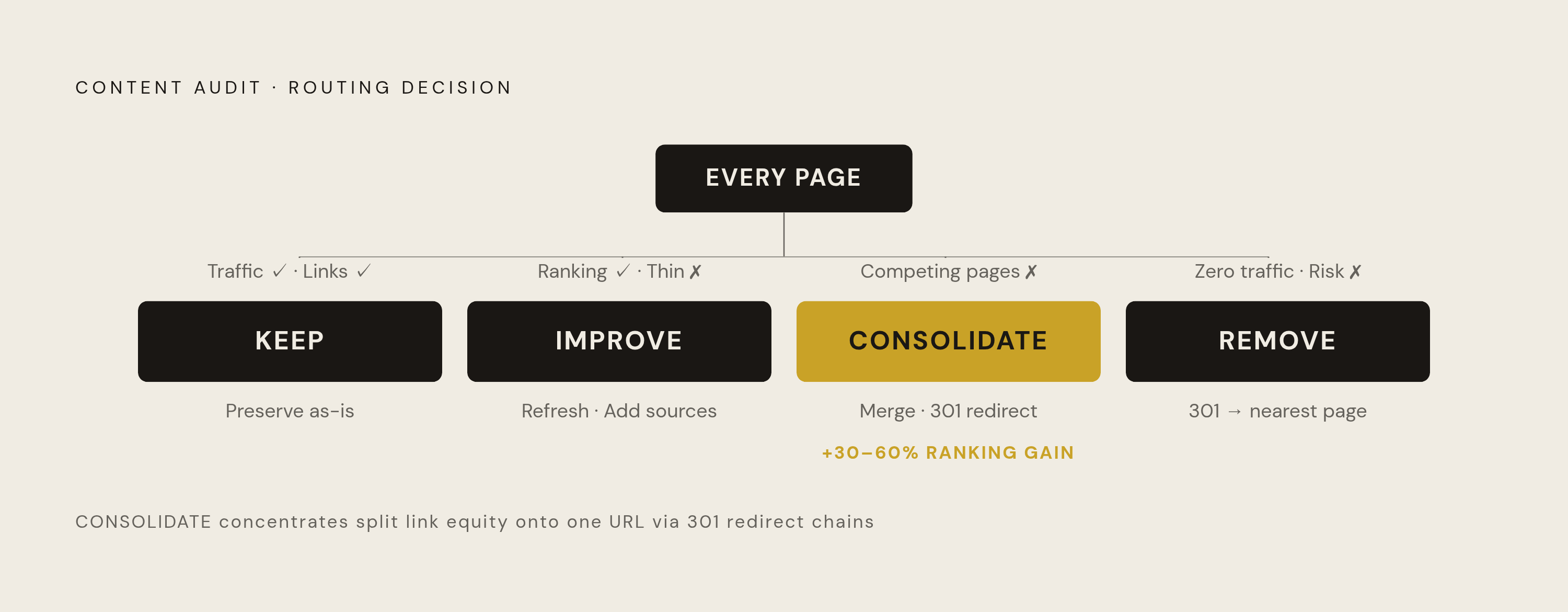
Most people get pruning wrong by reducing it to a binary call: keep it or bin it. This framing loses most of what pruning can gain, which is why so many efforts become too timid or far too destructive. Pick from four routes: improve, consolidate, keep, or remove.
Keep covers the pages that pull their weight: steady organic traffic, conversions that matter, plus backlink equity you'd hate to give up. A few pages can earn their keep despite low traffic, since they support the cluster's strength behind the scenes. Write down why every kept page qualified, then schedule regular freshness checks so it doesn't slip into the outdated pile over time.
Improve fits pages targeting a query people genuinely search for when they fail to perform. Broken headings plus messy meta, or information's outdated and detail stays thin. When a page carries backlinks plus ranking equity to save, the signal says fix it, not merge it elsewhere. Pages with clear quotes and statistics may achieve higher visibility in generated answers, so adding those elements during a refresh isn't a bonus step anymore, it's part of what "improved" means now. Listing real people, fresh research, and specialist quotes serves two purposes: boosting traditional rankings while making it more likely an AI tool cites your page.
The issue Consolidate targets is cannibalization. Merging three pages fighting over one query into a single URL ends the divided authority, then stacks every internal link plus all backlinks onto the one that remains. The ranking lift consolidation produces comes from a literal concentration of link equity that was previously spread thin, not from some vague "cleaner site" benefit. Choose the URL that already holds more backlinks, internal links, and past results than any other, point the rest at it using 301 redirects, then migrate the useful content off those dropped pages.
Remove applies when pages show zero traffic, conversions, and backlinks, plus no case for keeping them. Remove content that is factually wrong, risks a lawsuit, or covers an item no longer sold. Yet even removal doesn't have to mean a wipe when backlinks lead there. Instead, use a 301 Redirect to send it to the closest surviving relevant page, since link equity built over time disappears once that URL gives back a 404. And where some page continues helping logged-in readers and internal staff but shouldn't appear in search results, noindex it, not tearing down that page.
With each of the four routes, one thing holds: don't decide on noindex or removal using only organic traffic. Always look at conversions before anything else.
How pruning reshapes crawl budget and domain authority
Google visits each site only so often, and any visit wasted on a URL nobody looks at is one that never went to content that gets traffic or sales. Each crawl repeats that trade-off. This is basic arithmetic, hardly an abstract inefficiency.
Index bloat also compounds things past basic crawl counting. Pack a site with lots of unused URLs and Google's systems judge it as weaker, a signal that spreads beyond the inactive ones. Even those pages that perform well get pulled down when the domain is evaluated.
In one April 2026 example, after no more than a few weeks of cutting a set of weak URLs, Googlebot's visits moved nearly all onto the 150 or so URLs that stayed. After the four-month mark, that organic traffic was up 67%. Agency sees the same patterns in white-label projects: ranking gains of 30 to 60% 45 to 60 days after consolidation, in over 100 client implementations.
Folks always get this wrong, so here it is: Illyes noted during 2025 that the million-page mark where spider limits actually matter stayed the same after 2020. For most sites far smaller than that, an apparent crawl budget concern is usually poor content quality, thin internal linking, or bad hosting made to seem exotic. Pruning hits both of those problems right away. Google’s crawl systems consider content quality and freshness when allocating resources to work out how strongly they should scan each domain, and Google’s crawl behavior continues to reflect real-time quality signals. Crawl behavior shifts based on what pruning leaves behind on Google, not because the search giant turned on a different switch.
Adding a GEO layer to the audit: visibility in AI answers, not just search results
AI-driven visits increased 527% from January to May 2025 on measured sites, while Adobe saw AI-driven visits rise 693% in that period. BrightEdge data from April 2026 showed AI queries reaching a volume equal to 88% of regular organic search. It's a main way people find things today, ranked alongside organic search rather than below it.
Most teams still get this wrong, believing that ranking on page-one guarantees any AI citation, but it no longer lines up cleanly with organic rankings. Not true. After Google moved its AI Overviews to January 2026's Gemini 3, top-10 search placement matched inclusion in one AI Overview far less often, dropping 76% to a range of 17% to 38% by data from Ahrefs and BrightEdge. First-page placement no longer gets a URL into the AI response.
Work the GEO layer through your audit alongside traditional keep, improve, consolidate, remove steps, rather than bolted on afterward. Query prompt checks come first: feed the precise queries a given page addresses into ChatGPT, Gemini, Claude, plus Perplexity. Does brand show up? Linked and cited? Completely missing? Test for hallucination alongside it too, because AI may falsely invent or badly distort brand details, and the issue calls for correcting, not supplementing.
If your page ranking organically never shows up in the AI responses we checked, that citation gap means it must get GEO-specific updates, numbers, plus direct quotes and structured markup before it can earn the "keep" status. Tie it to freshness instead: when one stale page keeps organic rankings, it needs both a planned content refresh plus GEO review together.
Layer the technical stuff in as well: validate your schema markup for FAQ, HowTo, and Article, look at robots.txt so GPTBot plus other crawlers are not blocked, and never skip page load times or mobile-friendliness because both traditional and AI crawlers rely on those baseline accessibility signals. In April 2025 Otterly AI's GEO Audit came out, gaining a 2.0 release that July; it grades pages on multiple AI-visibility signals, produces a fix plan, and suits teams handling this layer in bulk, not one page at a time. Monitoring tools are also built around tracking your brand on AI platforms, a feature that matters when a project spans multiple client brands together and you need to share findings back.
Prioritizing execution: batches, severity tiers, and cadence
When each page carries its keep, consolidate, improve, or remove tag, don't begin executing yet. Start with severity. Working through pages exactly as listed in your spreadsheet lets a Tier 3 cleanup eat the time saved for a Tier 1 emergency.
Tier 1 is for URLs doing damage: false content, URLs competing with a more important one, useless files wasting search engine time with no return. Deal with these before anything else. Tier 2 holds salvageable material: pages to refresh and consolidation targets with backlink equity we need for preserving. Tier 3 means low-priority cleanup: thin pages getting zero traffic, zero links, zero conversions, and causing no real problem. Do those at the end.
After executing Tier 1, sit on Tier 2 for seven to twenty-one days. This gap matters because you need time to see if your rankings, plus crawl behavior, shift as planned, and to spot what broke before mistakes compound into the Tier 2 tasks built on a mistake.
Conductor's cadence advice: sites below 1,000 pages can do the audit twice a year, bigger ones at a three-month pace, while high-volume teams may use quarterly batches so the workload stays manageable. Errors start to creep up when you fix too many pages at once: targets for redirect that are wrong, backlinks you forgot, or URLs marked as removal but that convert in places no one looked.
Redirect discipline holds for every tier. Every removed URL with inbound and internal links should get a 301 to its closest surviving relevant page. Miss it and you lose that link equity forever, while people using outdated URLs hit a dead page rather than one that loads. Maintain a record of updates throughout, tracking what was altered and at what time, ensuring any ranking shift afterward gets traced back to the specific fix responsible, instead of guessed.
Running content audits across a multi-brand agency portfolio
Picture agencies handling multiple clients and AI tools face scaling challenges, each with its own content checks, page reviews, and tracking. Without a common setup, account teams lack the staffed numbers to manage such volume, and treating every brand like a bespoke effort is how it all collapses from its weight.
Standardization must lead. With one audit template and identical columns pulled per client, an account lead can review a fresh brand's inventory without remaking that methodology whenever another client is added.
Handling multiple brands together also reveals patterns one single-brand audit might miss. When consolidation produces a ranking lift for one brand, apply that lesson to every other brand before the upcoming cycle instead of leaving it buried in a single client's folder. Agency-wide boards showing how often a brand gets mentioned and cited by AI help the agency spot a brand losing ground in AI results before that dip hits traffic and the client spots it later.
Brand checks need their own spot when content quality gets reviewed in each multi-brand audit. At an agency, you must scan the most recent cycle to catch a graphic that's misrouted, or a wrong voice for the brand, or one client's info showing up in another's channel. It requires clear brand voice guides plus per-brand template checks so issues surface before any client sees them.
If the client can't make sense of the reporting, nothing here holds. Per-client reporting, structured each week, makes pruning calls and any ranking changes real proof rather than just noise. That same agency workspace is built directly around that operating model: one environment covering portfolio-wide AI visibility monitoring plus cumulative analytics across each client, with per-client access controls and client-ready reporting, all backed through an enablement process that lets account teams speak with real specificity on AI visibility findings, with GEO included, whenever a client wants to know why content was cut.
What to watch after the pruning is done
Pruning never closes as some one-time cleanup you finish and forget. If you treat it that way, that 200,000-page issue rebuilds within eighteen. Each page marked keep, changed, removed, or consolidated gets a follow-up time of its own, because the main signals for that call can shift soon after, mainly in AI visibility, where citation patterns change more quickly than traditional rankings did.
Start by checking crawl behavior. When a shift in the rate Googlebot revisits kept pages appears, it's typically the first signal that pruning altered how this domain is evaluated. Check the positions of the combined pages next, because those give you the best side-by-side read. Don't treat AI query prompt checks like a one-off task, but keep doing them regularly: any page earning a citation now might drop it when a system changes or whenever competitor's content proves more specific compared to anything listed in the index.
Pages marked "keep" need the same care as the ones you removed. Choosing keep using the quarter's numbers is a guess, not something fixed, and pruning discipline gets built by constantly revisiting such bets instead of thinking they last.