Fan Engagement Chatbots for Sports Teams and Leagues
Eighty-five percent of fans want AI in sports; teams are finally catching up.

Before people could debate how to roll it out, a study by IBM covering 20,864 respondents in 12 countries proved supporters were ready. 85% of fans see value in integrating AI technology into their sports experience, and 63% express trust in AI-generated sports content. For Clubs now debating whether fans want this, they push back despite data that already settled it: fans chose long before now, while the clubs slow to move are falling behind, not the prudent ones.
When Fans are asked what they want AI to do, their answer is boring in the best way. Live information led at 35%, with personal picks close behind at 30%. Teams going after fancy AI tricks need to realize they're focused on the wrong thing, since fans always prefer fast, useful answers. A Capgemini study showed 54% of fans turn to AI and generative AI for their main sports news. For most of those surveyed, it has fully taken over from search, not just supplemented it.
This Capgemini data showed about 70% say fans want real-time player metrics plus live match details now, not after the match. It's about speed, not how much detail they get. They don't care about a highlight reel the next day; they want that expected-goals stat mid-match, staring at the screen they're already holding. Fans will pay for the next step, too: 58% want to replay games with "what-if" scenarios, and 27% say they would pay a premium for features like that. Monetization in this case isn't a vendor's hypothetical pitch. Fans are naming the price, while clubs slow in making the tool are missing out.
Generation-by-generation numbers make the case even more clearly. Among Gen Z followers, 78% want custom online content; 63% show more interest in hands-on features. Apps back this up: roughly 82% of fans open them during live events, with 91% of those staying engaged the whole time, largely for real-time stats (44%) and analytics (41%). These supporters aren't looking for a play-by-play to tell them what went down. Chatbots do not have to make people learn a fresh habit. They just have to fit a habit people already follow, and that's much easier than what most clubs realize.
A sports chatbot’s role: the main capability set
Think about the chatbot's job in levels. Basic deals sit at the lowest step. The highest step feels like a real connection. If a chatbot handles tickets and parking, it's just a cost-saving tool rather than fan-engagement, while clubs may treat both as interchangeable and feel let down by software not built for that job.
The baseline is routine tasks: ticket bookings, upgrades, parking info, merchandise inquiries, stadium FAQs. Separate accounts say organizations resolving as many as 80% of everyday inquiries need no person in the conversation, and replies go from hour-long to second-long. This frees people for conversations that need real thought. It works through WhatsApp, RCS, Messenger plus Discord and team apps, right where a fan happens to be typing, since asking fans to download another tool makes no sense with so many apps open.
This stage makes bot part of the action, as participant. Live quizzes, prediction rounds, and real-time polls hold fans' attention between whistles. Gamified features encourage fans to engage with the app throughout the week. Interactive experiences during major tournaments can hold fans' attention well beyond matchday. Inside Discord, chatbots do a different job from what most expect of a "chatbot": they run live group talk instead of only posting to it.
Personalization is the high point, and that's where NLP keeps its worth rather than sounding like a buzzword slapped on a vendor deck. With NLP, A chatbot using natural language processing can tailor content to individual fans based on their engagement patterns, delivering highlight reels or tactical analysis at optimal times. If a conversation gets too hard or too delicate for automation, then a well-built setup passes it to a person. Seeing when to step aside is built into the system.
Of everything in the capability set, clubs going quiet through the off-season stands as the clearest chance they waste. Off-season access, athlete stories, manager talks, the material supporters often mention in polls, does well as interactive dialogue: supporters answering, the system replying, each interaction adding a signal to the user record rather than arriving as another one-way message into an empty inbox.
Vendors gloss over how useless everything gets with poor data. One survey puts 64% among European sports clubs with fan data scattered over multiple disconnected platforms. Putting that chatbot there gives a fan the same fragmented result, however well the underlying AI works. Unified data forms the base, not something optional to add, and by skipping it certain deployments break without notice, getting blamed for "the AI" rather than what they got bolted onto.
Chatbot deployments: real cases in different formats and media
Active deployments cover almost all big messaging platforms, and when outcomes get reported, the numbers are concrete instead of vague.
The Los Angeles Rams rolled out the 2025-2026 game plan to over 10,000 fans via RCS, SMS's newer replacement, so supporters could grab tickets within the message without installing an app. The club reported ticket sales up 60% jump and engagement up 70% jump, all through the messaging infrastructure fans already had. It stands out as the best data point here, since fans kept every habit they already had.
Alongside Infobip, F1 Team set up a WhatsApp chat at 2025 Monza: a question game for fans, where winners received exclusive signed merchandise from a team driver. That is okay, since it happened just one time during a race weekend. Some chatbots justify being built without having to turn into a lasting fixture, while clubs chasing permanence itself miss the whole point of any well-scoped effort.
FC Barcelona's "Futbot," launched on Discord in November 2025, delivers live stats, analysis, and polls for both the men's and women's first teams inside the platform fans already use for community chat. For merchandise personalization and email, the club uses another tool that reported email open rates with a 40% increase and game-day merchandise sales with a 22% rise. One tool powers live engagement, while the other powers commercial sales, and clubs that call "the chatbot" one thing miss the difference that counts.
According to Gitnux's figures, Real Madrid's chatbot answered 45 million fan queries in the 2022-23 campaign, getting 91% resolved right away. Read that as a past record of reach, not a live standard; the systems behind it have changed a lot in that time.
The NBA operates a Facebook Messenger bot delivering live updates and notifications, reaching fans where they already chat rather than requiring another app. Arsenal built "Robot Pires," a one-to-one bot delivering news, fixtures, results, and ticket information across Messenger, Slack, Skype, and Telegram, designed to deliver news, fixtures, results, and ticket information across multiple platforms.
PWC reporting notes the Cleveland Cavaliers rely on AI to shape what fans get, going past the words to match how they talk, their emojis, and their look to each person's habits. This personalization changes how things look, not just what they say, a granularity that most teams can't hit yet.
League Baseball created a dual-language English/Spanish chat assistant helping supporters of over 30 MiLB clubs. Wright, once MiLB's top marketing and commercial lead and today Chief Commercial Officer at a country-wide soccer authority, said the technology helps reach a wider group of fans. The chatbot acts as a tool for fairness just as much as speed, handling things the ticketing-and-parking framing misses.
Itransition reporting shows that the NHL as well as the NBA now use chatbots for parking, ticketing, and logistics, a sign it has become common in North American leagues. AWS supports Bundesliga with AI-driven fan engagement and data analytics. LaLiga's deal alongside Microsoft uses AI for game reviews, guessing results, and making content, treating audience connection as part of a bigger plan.
An unnamed Premier League club added AI-powered personalization to its app, analyzing fan behavior for customized highlight clips plus tactical breakdowns. Six months in, the club said app engagement was up 64%, with 42% more people under 25 passing material on to others.
No one platform is dominating the deployments, which span WhatsApp plus RCS and Messenger alongside Discord or proprietary apps. It can be a single WhatsApp game in Monza, or an always-on Messenger tool for a whole league, but the same rule applies each case: show up where fans already are, not where marketing wants them.
Chatbots follow the fan journey, from before to during and after.
Fan engagement spans multiple phases, each requiring tailored chatbot interactions.
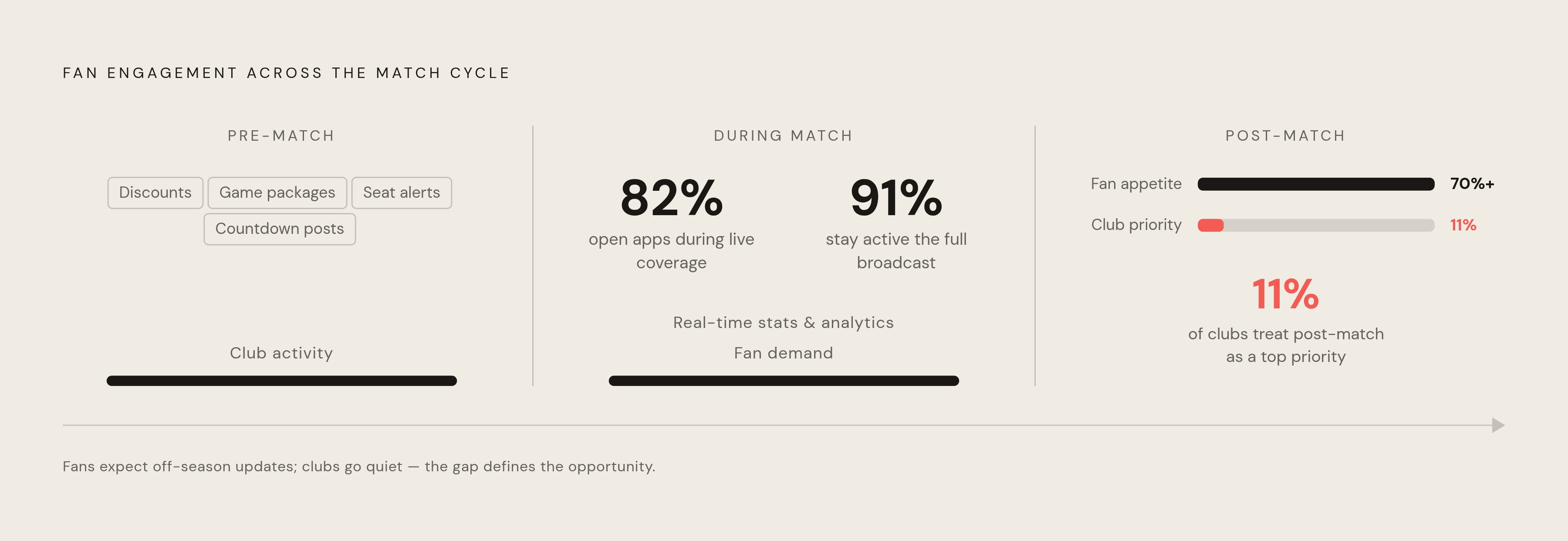
Ahead of the match, fans already care: picking meals, deciding who joins them, and whether they go. During that stretch, automated messages send out discounts, game packages, trip details, and seat alerts. A light conversational poll, something as simple as "reply with the flag of the team you're backing," collects preference data while feeling like participation rather than surveillance. Countdown posts hold a spot inside each fan's day long before kickoff arrives. The easiest phase here is simple to nail, so no club has any excuse for missing it.
While the game is on, fans stay locked in but bounce between multiple screens, with 82% opening apps during live match coverage, and of those 91% stay active the whole time, mainly for stats and commentary. The only constraint is how fast things move. Between periods, phone notes, single-click flash deals, real-time numbers, and brief surveys all get results; longer pieces can't register before the following action begins. At a stadium, chatbots sort out parking plus concessions and show fans where to sit, lowering friction without adding one person to the payroll.
The real gap shows up post-match, and this phase clubs fumble most. Just 11% of firms treat that stretch as top engagement, even while Fans stay replaying every play and searching for connection. An attentive fan finding nothing in their inbox is a big mistake. The data shows that organizations are wasting a clear chance, because A supporter who receives timely, relevant engagement after a match is more likely to remain connected with the club.
Of every gap, the off-season lasts most, and many clubs stop talking then, which the survey makes nearly indefensible. Over 70% of supporters expect regular updates then: off-camera clips, athlete profiles, signing rumors, first dibs on upcoming campaign seats. The current infrastructure handles itself, with no extra workers, right when people would normally be pulled thin or moved somewhere else. A chatbot's price tag stays flat no matter how wide the gap gets, so it pays off best here.
Chatbots connect the stadium to the fan at home. They make fandom an ongoing bond rather than disconnected events with quiet breaks between them, while clubs who keep acting like match day is everything still push away supporters they didn't have to let go.
What outcomes organizations can realistically expect
Outcomes come down to deployment quality, the state of underlying data, which channel gets picked, and how easily this bot fits into fan journey instead of standing apart as novelty. A chatbot bolted into fragmented setups, where 64% of surveyed clubs report fan data scattered across multiple platforms, won't match one built using unified fan data. Better language models alone cannot plug that hole once it exists.
The data still points the same way. Studies show sports organizations that have adopted AI-powered engagement tools have seen fan interaction rates increase by 30 to 50 percent compared to traditional methods. The specific examples prove it in practice: Rams' 60% jump for ticket sales via RCS, Barcelona's 40% rise with email open rates, and an unnamed Premier League club showing 64% growth in app engagement across six months. These are outcomes tied to specific channels, specific data setups, and specific execution choices, not to the mere fact of having "a chatbot." The lazy version of this project, buying a bot and bolting it onto whatever systems already exist and expecting a lift, is the version that fails, and it fails predictably enough that nobody should be surprised when it does.
What marketing admits is narrower compared to the real expectation: using a chatbot built from good fan data, placed where fans already use it, and active all twelve months instead of being confined just for match day, closes that gap they have been naming in every survey for a long time. The clubs already using these tools are meeting a need that has been there, mostly unclaimed, after the whistle quit marking the close of the conversation.
Sources
- Market Report: The State of the Art in Fan Engagement
- Top 5 AI Strategies for Engaging The Next Generation of fans | Playbook Sports
- Digital fan engagement in sports, unified ecosystems: PwC
- How AI is Transforming Fan Engagement in Professional Sports | C'mon Sports
- The State of Fan Engagement in 2026 - FanBase - Gamified Fan Engagement Platform
- Global sports fans demand always-on engagement from their favorite teams
- itransition.com