Fan Bot Content Strategy for Year-Round Engagement
Fans stay engaged year-round, but most bot strategies go silent in the off-season.
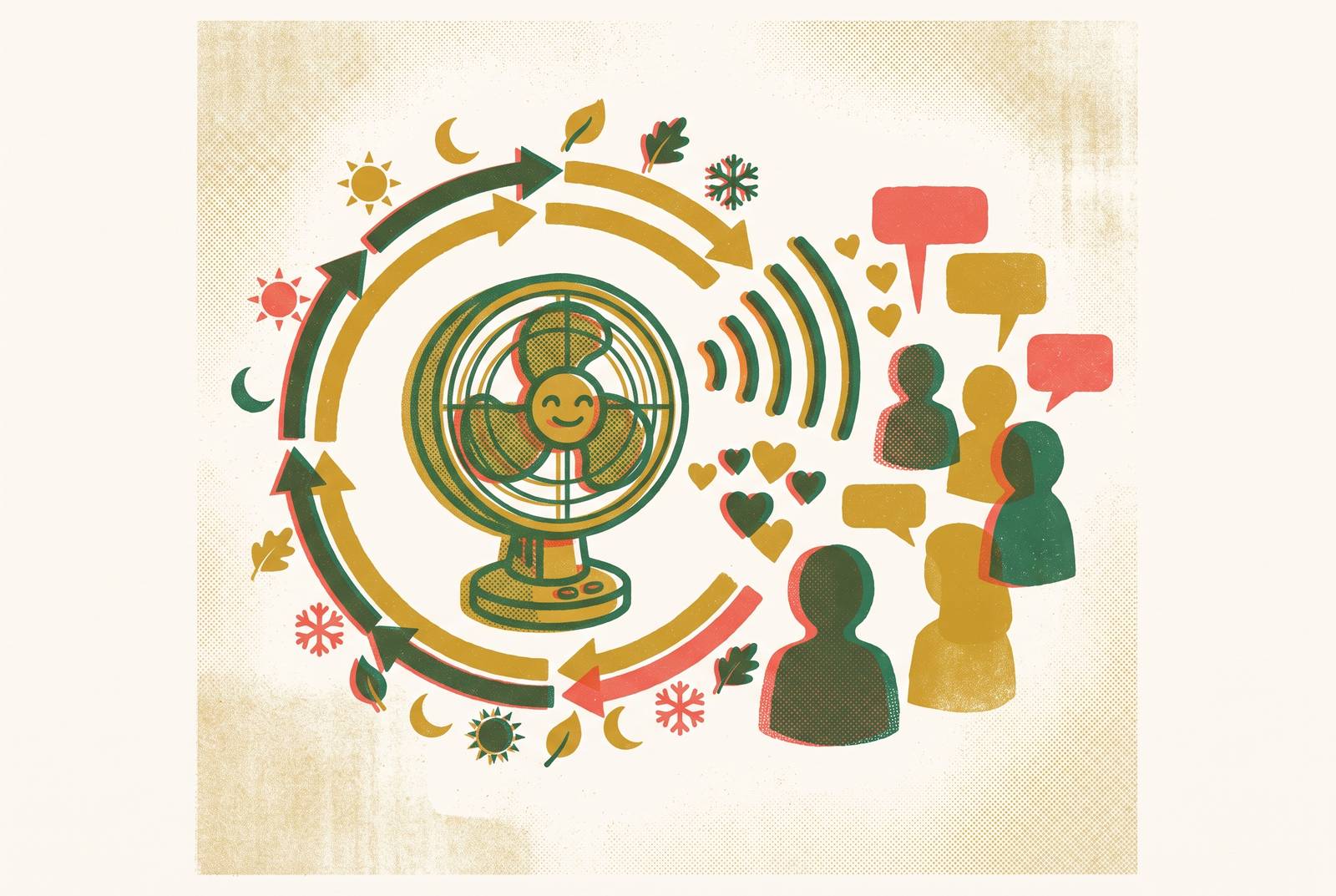
Fandom runs all year. US figures show fan behavior, in hours and dollars, remains consistent across different phases of their lives, but most fan bots get built like fandom switches on for postseason games and switches off come June. That mismatch drives this article: its price tag, why it continues, and how a year-round content calendar actually works.
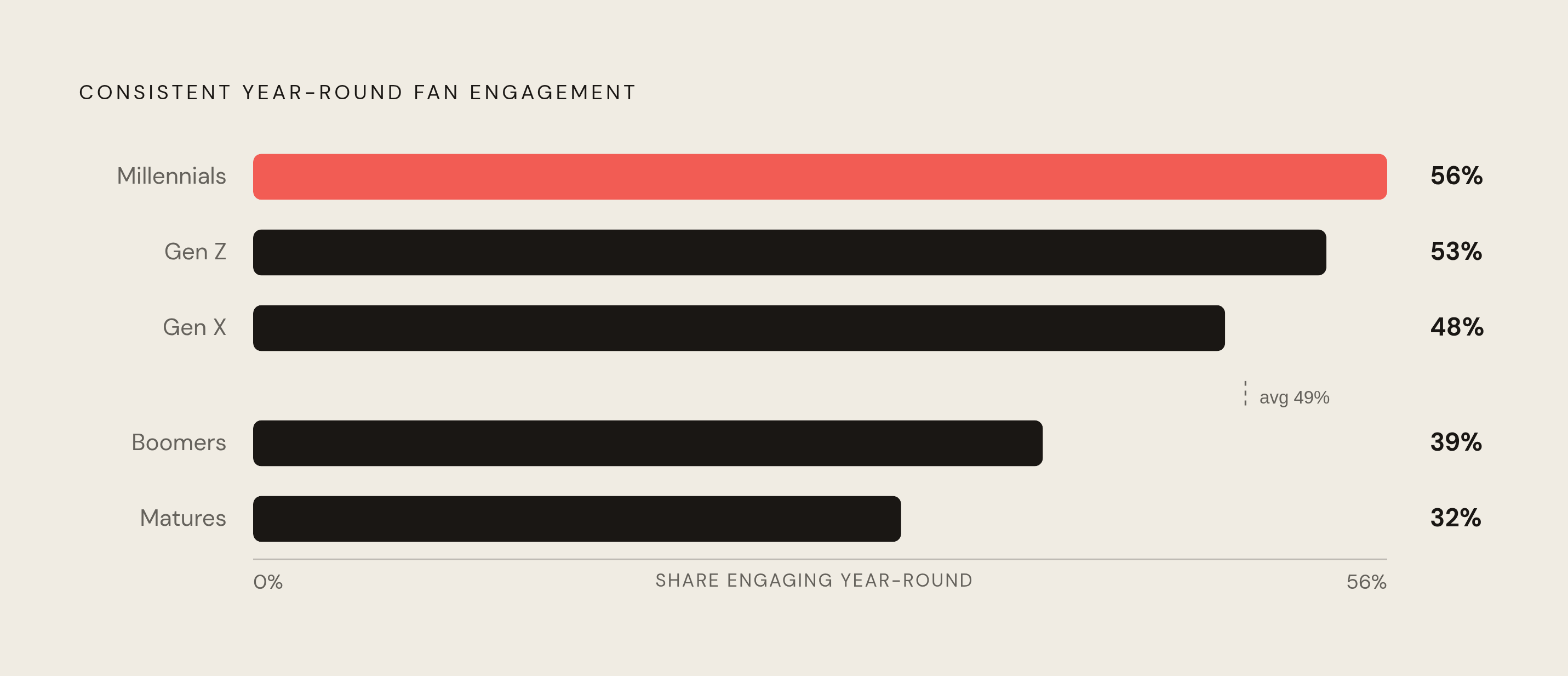
These stats should unsettle teams handling fan engagement on a schedule built only around events. In data from a large sample of US adults, 49% report steady engagement, with both attention and spending, no matter their stage. Each age group shows this steadiness at a different level: Gen Z at 53%, millennials at 56%, Gen X at 48%, boomers at 39%, and "matures" at 32% all report it. Cohorts skew weaker with age, yet nobody's fandom switches off. Deloitte frames fandom as lifetime value: long-run revenue a fan and those around them can generate, not seasonal buys or one-off engagement. Fans experience fandom all the time, yet most content still gets rolled out in spikes. Fixing that gap is what the rest of this is about.
What the engagement gap costs during off-peak periods
Lead with the stat behind this case: A large share of fans want some kind of content at least monthly during the off-season. Most fan bots miss that mark. They go quiet as soon as the fixture calendar does, which gets things the wrong way round: the supporters still showing up in the gap matter more than those who vanish once the schedule does.
Fans who engage even once a month in the off-season spend more than those who do not engage at all. That gap isn’t driven by major initiatives or flashy releases. A bot can handle repeatable touchpoints on schedule with no manual work: a trivia prompt, throwback video, or notification that the fan's favorite player has changed teams. It's all cheap. It all adds up.
Going quiet between campaigns means a price a dashboard won't show at first. A bot that disappears in the off-season shows followers there's no point checking in, and once that pattern takes hold, pulling a lapsed fan in again costs more than staying engaged ever would. Clubs that write off the off-season are, functionally, spending to win back supporters they already had.
How fan bots drive engagement
An AI chatbot works around the clock. At 2 a.m. it replies, gets a stat, and recommends the right highlight reel on demand. Tell a favorite player's name once, and the bot should bring up matching stats or clips on its own. That small touch helps a bot feel real to a fan, not some chatbot whose memory of the chat dies as soon as it closes.
For production, AI tools turn out match summaries and captions plus highlight reels in seconds. Post-game write-ups land before athletes have left the locker room, a task once left to a journalist with quick fingers and handled today by a system set up once and left alone.
Personalization earns its role in turning interest into action, not as a bonus. Systems built from supporter activity notice someone drifting toward leaving and launch a flow tied to their favorite club, latest views, and habits, all without a human pushing the button.
Format matters more than most realize, and many fall into the trap of choosing written responses simply because they cost less to produce. Talking faces win on attention and finished orders by a lot. People buy through agents at a rate several times higher than the chatbot rate. A bot using a playbook that's text-only throws away most of what it can do, and no smart copywriting closes the gap.
The content calendar framework: mapping fan bot content to the annual cycle
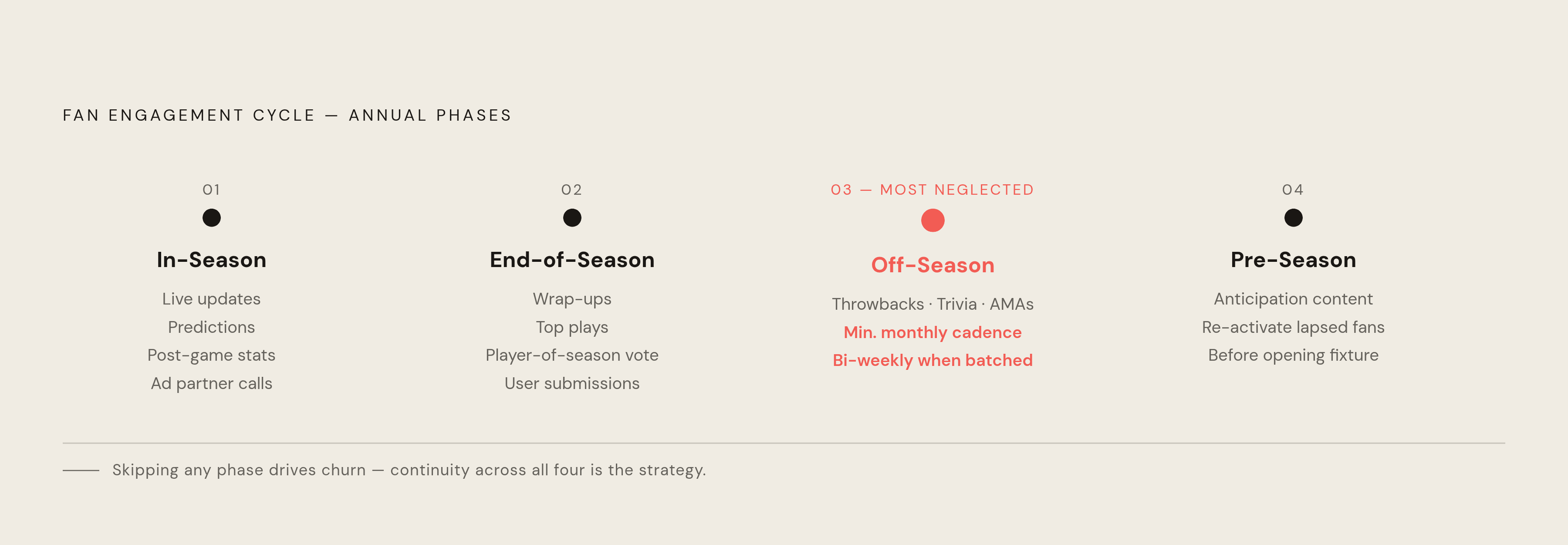
Several phases, not a pair. Most groups schedule around in-season, maybe drop a teaser pre-season, and ignore the rest. The calendar actually breaks into four clear phases, each with its own job, and missing any of them drives churn up over time.
In-season is when the bot shows up most: live game updates, predictions pre-game, post-game comments, stats when asked. Picks inside the app, messages about one athlete, "your view" requests after the final to share clips, and ad partner calls before play all work great here. Match summaries land while fans are still hitting refresh. Over-building just for this stretch can leave the bot so bound to fixtures it has no more to say when the schedule turns quiet, which is the mistake most programs make.
Once the season ends, the focus moves from breaking news to looking back. Wrap-ups, top plays, and posts about athletes all get picked based on what each person watched over the campaign. Community formats earn their place here too: player-of-the-season voting, "your moment of the year" submissions, both cheap to run and both generating user content during a stretch when live production has slowed to a crawl. Here, the bot's job moves from informing them to hearing them, saving what they like so off-season content feel made for them, not broad.
Off-season upkeep shouldn't be tacked on at the bottom of the calendar, with many fans wanting content at least monthly during that stretch. Give it the same care given to matchday content, arguably more, because a live event can't help it manufacture urgency. Old match clips, rumor Q&As sharing only proven facts, behind the scenes practice videos, plus trivia and a quiz series and profiles of past stars: not one needs live production, and everything can be batched well in advance. "Ask the manager" AMA formats and fan-shot compilations fit here for the same reason. Monthly is the minimum; bi-weekly can happen once batched content exists, as the bot sends it and adds personalization, and the content team makes it once early. Close to 40% of supporters will take AI-generated content on music, gaming, social, and streaming services, provided it's labeled openly. Marking AI posts in the downtime does double duty: fans don't get fooled, and that transparency works as a smart play.
Pre-season closes what the off-season began: anticipation content meant to bring lapsed supporters in before the opening fixture of the coming season.
Content types that hold attention between major events
Not every format survives when the live event that creates urgency disappears. A highlight reel that doesn't invite a response falls flat during a quiet stretch, while organizations that continue filling the off-season with broadcast-style content are throwing away the opportunity. Formats that give the fan a role last longer than formats that only speak at them.
Predictor challenges built around a persistent leaderboard keep people returning every week to find out how they stack up. Videos from supporters, taken from mobile posts and put together by software each week, make viewers the source of new material. Quiz series and Trivia, batched in advance and personalized to match a fan's favorite player or decade, stay cheap and repeatable. Throwback Legend-league matchups, where supporters pick past matchups, pull the archive off the shelf and put it back in play.
A rewards system adds spine to all of this. A fan earns something for a highlight, checking in, or a quiz, and that pull works even when nothing is happening; it's the bot's job to show where they stand and point to whatever gets them to a redeemable level.
The “Ask the manager” AMA content earns space again because it is cheap to make. People drop their asks during the week, and on Friday they get batched as a short-form update, so the format scales without becoming a production.
Personalization is what makes the same content feel different to every fan
A content calendar on its own just schedules. The bot's actual job is routing: picking which content a given fan gets, using their behavior, affinities, and past with the team.
Churn prediction is this whole process in action. Using many fan signals, it sees a person who's drifting toward disengagement, then sends a personalized sequence built from recent behavior, team affinity, and format, without a person seeing the drift or starting it.
To do that, the bot needs to watch a handful of things: the player a fan backs, stated explicitly or inferred from their taps; the format that lands, clips, stats, recap, quiz; the times they actually log in or answer a text; and which offers, a merchandise launch, a renewal, they engaged with before. Skipping any of these degrades personalization down to a slightly-better bulk send.
Alerts tied to one player do more than their size suggests. A fan who opts to follow a single player may see increased engagement. The bot guides someone through it quickly, and that small effort can drive retention..
AI adoption context: what the broader industry shift tells content strategists
It's not unfolding in isolation. The 2026 Fan Engagement, Monetisation and AI Trends Report found that 81% of executives surveyed have expanded their use of AI in the past year to gain efficiency and cut costs. This signals a real industry-wide shift, not just a few clubs testing the waters.
The platforms are shifting as well. Digital engagement is shifting toward owned apps and social video platforms. A fan bot built into that channel lands right where audiences are going, so it would be a mistake to under-invest there.
Supporters have already taken the lead. 54% now rely on generative AI tools or AI as their primary source for coverage, and 59% say they believe these tools. Fans hit AI in the info space regardless of what any given team has or hasn't put there. They already turn to AI. Nobody knows yet if a brand's fan bot will be the AI people rely on, or if a third party takes that role instead.
Glossing over this divide would be dishonest: 33% lean positively toward AI's expanding role, with 37% negatively. Because of that gap, labeling belongs in everyday work, not just values. The 40% acceptance cited before is the working fix: mark AI content openly, and a portion of viewers accepts it with no friction.
How fan bot content ties into AI visibility
About 85% of brand mentions in AI search originate from third-party pages, not brand-owned sites, and companies have substantially higher odds of being cited when the source is a third party. The whole idea of "distribution" has shifted. A fan brand that only posts in its own app might as well not exist to the AI tools 54% of fans now use as their primary source.
Today, over 60% of Google searches now end without a click to a third-party website. A fan checking the team's next game or opening act might never reach the official site. Getting cited in an AI-generated response is the main entry point now, and content not structured for citation stays out.
These disciplines are key in this context, and most organizations still get conflating them wrong. Answer Engine Optimization formats material so an AI tool can pull and reference it: interrogative titles, standalone blocks of concise, focused content, FAQ areas on important URLs, a clear reply opening every part. Engine Optimization goes beyond that: how often AI names the brand, how people feel about it, what story shows up, and which sources it uses. AEO helps ensure content is structured for citation, while GEO aims to increase visibility across search contexts, not only there.
Sources
- 2026 Digital Media Trends: Capturing always-on fandom between releases and seasons
- Accelerated AI Adoption, Shifting Fan Expectations and Sponsor Priorities: The 2026 Fan Engagement, Monetisation and AI Trends Survey
- How Data-Driven Fan Engagement Strategies Are Revolutionizing Season Ticket Sales - WSC Sports
- fanbase.gg