Fan Engagement Bots Versus Community Managers
Bots handle volume, humans provide judgment—the best communities keep them separate.
Bots that drive fan engagement and the managers who run communities fill different roles. The first deals with volume, the second supplies judgment, and the fastest-growing communities are those that keep the two jobs from bleeding into each other.
Every fan community faces two pressures at the same time. The first pressure is sheer scale, a constant flood of items arriving nonstop that no single human could ever read. Then there is the danger of a few rare missteps, when a hasty reply shatters confidence in a way it never recovers from. Most teams handle this badly. Some teams push bots too far and lose the human cues that keep a community intact. Others leave too much manual work in place, exhausting a community manager with duties software could take on much more cheaply. Deciding what bots should do and what people should handle should follow the specific choice at issue, rather than staffing levels, available funds, or a bias toward either option.
What bots do well in a fan community
In fan communities, bots prove their value by absorbing the behind-the-scenes workload: large-scale, rules-driven, urgent tasks that do not call for emotional interpretation. Automated moderation screens junk posts, abuse, and toxicity early, keeping routine problems away from human moderators and leaving them more time for cases that require real judgment. The first-week experience is shaped by greetings, automatic role setup, channel walk-throughs, and intro prompts; bots make that onboarding identical for member one and member ten-thousandth every time. Events work similarly: bots can stage timed quiz sessions, deliver automatic check-ins that keep members engaged, and react to member actions on their own, with no human queuing them up. As membership grows, manual management breaks down, while bots can keep moderating, answering questions, greeting newcomers, tracking engagement, and running events around the clock on their own.
The money argument comes right out of that. Community managers surrender much of each day handling repetitive inquiries, policing standard violations, and removing spam. Automated tools shoulder those routine burdens, returning hours to staff for efforts that genuinely expand the community. That logic applies equally to creating material beyond community management, since services like Letterstory handle inquiry, composition, and multi-channel publishing at scale, leaving their operators free for choices demanding real contextual judgment instead of getting stuck in the repetitive mechanics of distribution.
The hard ceiling for bots: decisions that require a human
The ceiling bots reach here isn't about raw compute or model refinement. That limit is baked into the choice being made: certain judgments can't be stripped of context, and errors here cause real harm. The clearest case is judging tone and intent. A human moderator generally distinguishes banter from actual harm, whereas an automated classifier matches surface patterns instead of meaning, and the hardest calls straddling that boundary carry the greatest stakes.
Most teams now rely on a layered approach: every message passes through a quick first-pass model, anything ambiguous or risky moves up to a stronger system, and genuinely difficult calls remain with a person. The human stays in the loop. Instead, people focus only on the few choices that truly require their judgment. Crises and disputes follow this pattern. When members split after a team defeat, public drama, or infighting, what keeps the community intact is never a canned response. That takes someone who knows the particular background, the interpersonal ties, and where that group is emotionally. Brand voice runs the same course: once a voice exists, bots can relay it, but they cannot invent it, and deciding whether a brand should weigh in at any particular moment remains a call only people can make. Letterstory runs AI-generated drafts past human reviewers at every stage for exactly that reason. Automation covers the routine work, but nothing goes out without a chance to review and pull it back, so the human call that protects trust is never lost.
Material rooted in personal connections falls into the same group. Conversations, joint projects, and material relying on authentic bonds between audiences or makers resist automation, since that very connection is what gets delivered. The clearest example comes in the moments immediately following a game's conclusion. For the twenty minutes following the last whistle, fan engagement peaks in sports, yet that span goes virtually untouched. Those who won go searching for the key play. Losers are searching for a shared place to feel the loss. Both groups keep replaying the same clips and debating the same lineup call, long after the stadium has cleared. A bot can reach people during that opening. A community manager knows how to gauge the mood of this community in the moment, and then respond. The constraint lies in the occasion’s demands, not in bot sophistication.
How engagement bots backfire when deployed outside their lane
Using bots for work that calls for human discernment is not a neutral move. It creates measurable damage to the very metrics the deployment was meant to lift. Start with follower counts. To calculate engagement rate, analysts typically compare total engagements with the follower count, though some formulas use reach or impressions instead. When bots pad follower totals but add no engagements, the account’s apparent audience grows even as its score drops on the sponsor- and partner-facing metric.
The fallout isn't only on the spreadsheet. Prospects and the partners, customers, and community observers who audit a follower list and flag the obvious fakes come to one conclusion: the brand either shelled out for subpar growth hacks or lacks the pull to earn genuine followers on its merits. Both readings cost credibility with the very audience the brand is trying to win over. That danger peaks when a bot adopts the brand's voice at precisely the juncture a human touch was required. AI is meant to back up a community, never to pose as the people steering it. When a follower later finds out the conversation was a bot replying in human clothing, the resulting loss of trust wildly exceeds any efficiency the team captured by leaving a person out of that moment.
The staged handoff model, how teams that get this right structure the work
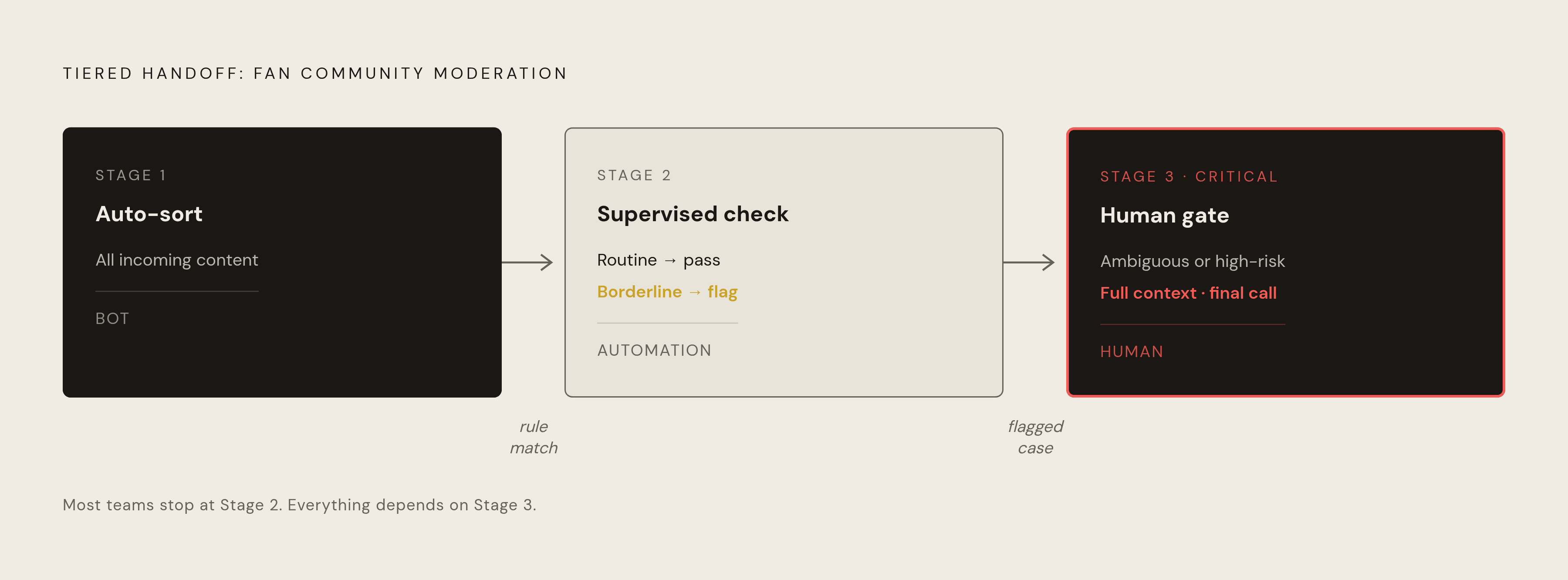
Well-managed teams avoid choosing sides in the bots-versus-humans debate. They set up a clear tiered handoff in which every layer deals solely with the calls it was designed to make. It unfolds in three stages: incoming material is automatically screened and sorted, routine items pass automated checks while borderline ones get flagged, and cases that are ambiguous or risky move up to a person equipped with the background to judge. Human focus lands solely on the calls that truly demand it.
A lot of teams never build the human gate, a checkpoint separating automated systems from anything that reaches or replies to the fan. Configured well, this layer intercepts off-key messaging yet leaves the remaining workflow free to operate without supervision. The fan journey follows this same shape almost exactly. In the pre-game window, hype material such as timers, surveys, and early deals arrives in bulk on fixed schedules using templates, making automation a natural fit. During live play, supervised automation handles reactive but rule-bound tasks like companion-screen updates, mid-game prompts, and operational support. Post-match, tailored outreach lands in a period most organizations squander, and since its tone shifts with feelings and circumstances, people must handle it or at least approve every message prior to delivery.
Orchestration is what keeps fan context tied to the fan instead of the channel they used; lacking it, the whole system falls apart. Human agents stepping in ought never to restart a dialogue the brand initiated. Losing track of an exchange means forfeiting the very opportunity a brand sought to seize. True automation saves human input for choices demanding it, while letting all remaining processes operate independently.
What community managers do with freed-up time
After bots handle incoming demands, community managers can stop spending so much time on upkeep and focus on growth, including work that remains beyond a bot’s reach. Planning events, shaping content programs, strengthening relationships with key voices, and crafting fan experiences people want to revisit require human judgment about the needs of the moment. A classifier is not good at choosing the right response.
Community-driven partnerships yield much stronger member retention compared to transactional influencer deals, since the bond between those involved gives the content its credibility. A templated promo post comes across as exactly that. An authentic collaboration with a community manager and a creator fans already believe in comes across as something different.
This shift has a second payoff, one that is less obvious. When community managers devote the hours this frees to genuine dialogue on Reddit, in forums, and on platform communities, they build something reaching well past mere fan loyalty. AI answer engines lean heavily on third-party community platforms, treating them as key references alongside trusted names such as Wikipedia or leading news outlets, while genuine engagement builds on itself over time. By hosting an authentic exchange on a forum thread, a community manager may unknowingly be creating exactly the sort of content AI systems later quote in response to a query about the brand. That is why authentic dialogue carries more weight now than in the past, and why manufacturing it is not the answer.
Putting a measurement layer on the bot-human split so you can improve it
A staged handoff gets stronger only when instrumentation shows where each layer succeeds and where breakdowns, mistakes, or missed opportunities are occurring. For a community, the key measures are escalations that begin in bot-run exchanges and show the bot has overreached; repeated human involvement in the same situation, showing it belongs back in the bot flow; and post-match periods that drive the most later engagement, showing where people should focus next.
Most brands consider AI essential for how fan engagement will evolve. Yet many of them remain unable to deliver tailored experiences broadly or demonstrate financial returns, having deployed the technology before creating the metrics needed to confirm its effectiveness.
AI visibility gives brands a practical test. If AI answer engines cite a community's real conversations, forum activity, and user-created work, it signals that members are contributing substantive, credible material with lasting value. A brand confined to its own site will usually appear less often in AI answers to discovery and reputation questions than one backed by community-driven outside references, though the lift depends on both the platform and the query type. Letterstory checks whether Perplexity, Gemini, Claude, and ChatGPT name and source a brand, extending the test to bots versus people: AI-cited community material shows genuine authority that purchased bot followers cannot fake.
Treating how work is split between bots and humans as a hypothesis about where each task fits beats treating it as a one-time call a group walks away from, and it only works when somebody tracks it, reads what the numbers show, and shifts it when the numbers push for a shift.