Building a Fan Engagement Bot on Existing Social Channels
AI systems now cite social media bots based on credibility, not just reach.

When a fan engagement bot runs on existing social channels, its role extends beyond responding to comments and sharing game clips. Such a tool produces material that AI search systems crawl, evaluate, and occasionally reference whenever someone asks about the top-performing squad at the moment or seeks genuinely worthwhile sports reporting. This reality alone redefines the tool's purpose. The way its material is composed, checked, structured, and pushed out effectively serves as a reference framework too, regardless of whether the creators have noticed.
This change has its roots in the way people actually engage with AI systems. A typical Google search is far shorter than a ChatGPT prompt, and that gap signals something specific: the user at the keyboard has already left browsing behind and arrived at a decision. Their requests are more precise, their tone more like a conversation, and they are far likelier to follow through on the response they receive. Executives in sports media polled by the Stats Perform 2026 Fan Engagement & AI Trends Report anticipate in-house apps and social video outlets displacing websites as the chief route to fans by 2030, exactly the ground AI systems already crawl heavily.
The effect is blunt. A fan sent by ChatGPT toward an account or by Perplexity toward a team may never visit the brand's site. Getting cited has become the moment that matters. But many groups running fan engagement bots keep measuring the same stale signals: replies, impressions, and post sentiment scores. They do not reveal whether the material is being packaged in a form AI systems will find, rely on, and reference. Those stale measures cannot show if the bot is reaching fans beyond its existing followers.
What AI answer engines cite
The data showing which sources AI systems really cite is pointed enough to make a bot confined to the brand's own social channels squirm. When AirOps examined how brands were mentioned on Claude, Perplexity, and ChatGPT, it saw that most brand citations point outside the company's site, with nearly all of those outside references drawn from listicles, reviews, and comparisons. A bot publishing solely on brand-run feeds, however good its copy, is scrapping over a thin share of the material these systems actually quote.
The issue lies in distribution, rooted in which sources AI systems treat as reliable. GEO differs from AEO, with each handling its own task. GEO takes the broader remit: model presence, cross-surface AI sentiment, citation strength, plus control over the story, showing the full view of a brand’s presentation in generated AI answers. Answer Engine Optimization focuses more narrowly on whether a brand becomes the cited response for a particular query. A fan bot plan keyed to when it posts and which hashtags it uses does not address either discipline.
Citation patterns make this worse, because a handful of cited domains capture nearly every AI mention, and brands everywhere, sports included, lack any GEO strategy aimed at winning those references. Semrush's study of how AI engines cite sources shows Reddit by itself drawing a heavy chunk of those mentions, yet the teams running fan engagement seldom make it a priority, despite AI systems leaning on it heavily. YouTube comes in second. Transcript-level indexing makes its videos searchable, while the domain's standalone authority ensures AI systems treat cited videos as credible sources. Each platform already hosts fan-made material in various formats. Few automated systems can extract that material.
The authenticity penalty that can undermine everything the bot publishes
Ramping up bot output without someone checking it comes with a cost, before anyone even asks whether the content is worth citing. Unreviewed AI content provokes a backlash that cuts into the very citations the bot is meant to secure. A Brand24 sweep concluded that roughly half of all replies flagging brand-produced AI output read as hostile, with the steepest surges clustered in the very verticals where fan-engagement bots have multiplied quickest.
The mechanism is not abstract. Audiences read unreviewed AI output as a cost-cutting move rather than a genuine effort at quality, and they respond to that reading directly, replying to brand accounts, sometimes organizing coordinated pushback that drags down a brand's broader sentiment profile. AI systems pick up on that sentiment shift. Engagement drops measurably once users identify a piece of content as AI-generated, a pattern the research shows consistently. Sprout Social's 2026 Social Media Content Strategy Report, surveying consumers in the US, UK, and Australia, found that audiences prefer human-made social content even as marketers keep expanding their AI use. Brands are expanding AI use while audiences increasingly prefer human-made content, and that distance is growing.
Rules now address that gap. Under the EU AI Act, mandatory labels for machine-produced material have applied throughout the European Union since 2 August 2026, encompassing chatbots, deepfakes, and text shaped or written by algorithms that appears on public-interest topics lacking meaningful human oversight. Bots serving fans across Europe must now reveal their automated nature. Such transparency obligations go far beyond a minor compliance detail bolted onto the system's design. It determines the commitments a bot can truthfully make to its audience.
The developers behind such bots frequently assume that sheer output volume will overwhelm any credibility backlash. Yet the evidence suggests otherwise: publishing unchecked material creates risk, since AI answer engines now evaluate credibility and tone alongside how often a source appears. Rushing out unchecked posts exposes a bot to far graver consequences than temporary criticism. Doing so erodes the credibility markers determining if its content ever earns a reference.
The pipeline architecture that resolves the speed-versus-trust conflict
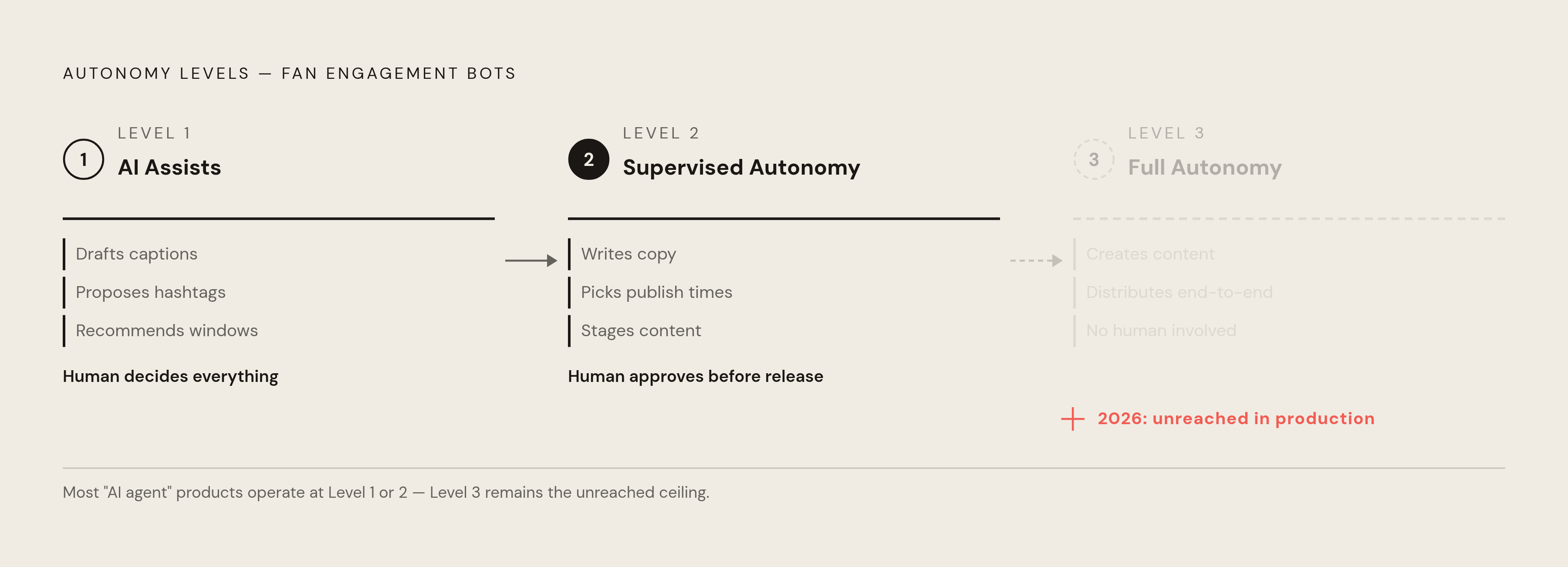
The solution avoids trading velocity for excellence. By keeping people involved, fan engagement bots can publish material quickly while remaining reliable enough for others to reference. As AdMove.ai outlines in its agent behavior guide, practical autonomy comes in three tiers, so recognizing a system's tier outweighs scanning its feature list.
At the first level, AI assists: the human makes every call while the machine handles execution, drafting caption options, proposing hashtags, and recommending posting windows. At the second level, the system runs on its own within set limits. The agent writes copy in the brand's established voice, picks its own publishing times, and stages everything for human sign-off before release. Rather than going over each draft at the start, the human steps in at the end as the final check. At level three, the system would take over the entire workflow, creating and distributing content without any human involvement. As of 2026, no production social media management tool has reached that Level. Many offerings branded as AI agents are really limited to the first or second level; classifying them accurately is the best way to judge a platform.
In the right setup, people make the last call on what ships instead of merely polishing work from an automated pipeline. AI takes on alternate captions, hashtag discovery, prepared replies, calendar timing, and format-specific content adjustments. People are responsible for strategic direction, voice judgment, sensitive team or fan issues, and the last sign-off before publication. MediaCreator.ai runbooks from late September 2026 present the same staged model: a co-pilot first tunes draft material to match the brand style, review comes next, and the dashboard governs approval for every scheduled item.
When a pipeline combines AI drafting with reviewer oversight, or gives a team room to use full autonomy when appropriate, the system can still publish content at scale while preserving the standard that keeps brand-backed work credible. For teams comparing providers across areas such as B2B marketing and sports analytics, the priority should be API access to the platform’s full capability set. With that access, the pipeline can plug into the tools already in place rather than require the team to adopt a separate, self-contained workspace.
Structuring bot output for AI answer engine citation
A pipeline can turn out well-reviewed content and still fall short when the platforms that cite it can't read what it publishes. A bot built for fan engagement may clear every stage of human review yet never appear in AI answer engines, because the formats it releases in resist the chunking, extraction, and source attribution those systems rely on. Formatting here does more than look good: it determines if the content is retrievable at all.
Retrieval Augmented Generation uses indexed units of content, commonly formed from paragraphs or heading-based sections, that must remain clear even when extracted. In practice, that calls for modular paragraphs brief enough to function on their own as answer-ready pieces, an approach GEO research explicitly identifies. Each chunk needs its own context so it can work as a full answer without relying on earlier surrounding text.
Table-formatted content earns far more citations than identical material presented as running text, and well-built HTML comparison tables markedly lift how often AI systems cite them. A bot built for fan engagement should therefore put matchup recaps, standings side-by-sides, and stat splits into tables instead of burying them inside commentary prose and forcing the AI to work out the layout on its own. Dense, well-sourced material matters for a similar cause: replies that include expert voices by name, fresh data, and figures with sources are simply easier for an AI to quote than pure opinion takes, and the Princeton University GEO study (arXiv:2311.09735) ranks adding sources, quotes, and stats among its three most effective levers for boosting AI visibility.
This needs a dedicated home to function. The ground site serves as the brand’s official owned domain, built so AI can extract it easily through answer-ready structured sections, schema, self-contained paragraph modules, and data the brand created itself. That is where the bot's best output should be published in its lasting form. Phantom sites spread brand-linked material intentionally across trusted third-party platforms, broadening the mix of sources available to AI models, as noted earlier. Brands should prioritize Reddit alongside YouTube and specialist forums as key distribution channels, given their significant role in AI citations across major platforms. YouTube serves as an ideal phantom-site anchor because AI systems index its transcripts directly and rely on its strong domain authority when generating responses. Fan bot videos carrying precise transcripts packed with target terms pull their weight twice over, reaching social viewers while feeding the retrieval layer simultaneously.
A single technical check beneath all this formatting effort can silently undo it. In 2025, Cloudflare began blocking AI crawlers by default. Brands need to check that their disallow rules leave ClaudeBot, GPTBot, ChatGPT-User, and PerplexityBot unblocked, a configuration failure that is easy to miss. No amount of modular layout or careful table design on a page matters when the crawler that should be reading it gets turned away at the server.
Formatting earns citations, and original material is what keeps earning them. Commentary from AI merely establishes a baseline, whereas firsthand proof determines the upper limit. Surpassing that baseline requires releasing material no AI system can generate alone, such as firsthand audience polling, exclusive interaction metrics, or named expert opinions drawn from real conversations. Automated tools pairing such evidence with routine dialogue reach a higher referencing level than those offering nothing but analysis.
Measuring whether the bot is being cited, not just engaged with
The pipeline and content architecture only pay off when a team tracks the metric that actually matters. Without a direct view of AI citations, teams are left unable to judge whether their efforts are paying off, since their usual social engagement dashboards miss AI visibility entirely. QuickSEO found that roughly 14% of marketers are currently tracking AI citations. Most teams still lack a clear view of the measure shaping discovery among their highest-intent audience.
Unlike conventional rank tracking methods, AI citation tracking operates on fundamentally different principles. Instead of tracking a page's position on search results, these platforms execute standardized queries across ChatGPT, Gemini, Claude, and Perplexity at regular intervals, documenting whether the brand appears in the response, its placement within that response, the tone surrounding it, and which particular pages serve as references. Solutions such as Semrush One, Evertune, and Profound address a monitoring blind spot that conventional SEO rank trackers cannot handle.
The right way to think about this tracking is as an engineering instrument, not a vanity number. Each week, test prompts reflecting real fan curiosity, such as where to find the best account covering a given sport or who currently leads a particular league. Monitor the machine-generated pages and external posts that surface as references, since those patterns reveal which formats and channels truly carry retrieval weight. Overlay emotional tone analysis onto those reference metrics to flag credibility issues before they snowball. Receiving unfavorable mentions leaves a bot in a more precarious position than total obscurity. How often AI platforms mention the bot acts like its traditional search placement, so teams should review it just as regularly as they do the existing social engagement figures on the dashboard.
This is also the point where the phantom-site and ground-site strategy runs into reality. Suppose most citations trace back to Reddit discussions and YouTube transcripts, and the company's site barely registers: that's a clear prompt to move budget into content the brand owns instead of publishing more social posts. And the measurement layer does more than verify the approach is paying off. It pinpoints where the team's next push of work belongs.
Sources
- Accelerated AI Adoption, Shifting Fan Expectations and Sponsor Priorities: The 2026 Fan Engagement, Monetisation and AI Trends Survey
- AI agents for social media: a no-hype guide for 2026
- GEO: Generative Engine Optimization Pranjal Aggarwal∗
- Will AI-Generated Content Hurt Your Reach in 2026? What the Platforms Actually Reward · Getix Group
- ChatGPT vs Perplexity for AI Visibility in 2026: Citations, Traffic, and Conversion Compared