Content Personalization as a Conversion Lever
Personalization cuts bounce rates by targeting the right offer to the right stage.
Personalization converts better because it kills friction. Get that mechanism backwards and you'll spend next year's budget propping up the wrong lever while the actual leak stays open.
You've heard "relevance builds trust" at every marketing conference since roughly the invention of marketing conferences. Fine for a keynote slide. Weak ground for deciding what to build next quarter, since trust is a feeling and nobody's running an A/B test on a feeling. What you can test is whether someone bounces because the CTA doesn't match what they came to do, or whether a lead goes cold because you handed a top-of-funnel blog post to somebody three days from signing a contract. Personalized content cuts bounce rates by up to 45%, according to Instapage, and a bounce is a measurable behavior: someone showed up, hit a wall, left. That's friction, and it's a far more useful thing to chase than a vague sense of whether a landing page "feels personal enough."
The real question was never whether to personalize; everyone settled that one years ago. The question is which lever, at which stage, removes the most friction for the least effort, and the data actually answers it: audience segmentation, dynamic CTAs, and journey-stage messaging, roughly in that order of leverage. This piece walks through all three, then gets into how you sequence them when your team doesn't have a bottomless budget or a data warehouse someone actually cleaned this year.
What the aggregate numbers actually tell us about where personalization pays off
Fast-growing companies earn 40% more of their revenue from personalization than their slower-growing peers. Everyone quotes that stat at conferences, and almost nobody notices it's an outcome, not an instruction. It tells you personalization correlates with growth. It leaves the question of which button to push Monday morning wide open, which is sort of the whole problem with citing it in a strategy meeting.
McKinsey's numbers are more honest about the fuzziness, if less quotable. Their research puts the revenue lift from personalization somewhere between 5% and 15%, with marketing ROI improving 10% to 30%. Normally a spread that wide is the part of the report everyone skips to get to the headline number. Here, the range itself is the finding: personalization depends heavily on where you apply it and how well you execute it, and it doesn't act as a flat multiplier you slap on everything and watch climb in a straight line.
Then there's Amazon, where roughly 35% of purchases trace back to personalized recommendations. Sit with that less as a target and more as proof of concept. Recommendation-layer personalization alone, done at genuine scale, can carry a serious share of total revenue without any help from other tactics.
None of these figures, impressive as they look on a slide, tell you which specific mechanism did the work. Segmentation? A sharper CTA? Timing? They blend channel, tactic, and audience into a single percentage, and a single blended percentage is a bad tool for deciding what to build next quarter. If your CMO reads "40% more revenue from personalization" and greenlights a six-figure platform without knowing whether the win came from email segmentation, product recommendations, or a smarter form field, that purchase is a bet dressed up as a strategy. Closing the gap between the aggregate number and the decision sitting on your desk right now is what the rest of this piece tries to do.
Audience segmentation as the foundation: why unsegmented content bleeds conversions before the CTA is ever seen
Segmentation is the thing that makes the other two levers possible in the first place. A dynamic CTA needs to know something about the visitor before it can do anything dynamic; a journey-stage message needs to know what stage the person's actually in. Skip segmentation and personalization becomes guessing with better production values.
The consumer numbers make the cost concrete. McKinsey finds 71% of consumers expect personalized interactions, and 76% get frustrated when a brand fails to deliver one. Most of your audience walks in expecting something your one-size-fits-all content isn't giving them. Meanwhile, 66% say hitting non-personalized content would actually stop them from buying. Two-thirds of your audience treats generic content as a blocker sitting in the funnel, not a nice-to-have you'll get around to eventually.
Email is where this plays out most visibly, and the numbers are almost comically lopsided. Segmented email campaigns can lift revenue by as much as 760%, per data cited by Linear Design and the DMA. Segmented and personalized emails already generate 58% of all email revenue, meaning the majority of the money email produces sits in the sends that bothered to segment in the first place. Unsegmented blasts sit well below that baseline, actively leaving most of that revenue on the table. Nobody thinks of "send to all subscribers" as a decision at the moment they click send. It is one, and a fairly consequential one.
B2B tells a similar story in a different accent. 83% of B2B marketers report improved lead generation from personalization, and 80% of businesses see higher spend from customers when the experience is tailored. The inputs differ: B2B leans on firmographic data like company size and role, plus intent signals like which pages a buying committee keeps circling back to, while B2C leans on purchase history and browsing behavior. The mechanics underneath don't shift much between the two, though.
You don't need fifty segments to see the lift. The 80/20 pattern shows up reliably here, where two or three well-defined segments drive most of the conversions. Start there, and resist the urge to build a segmentation scheme so elaborate it takes a quarter to launch and is obsolete before it ships. Nobody's handing out awards for the most granular customer taxonomy.
Dynamic CTAs: the single highest-leverage on-page intervention the data supports
If segmentation is the foundation, the dynamic CTA is the single most efficient thing you build on top of it. HubSpot data, via Instapage, puts personalized CTAs at a 202% higher conversion rate than generic ones. That's the largest single-tactic lift in this entire dataset, and it isn't particularly close.
Why does swapping a button's text and offer move the needle that hard? A generic CTA asks every visitor, regardless of what they know, need, or already did on your site, to take the identical next step. A first-time visitor and someone who's read six blog posts and compared pricing twice both see "Learn More." One of them is ready to talk numbers; the other found you five minutes ago while googling something adjacent. A generic CTA doesn't discriminate between the two, and discrimination, in this narrow and useful sense, is exactly what conversion optimization needs to do.
Context fixes the mismatch: pages already viewed, segment membership, referral source. Returning visitors see a different offer than new ones; enterprise-flagged traffic sees different copy than an SMB visitor poking around the pricing page. Someone at the awareness stage gets asked to read the guide, someone circling a purchase decision gets asked to start the trial. The CTA is the highest-stakes friction point on the page, maybe on the whole site, because it's the literal fork between conversion and exit. Everything before it is setup. The CTA is where that setup cashes out or doesn't.
Dynamic CTAs and segmentation compound rather than sit as separate line items on a roadmap. A perfectly segmented audience shown a generic CTA still underperforms, because you did the hard work of understanding the visitor and then declined to act on it. A dynamic CTA system pointed at an unsegmented audience has nothing to key off, like an engine idling in neutral, going nowhere but burning fuel anyway. The 202% figure is an average across implementations, and the biggest lifts show up when the CTA logic ties to real behavioral or segment data, rather than a persona label somebody sketched on a whiteboard during a workshop two years ago.
Journey-stage messaging: why the right content shown at the wrong moment fails even when it is relevant
Here's a distinction that trips up otherwise sharp content teams: relevant content and well-timed content are not the same thing. Marketers who focus specifically on where a lead sits in the funnel see conversion rates 73% higher, according to Linear Design. Big enough a number to suggest stage-awareness does independent work, separate entirely from whether the content itself is any good.
Picture the failure mode. A prospect ready to buy today lands on an awareness-stage post explaining what your product category even is, while somebody who found you five minutes ago via a random search gets served a pricing page and a demo request form. Both pieces of content might be well-written and accurate. Shown to the wrong person at the wrong moment, both create friction anyway, because the information doesn't match the intent behind the visit.
Email shows this most clearly, since the data on triggered messages is unusually granular. Automated triggered sends, browse abandonment, cart abandonment, post-purchase follow-up, make up well under 3% of total email volume in one dataset cited by Involve.me and Barilliance, yet drove 38% of total email revenue. Browse abandonment flows specifically converted at 4.3%, against 1.7% for regular campaigns, and that gap comes down almost entirely to timing rather than copywriting, since the message lands while the intent is still warm. Meanwhile, 60% of shoppers who get a personalized cart reminder come back to finish what they started.
B2B has its own, arguably higher-stakes, version of this. Per the 6sense 2025 Buyer Experience Report, 80% of B2B deals get won by whichever vendor the buyer already favored before anyone from sales made first contact, during the anonymous, content-driven research phase. Journey-stage content in B2B stops functioning like a warm-up act for a future sales call and starts functioning as the sales call itself, one that happens before anyone picks up a phone. Early-stage content carries far more weight than the label "top of funnel nurture" suggests. It's the most competitively important real estate in the entire buying cycle, which is a strange thing to say about a blog post, but there it is.
One thing carries into the next section: doing this well takes behavioral triggers, actual page visits, time on site, content consumed, not just declared data somebody typed into a form six months ago. Declared data tells you what a person said about themselves once. Behavioral data tells you what they're doing right now, which is a different and more useful thing entirely.
The perception gap that makes this an opportunity: most competitors haven't closed the loop
Here's a number worth sitting with for a second: 85% of companies believe they personalize effectively. Only 60% of customers agree. Twenty-five points separate what marketing teams tell themselves in the quarterly review from what the people on the receiving end actually experience, and every point of that gap is conversion leakage nobody's tracking on a dashboard.
Retailers show the identical pattern with different numbers attached. Sailthru and Marigold data finds 67% of retailers believe they excel at online personalization, while only 46% of consumers back that up. The room believes one thing; the audience next door believes something else entirely, and nobody's comparing notes.
The gap is mostly operational rather than some grand act of collective self-deception. Nearly all retailers, 96% by one measure, report real obstacles: limited IT capacity, a bewildering platform selection process, internal teams that can't agree on what "personalized" even means in a shared doc. Mastercard's data points to real-time customer data maintenance as the single biggest headache, flagged by a majority of retailers surveyed. Separately, 61% of business leaders worry that bad underlying data will undercut whatever AI-driven personalization gets built on top of it, a reasonable worry given that bad inputs have produced bad outputs since long before anyone slapped the word "AI" on the process.
The opportunity inside that 25-point gap is straightforward, even if closing it isn't. Teams that actually operationalize personalization, instead of just believing they've handled it, compete against a field mostly running on self-reported confidence rather than customer-confirmed results. That's a lower bar than the industry conversation usually makes it sound, and it's worth remembering the next time a competitor's case study sounds unbeatable.
Speed matters here too, maybe more than anyone wants to admit. Personalization that takes months to plan, approve, and finally ship misses the exact behavioral window (the browse signal, the cart abandonment, the research-phase content binge) that made it relevant in the first place. A perfectly personalized message delivered four months late functions as ordinary mail with extra steps.
Where data trust and privacy expectations constrain what personalization can do
Only 37% of customers trust brands with their data. Most of the people you're trying to convert through personalization walk in already skeptical about how you'll use the information personalization requires them to hand over. That's the actual terrain you're building on, a field where trust is scarce rather than assumed.
A 2024 Deloitte study found 70% of consumers would stop buying from a brand entirely after a data mishandling incident. The downside risk isn't symmetrical with the upside, and that asymmetry deserves more attention than it usually gets in a personalization strategy deck. Get personalization right and you might see a meaningful conversion lift. Get the data handling wrong and you don't just lose the lift, you lose the customer, possibly for good.
There's a real paradox sitting at the center of all this, too. Per the 2024 Forbes State of Customer Service and CX Survey, 81% of consumers say they prefer companies that offer personalization. At the same time, KPMG data shows 30% flatly refuse to share their data, full stop, no negotiation. Roughly a third of your potential audience wants the benefits of personalization while declining to hand over the raw material it runs on, which is a bit like wanting a custom suit without letting anyone near you with a tape measure. That's exactly why zero-party data (information people volunteer directly, through preference centers, quizzes, explicit opt-ins) and first-party data matter more now than they used to.
There's generational texture here too. 49% of Gen Z say they're less likely to buy from a brand offering an impersonal experience, making them both the most demanding audience for personalization and the most demanding audience about how it gets done responsibly. Consumers over 35, meanwhile, show measurably more discomfort with AI-driven recommendations built on personal data. The trust calculus isn't uniform across your customer base, and treating it as one number on a slide is probably a mistake.
Think of this as a design constraint rather than a reason to hold back. The highest-converting tactics in this piece, the 202% CTA lift, the 73% funnel-stage lift, run fine without surveillance-grade tracking. They rely on behavioral signals (what someone clicked, what page they lingered on) and declared preferences (what someone told you directly). The real work is building the whole operation on first-party data and explicit signals, which happen to be more accurate anyway, and which age a lot better as privacy regulation keeps tightening its grip year over year.
How to sequence the three levers when resources are limited
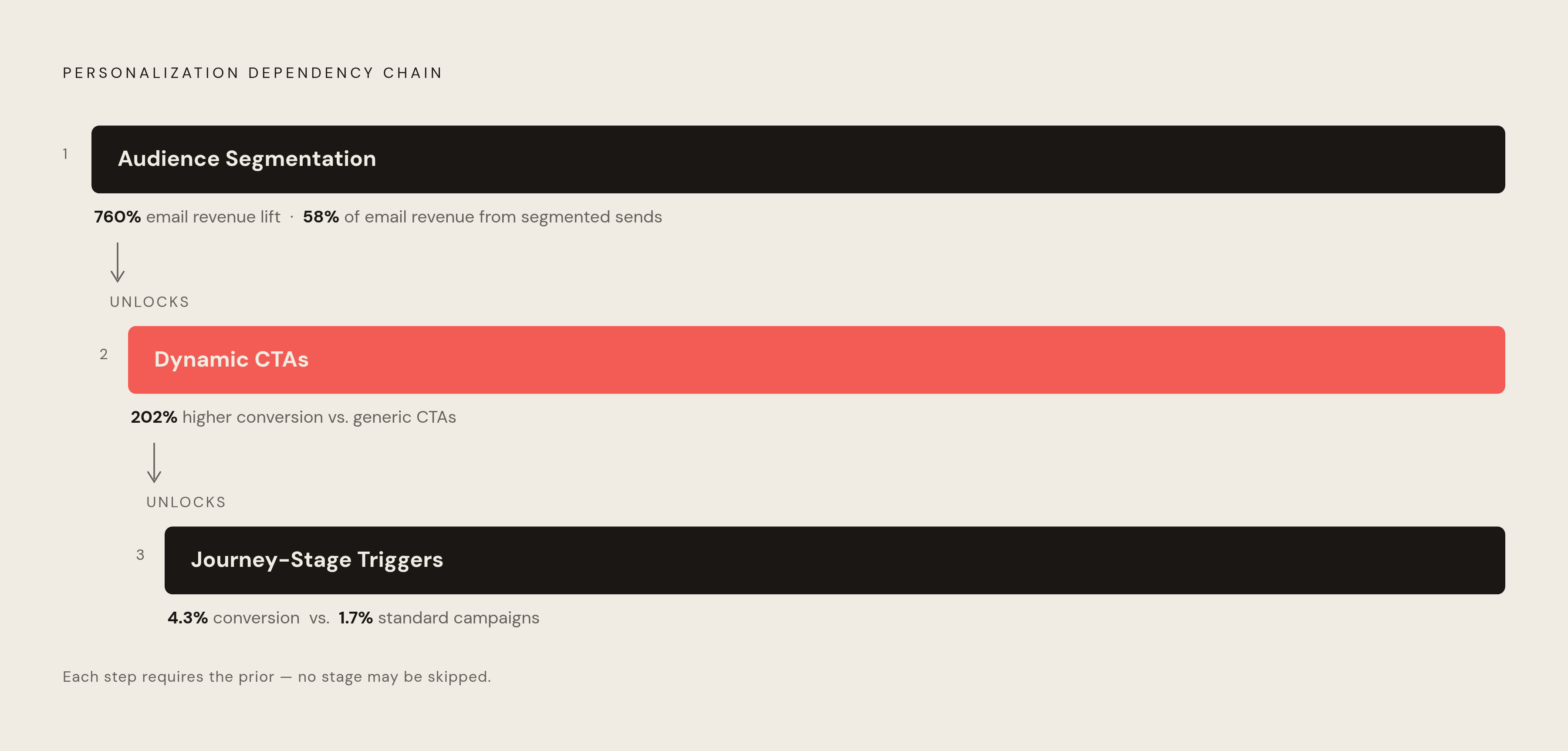
Nobody gets to build all three levers at once with infinite budget and a spotless data warehouse. The evidence supports a fairly clear order, and it follows a dependency chain once you look at it closely enough.
Start with segmentation. It's the upstream enabler for everything else, and even basic list segmentation gets you into that 760% email revenue range and the 58% revenue concentration effect mentioned earlier. It needs the least technical infrastructure of the three and produces the most immediately accessible lift. If you're starting from zero, this is where zero ends.
Layer dynamic CTAs in second. Once segments exist, swapping CTA copy and offers by segment, or simply by returning-versus-new-visitor status, becomes a contained, testable build. The 202% lift potential makes it the highest-ROI single build once the segmentation groundwork is actually in place, not before.
Build journey-stage triggers third, because this one needs real data plumbing: behavioral tracking, trigger logic, integration between your CMS and whatever email or marketing automation platform you're running. It's the most technically demanding of the three, but it delivers that 4.3% versus 1.7% conversion gap seen in browse abandonment flows, and the gap compounds as volume scales up.
The B2B sequencing note deserves its own mention, because it changes how you think about "top of funnel" content entirely. Given that 80% of B2B deals get decided before first sales contact, journey-stage content published during that early research phase is arguably the single most leveraged conversion point in the whole cycle. Treating it as an afterthought, something the intern writes while everyone else focuses on the "real" campaigns, is an expensive mistake dressed up as a reasonable one.
Speed ties all three levers together, and it's the variable most teams underrate. Personalization that takes months to design, route through approval, and finally publish misses the behavioral window it was built to catch. Teams that close the perception gap from earlier tend to run on workflows fast enough to match content to intent while that intent is still warm, more than on a five-year personalization roadmap sitting untouched in a slide deck.
Segment first, because nothing else works without it. Layer in dynamic CTAs second, because that's where the biggest lift per unit of effort lives. Build journey-stage triggers third, because they need infrastructure the first two don't. Do all three faster than feels comfortable, because the friction you're trying to remove doesn't wait around for your Q3 roadmap to clear review.