SEO Content Tools vs Answer Engine Tools — What Each Actually Does
Answer engine tools require different content work than SEO ranking strategies demand.

SEO tools aim for a ranked link that earns a click, while answer engine tools aim to get content into an AI-generated response. This comparison explains what each category does and why a content strategy built for one cannot serve the other equally well without distinct work on content, authority, and measurement.
The mechanical difference between SEO and answer engine tools
Traditional search shows a ranked list of links. SEO content tools help a page compete for a place in that list, where the user can choose a result and visit the site. The page is the destination being offered. Where it sits affects whether the user sees it, and how it looks in the results affects whether the user clicks. The tools therefore work toward visibility at the point where a search engine offers pages to a reader.
Answer engine tools, also called GEO/AEO tools, aim to get content into a synthesized response. ChatGPT, Gemini, Perplexity, and Google AI Overviews can answer a question using information from sources the user never visits. The answer itself can become the destination. A brand or source earns visibility when the response mentions it or cites its content, even if that visibility produces no visit to the source site.
AI answer engines use Retrieval-Augmented Generation, or RAG, to pull selected passages from source documents and synthesize them into a coherent response in natural language. Rather than presenting a page for the user to evaluate, the system uses material from that page to help compose an answer. Selection happens at both the passage and page levels. That distinction changes what the content must make available to the system, as well as what a tool must observe to judge its success.
What SEO content tools are actually optimizing for
SEO content tools are built around the signals used to place a page in ranked search results. Their optimization targets include keyword targeting and density, backlink and domain authority, page speed and crawlability, metadata, and search results appearance. Keywords help establish the page’s subject, technical signals make it accessible to crawlers, and metadata shapes how it is presented in results. Backlinks and domain-level trust supply authority signals beyond the words on the page.
Technical hygiene helps with that work before a reader arrives. Clean robots.txt, updated sitemaps, and structured on-page signals help make a page legible to a crawler building a ranked index. These are not merely finishing touches on the copy. They concern whether a search system can access and understand the page that the content program wants to rank. A content tool’s advice is therefore part of a wider SEO workflow that also deals with the site’s technical condition.
What does success look like in that workflow? Rankings show where the page appears, click-through rate shows whether users choose it, and organic traffic records the visits that follow. The supported journey runs from a short keyword query to a ranked list and then to the site. These metrics describe different stages of that journey. A ranking creates an opportunity for the click that the rest of the workflow seeks to earn.
Authority also centers on the page because independent sites show trust by linking to it. Domain-level trust also accumulates over time, giving the SEO program an authority base that extends beyond a single piece of content. This is a coherent optimization job in its own right. Its targets and metrics make sense for a system that asks users to choose among links.
What answer engine tools are actually optimizing for
Answer engine tools treat repeated inclusion across AI responses as the unit of success. Instead of targeting a ranked position for a keyword, they track how often a brand appears across responses to many different prompts. There is no equivalent of “position one” to secure. A synthesized response may mention a brand, cite a source, or use information without taking the user from a ranked link to a page as SEO tools assume.
Conversational questions are longer than short keyword phrases, and AI systems can break a user’s question into sub-queries and retrieve material against each one. Content may be relevant to one part of the question without being the best complete page for the original prompt. This is why keyword ranking is an imprecise fit for understanding which passages an answer engine selects.
To support that selection, answer-engine-ready content emphasizes self-contained paragraphs, extractable facts, semantic clarity, structured data, and consistent entity definitions. A passage needs to be understandable outside its original surroundings. Clear definitions help show which brand or subject the content is about, and passages that state facts plainly give the system material it can use in a response.
Positive mentions on trusted independent platforms and in communities are linked to how likely AI is to cite a source in ways that backlink profiles alone do not show. The corresponding metrics include citations in AI answers, brand mention share, described as Share of Answer or Share of Model, and AI referral traffic. Each measures a different result of inclusion. Referral traffic counts visits, while mention and citation measures can show when a brand is seen even if no one clicks.
Why the same content strategy cannot serve both jobs equally well
The structural gap begins with what the content is designed to survive. A page built around keyword targeting and metadata can compete in ranked results even if its passages are hard to follow when taken out of the page. Conversely, an extractable answer does not by itself address page speed, crawlability, backlink authority, or results appearance. Neither job contains the whole of the other. Some useful work overlaps, but overlap does not make the two optimization problems interchangeable.
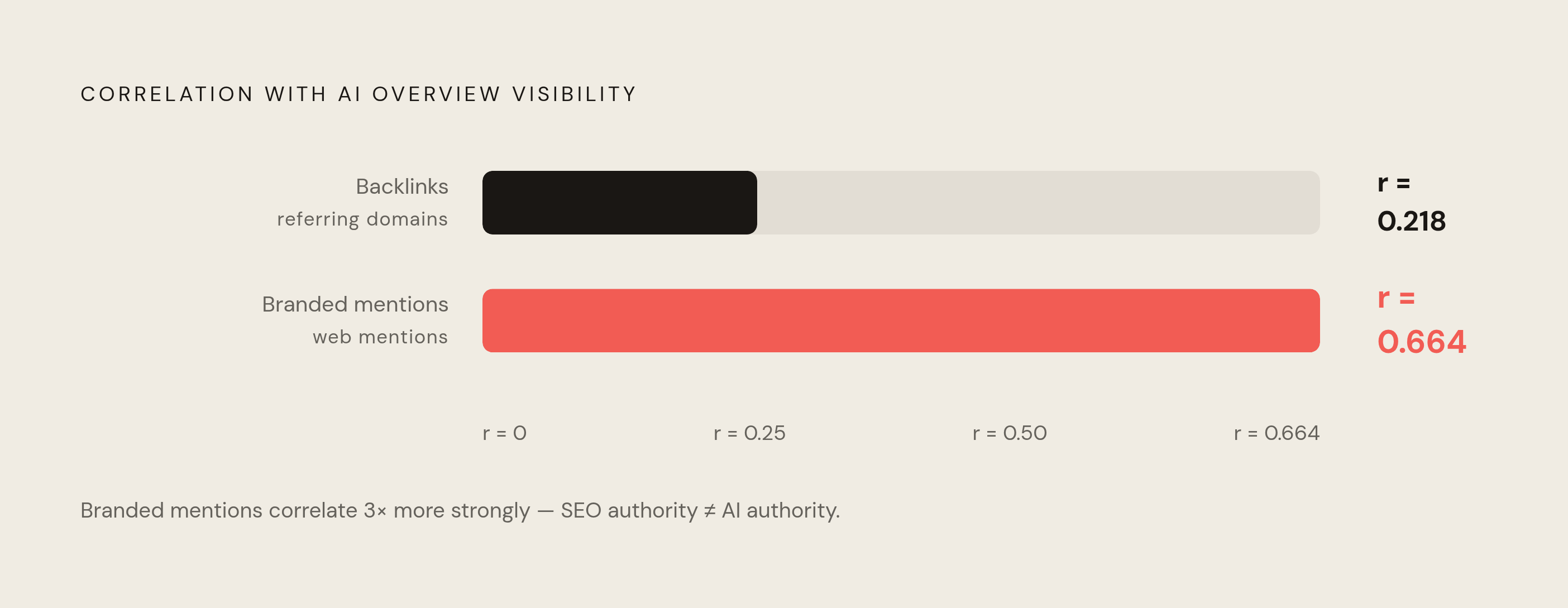
That distinction becomes sharper when authority enters the picture. Ahrefs found that backlinks, measured as referring domains, correlated at r=0.218 with AI Overview visibility, compared with r=0.664 for branded web mentions. The finding challenges the assumption that the authority signal central to SEO is an equally strong proxy for AI visibility, while leaving a causal link between mentions and citations unestablished. A program focused on earning links can therefore leave a different form of independent recognition underdeveloped.
SEO content is usually built around keyword targeting, density, and metadata, while citation-ready content needs passages a RAG system can retrieve without the text around them. Pages can still do more than offer a set of standalone answers. It does mean that ranking-oriented organization alone is insufficient evidence that the content is ready for extraction. The two tests ask different questions of the same text.
Could GEO simply become another feature in an SEO workflow? Only if the workflow also takes on the separate structural, authority, and measurement work that AI inclusion requires. A brand can rank well yet remain absent from AI answers, and existing rank reports need not reveal the omission.
SEO tools are doing the job their signals and outputs were designed to support. The error arises when that job is treated as a substitute for another one. A content strategy cannot serve both channels equally well if it lets the requirements of ranked pages stand in for the requirements of retrieved passages and synthesized answers.
What each tool category actually measures — and what that leaves invisible
SEO measurement follows the path from query to ranked link to click. Rankings, click-through rate, organic sessions, backlink counts, and page-speed scores help a team see performance and diagnose problems along that path. Those signals have a defined field of view. They do not directly show whether an AI response included a brand or selected a passage from its content. A strong SEO report can be accurate while leaving AI absence entirely undetected.
Answer engine measurement starts with a defined prompt set and observes the responses generated across it. Tools track how often the brand appears, whether platforms cite URLs or mention brand names only, and whether referrals from those citations reach the site. When a mention has no link, there is no URL citation to count, and even when there is a citation, it may bring no visit.
Platform differences make that separation especially important. Some AI platforms mention brands frequently without including URL links, while others link to sources in the majority of responses. Still others send referral traffic that analytics can track directly. No single platform’s behavior generalizes across the category. Multi-engine tracking is needed to distinguish a brand’s visibility from the particular citation habits of the platform being observed.
What can the site data already on hand show without tracking responses directly? Some teams monitor server logs for AI crawlers such as GPTBot, ClaudeBot, and PerplexityBot, or segment sessions arriving from AI platform referral sources. These signals provide only a partial view. OpenAI documents GPTBot as a training crawler, so its presence is not evidence that a page appeared in an answer. Likewise, referral segmentation counts visits but leaves out mentions or citations that led to no visit.
These proxy signals can supplement answer measurement but cannot replace it. Crawler access shows which pages a bot reads, while referrals show the traffic that reaches the site. Neither shows how often a brand or its content appears across generated responses. Without that direct measurement layer, a team cannot tell from its SEO instrumentation alone whether the missing AI signal represents absence or simply something the tools were never built to see.
What a content program needs to address if it wants to serve both channels
For a team serving both channels, the practical lesson is to run distinct content and measurement programs grounded in each channel’s mechanics. The programs’ requirements can overlap, but the SEO workflow cannot supply the answer engine program’s goals by default. Rank-oriented work needs its own technical, keyword, and authority targets, while AI citation work needs explicit attention to extractability, independent mentions, and response-level visibility.
On content structure, that second program needs clear facts, direct answers, and credible source citations within passages that stand on their own. The surrounding page can develop a fuller argument, but the retrieved passage must remain intelligible without it. Research offers support for those specific choices. Princeton / IIT Delhi / Georgia Tech / Allen Institute for AI’s GEO-Bench research, published at KDD 2024, found that citing sources, adding authoritative quotations, and adding statistics produced the strongest improvements in AI citation visibility. Classic keyword optimization was not the leading approach in that finding.
Authority work also needs a broader target than links to owned pages. Earning independent brand mentions on trusted platforms builds the kind of recognition that the Ahrefs finding linked more strongly to AI visibility. Publishing cadence belongs in the program as well. AI answer engines draw heavily on recent content, which gives irregular or infrequent publishing a structural disadvantage for AI citation. SEO, by contrast, relies on authority built up over longer periods.
Rank tracking and organic analytics measure how SEO is doing, while prompt-set monitoring, Share of Answer tracking, and AI referral segmentation measure how a brand is doing in answer engines. The signals must be read separately before cross-channel conclusions are drawn. Otherwise, a gain in one contest can conceal a gap in the other.
The final distinction is between being offered as a destination and being used inside an answer. Both can create visibility, but they leave different evidence. A content program cannot manage either reliably by measuring only the other.