Tech Stack for an In-House Content Team
Teams producing triple the content with flat budgets need infrastructure to close the gap.

Ninety-one percent of marketers say they're increasing content output right now, and 46% of them are producing three to five times more than they did in 2024. Only 25% of those same teams got a budget bump north of 10%. That gap, more volume with barely more money, only closes one way: through infrastructure. This piece walks through what an in-house content tech stack actually needs to cover, layer by layer, and why picking tools by feature list instead of function is how teams end up with ten subscriptions and one working process.
What "tech stack" actually means for a content team, and the five functional layers it needs to cover
Ask five content leads what's in their stack and four of them will start listing tool names. Almost none of them will describe what each tool is actually responsible for. A stack is coverage across five distinct jobs a content operation has to do, whether it does them with duct tape and a spreadsheet or with tens of thousands of dollars worth of annual licenses.
The five jobs: strategy and planning (deciding what to make and why), creation and writing (making the thing), SEO and optimization (making sure it can be found), distribution and publishing (getting it where it needs to go without someone retyping it three times), and measurement and iteration (finding out if any of it worked, then doing something with the answer).
A tool earns a spot in the stack by owning one of those five jobs cleanly. The moment a platform tries to be a little bit of everything, a little planning, a little writing, a little analytics, it usually ends up being none of them particularly well. That's just what happens when scope creeps. A team of three people with tight coverage across all five layers will out-produce a team of ten drowning in redundant subscriptions, because the ten-person team is spending half its week reconciling three different tools that all claim to "own" the content calendar.
This framework doubles as an audit tool, by the way. Take the current stack, map every tool onto one of the five layers, and see what falls out. Usually two things show up: a layer with nothing in it, and a layer with three tools fighting over the same job. Both are expensive. One just costs money and the other costs time, which, depending on the week, might be worse.
Strategy and planning layer: where editorial direction gets documented before a word is written
Most teams build their stack backward. They buy a writing tool first, then an SEO tool, and only later realize nobody wrote down why any of this content exists in the first place. The strategy layer is supposed to come first, on paper at least, even if in practice it's the layer that gets stitched together last, out of guilt.
What it needs to do is straightforward to describe and surprisingly hard to pull off: keep the editorial strategy somewhere other than one editor's head, keep a calendar that everyone touching production can actually see, keep briefs and approved positioning on file so nobody starts from a blank page every single time, and tie content decisions back to whatever the business is actually trying to do that quarter.
Project management platforms like ClickUp, Notion, and Trello all claim this territory, but they're not interchangeable. Task management, documentation, and knowledge base are three different problems wearing the same UI. Among practitioners, Notion has gained significant traction for knowledge management and internal wikis, while Google Sheets remains a common planning layer. Older tools have lost ground as teams consolidate rather than run five overlapping systems out of habit.
For editorial-specific work, there's a case for tools built explicitly around content approval workflows, things like Planable, which exist to let stakeholders preview and sign off across formats without a 40-reply email thread. And increasingly, AI is showing up here too, not just in the writing itself: over half of B2B marketers now use AI specifically for content planning, per a 2025 industry report, which suggests the strategy layer is no longer just a human judgment call with a spreadsheet attached.
The output that matters here is simple to state: a shared, documented plan that the creation layer can execute against without guessing. Skip this step and every downstream tool gets used reactively, which is a polite way of saying it gets used badly.
Creation layer: where AI and human expertise have to work as one system, not two separate tracks
Here's where the math gets interesting, and also a little uncomfortable. AI-assisted production cuts article turnaround by 40 to 50%, according to SQ Magazine, and According to allaboutai.com, the cost gap between AI-assisted and human-only blog posts runs around $480 per post, $131 versus $611. That's the kind of number that gets a CFO's attention in a budget meeting.
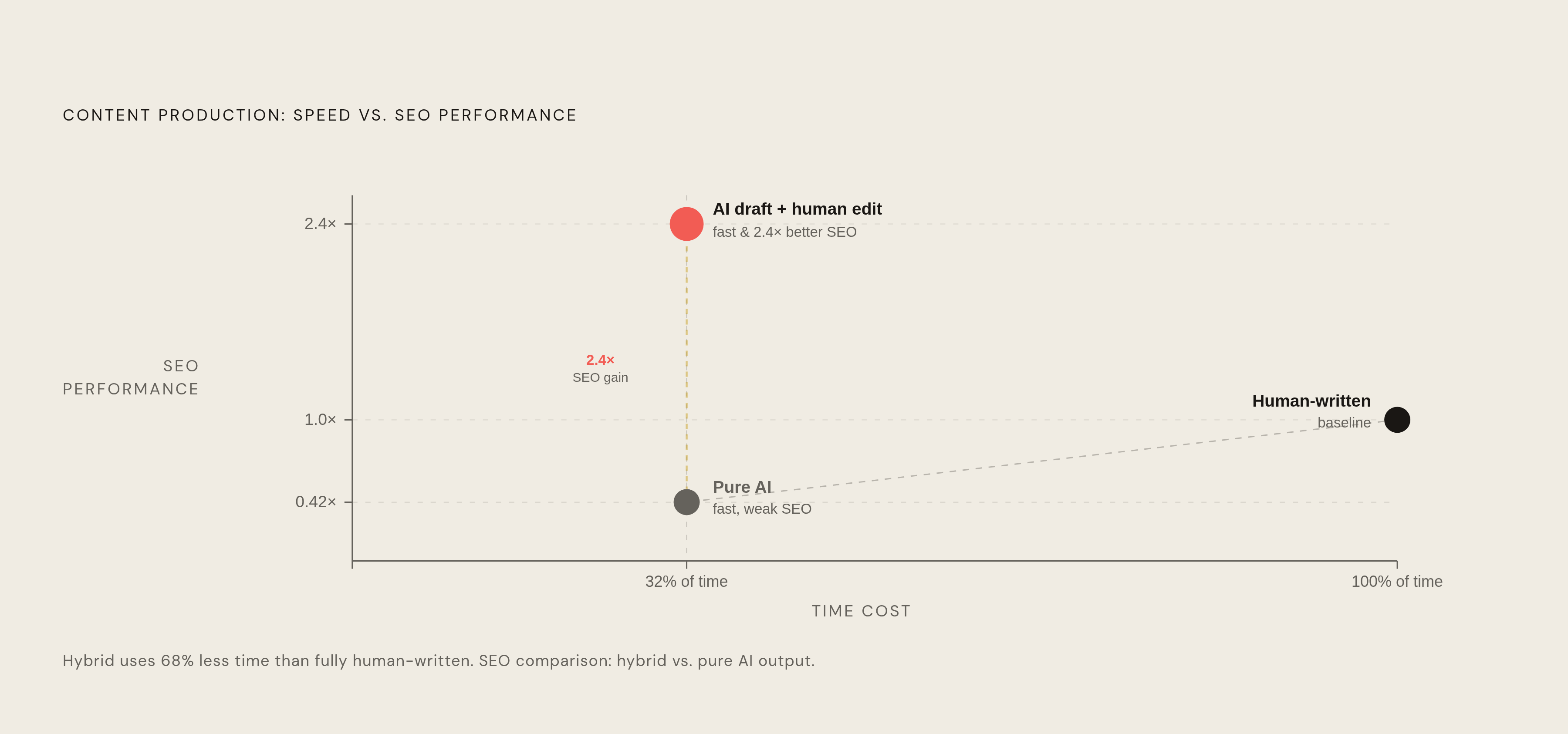
But speed isn't the whole story, and pure AI output has a quality problem that shows up in the metrics that matter. A 2025 analysis from AllAboutAI found that a hybrid model, AI drafting paired with human editing, delivers 2.4 times better SEO performance than pure AI content, while still using 68% less time than fully human-written work. Meanwhile, data from sqmagazine.co.uk found that 74% of newly created web pages in April 2025 contained AI-generated content. So the market has already made its decision on adoption; what's left to fight over is quality, and that fight is being won by teams that treat AI as a drafting partner rather than a replacement typist.
The creation layer's job, concretely: turn an approved brief into a structured first draft fast, keep brand voice consistent whether a human or a model wrote the sentence, let editors actually edit without fighting the tool, and keep everything in one place instead of scattered across browser tabs.
ChatGPT leads on trust among content marketers, selected by 80% as the most trusted AI writing tool, with Claude following at 55%, and 90% of content marketers now use AI writing tools on a regular basis. What's less obvious: the average enterprise content team uses 4.2 different AI tools, not one. That's teams figuring out that no single model is best at everything, the way nobody hires one contractor to also do the plumbing and the electrical.
Google Docs, unglamorously, remains the default home for the actual editing pass, because drafts need to live somewhere an editor can leave a comment without exporting anything. And strategy-first platforms that wire the editorial brief directly into the generation prompt, rather than bolting AI on after the fact, tend to produce output that needs less rewriting, because the AI knew what it was supposed to sound like before it started typing.
The failure mode here is worth naming plainly: using AI to pump out volume with no brief and no brand context. It's fast. It also doesn't convert, and it quietly undoes whatever work the strategy layer put in. allaboutai.com puts the time savings at 12.3 hours per content creator per week, and that number is only a win if those hours get reinvested into strategy and editing. Otherwise it's just 12.3 more hours spent generating content nobody asked for.
SEO and optimization layer: the tools that connect content to search demand before and after publishing
Eighty-six percent of SEO professionals have already folded AI into their workflow, and keyword research has emerged as one of the most widely adopted AI use cases in the discipline. So the question for an in-house team isn't whether to use AI here; it's which research platform to build the layer around.
Semrush and Ahrefs are among the most widely discussed platforms in this space, and they're not really competing for the same buyer. Semrush makes sense for teams that want SEO and broader content marketing intelligence under one roof, with a wide range of tools bundled into a single subscription. Ahrefs is the sharper tool for teams focused purely on organic search, backlink analysis, and site auditing, without needing PPC data or marketing tooling bolted on. The price gap between their entry tiers is real enough to matter for a smaller team choosing a primary platform, so the decision often comes down to whether the team needs the extra breadth or just wants the sharpest possible view of organic search.
The broader trend in this space points toward AI agents querying research data directly through natural language rather than a dashboard — a shift worth sitting with: the tools themselves are being rebuilt for a world where an AI agent, not a human analyst, is the one pulling the report.
Beyond the two big platforms, the layer rounds out with Google Search Console, which is free and gives real search data rather than modeled estimates, so no serious SEO setup skips it. Surfer SEO handles on-page optimization once the keyword research is done, useful mainly for teams publishing at real volume. Screaming Frog covers technical crawling, which matters if the team has engineering access and less so for a purely editorial shop with no server-side control.
Then there's the wrinkle nobody fully has an answer for yet: GEO, or Generative Engine Optimization. AI Overviews are appearing in a growing share of searches, and zero-click behavior keeps climbing, which means getting cited inside an AI-generated answer is becoming its own goal, running parallel to traditional ranking rather than replacing it. Most in-house teams are still catching up on how to track this properly. The minimum viable setup, for anyone wondering where the floor is, is one research platform plus Search Console. Everything past that is value at scale, not a baseline requirement.
Distribution and publishing layer: the infrastructure that gets content to the right channel without manual rework
The CMS anchors this layer, and the CMS market is genuinely shifting under everyone's feet. WordPress still powers 43.3% of all websites and holds 60.7% of the CMS-specific market, per searchenginejournal.com, but that share has slid from a peak of 65.2% back in 2022. Something is pulling users away, and it's not mysterious: SaaS platforms like Wix, Squarespace, and Shopify are picking up share (Wix alone grew 32.6% year-over-year) because they cut the technical overhead for teams without a developer on staff.
For bigger operations juggling multiple brands or regions, headless CMS platforms, Contentful, Sanity, DatoCMS, offer one content repository that can push to many channels at once, rather than maintaining five separate publishing pipelines. More than half of enterprise developers are now experimenting with this kind of decoupled setup.
The choice here really comes down to team shape, not preference. Small to mid-size in-house teams do fine with WordPress or a managed SaaS CMS: less maintenance, faster time to publish, plenty of flexibility for a normal editorial workflow. Enterprise teams managing multiple brands or channels are better served by headless architecture, even though it costs more to set up, because it removes the tax of manually reformatting the same piece of content five separate times.
Around the CMS sit the rest of the distribution tools: email platforms like Mailchimp, Klaviyo, or Beehiiv for owned-audience newsletters, social scheduling tools like Buffer, Hootsuite, or Sprout Social for extending reach without someone manually posting at 9am, and digital asset management systems that tend to get ignored right up until they become the biggest bottleneck in the building. Bynder suits larger organizations juggling brand consistency across many channels; Canto has a gentler learning curve; Cloudinary earns its keep specifically around media optimization at volume.
The failure mode in this layer is almost always the same story: every channel needs its own manual reformatting pass because nothing talks to anything else. Headless architecture, or even just a properly built content hub, fixes this, but only if someone plans for it before the team outgrows its current setup, not after.
Measurement layer: closing the loop between what was published and what the strategy should do next
Content output keeps climbing while budgets crawl behind it, and 66.5% of content marketers say they still don't know where to put their limited resources. It's a measurement problem, and it's the layer most in-house teams build last, if they build it at all.
The job here: track performance at the individual piece level (not just aggregate site traffic), connect content activity to actual pipeline or revenue so leadership stops asking "so what did the blog do for us this quarter," figure out which topics and formats keep compounding over time versus which ones peak and die, and then, critically, feed all of that back into the strategy layer instead of filing it away in a dashboard nobody opens.
Google Analytics 4 is the free baseline every team starts with, whether they like the interface or not. Search Console pulls double duty here too, showing which specific queries are driving impressions and clicks down at the content level, not just the site level. Platforms like Letterstory, an end-to-end content automation platform, fold this monitoring step into the same system that handles drafting and publishing. CRM integration, connecting your CRM platform to content analytics, is the piece that connects content engagement to sales pipeline; skip it and there's no honest way to claim revenue attribution for anything published. Content-specific analytics platforms like Chartbeat or Parse.ly add real value for high-volume publishers tracking engagement depth, though they're overkill for a smaller team still figuring out its GA4 dashboard.
GEO visibility tracking, watching whether content actually gets cited inside AI Overviews or chatbot responses, is starting to migrate into this layer too, alongside traditional rank tracking rather than replacing it.
None of this matters without a cadence, though. A dashboard that nobody reviews on a set schedule, weekly, monthly, whatever fits, is just an expensive screensaver. The tools in this layer are only as good as the meeting where someone actually looks at them and changes next month's plan because of what they saw.
How to audit and build this stack in practice: sequencing decisions and avoiding the tool-accumulation trap
Start with an audit, not a shopping list. Map every tool currently in use to one of the five layers and see what happens. Two patterns tend to surface immediately: a layer with nothing covering it, and a layer with two or three tools quietly doing the same job because nobody canceled the old subscription when the new one arrived. Cut the redundancies first. Adding a new tool on top of an unresolved overlap just makes the overlap more expensive.
For a team building from zero, sequencing matters more than most people assume. Strategy comes first: a shared planning space before a single draft gets written, because creation without a documented brief is just improvisation with a deadline. SEO research comes next, ahead of creation, so keyword and topic data shapes the brief rather than getting bolted onto a finished draft as an afterthought. Creation follows, built around those briefs and brand context rather than a standalone AI tool used whenever someone remembers it exists. Distribution gets chosen based on the team's actual technical capacity and channel mix, not the architecture a much bigger competitor happens to use. Measurement closes the loop, feeding back into strategy so the next cycle starts smarter than the last one did.
The frame worth holding onto through all five layers: the goal is coverage, chosen by what the workflow actually needs done, layer by layer, with nothing missing and nothing duplicated. That's the whole difference between a stack that compounds and one that just accumulates.