Content Briefing Tools That Improve Writer Output
Structured briefs cut revision cycles by half and align teams on what writers actually need.

A content brief either tells a writer what to think before they start typing, or it doesn't. That single fact decides whether the first draft is publishable or a rough sketch that needs three more passes. This piece looks at the tools that generate briefs, what each one actually forces a team to decide versus what it leaves as a suggestion, and why that difference matters more than any feature list ever could.
Start with the math nobody likes to say out loud: a content or PR team working without dedicated briefing tools can realistically turn out maybe one or two solid briefs a week. That's a ceiling. Everything downstream, drafts, edits, publish dates, sits on top of that number. A writer handed a genuinely clear brief can produce a passable draft in a few hours. Hand that same writer a vague one, and the "quick edit" turns into a three-day revision cycle where the real problem never gets named, because nobody wrote it down in the first place.
Consider the failure mode worth calling by name: a brief that's really just a coverage map. It lists the subtopics competitors touched on, maybe a word count, a keyword or two, and calls it done. The writer follows it faithfully and produces something structurally sound and completely inert, a well-organized answer to a question nobody actually asked. A topic assignment says "write about X." A brief encodes the stuff a writer has no way to guess: who's reading this, what do they already know, what decision are they trying to make, and what does "good" look like here versus on the competing pages already ranking. The rest of this piece looks at which tools actually force that information into existence, and which ones just make the coverage map look prettier.
What a brief must encode to change what a writer produces
A brief that's doing its job carries a specific set of things, required fields rather than nice-to-haves. Search intent comes first: what the person typing a query wants to walk away with, and which content format actually delivers that. A "how to" query wants steps. A comparison query wants a table. Get that wrong and the rest of the brief accomplishes little.
From intent, heading structure follows: subtopics, the semantic terms that should show up under each one, in an order that mirrors how someone actually reads to solve a problem. Then competitive context, meaning what the top-ranking pages already say, and more usefully, where they go quiet. Audience definition sits alongside all that: who's reading, what they already know walking in, what they need to decide by the time they leave. Tone and voice guidance has to be specific enough that a dozen different freelance writers, none of whom have met each other, produce work that reads like it came from the same publication. Word count, metadata, structural requirements round it out; those matter, but they're the least interesting part of the list and usually the only part a bad brief bothers with.
Google's own quality guidance gives a useful lens for testing whether a brief is actually complete. The "Who, How, Why" framework baked into the helpful-content and E-E-A-T guidelines asks: who wrote this and what makes them credible to do so, how was it produced and what's the evidence behind it, and why does this page need to exist at all. The quality rater guidelines that spell this logic out ran to 182 pages as of the September 2025 update, which is a lot of reading for a writer on deadline. A good brief works as the translation layer: it takes that document and turns it into fields a writer can fill in without digging through source material on their own.
Here's the part worth stating plainly: most brief tools fail because they treat intent and audience as optional fields instead of required ones. A tool that makes a writer answer "who is this for" before it lets them past the first screen behaves completely differently from one that offers the same question as a greyed-out suggestion nobody reads. No tool, however well built, can supply a decision the strategy team hasn't made yet. A brief tool amplifies clarity that already exists; that's worth remembering before blaming the software for what is, underneath, a strategy problem.
What structured briefs measurably do to revision cycles and team alignment
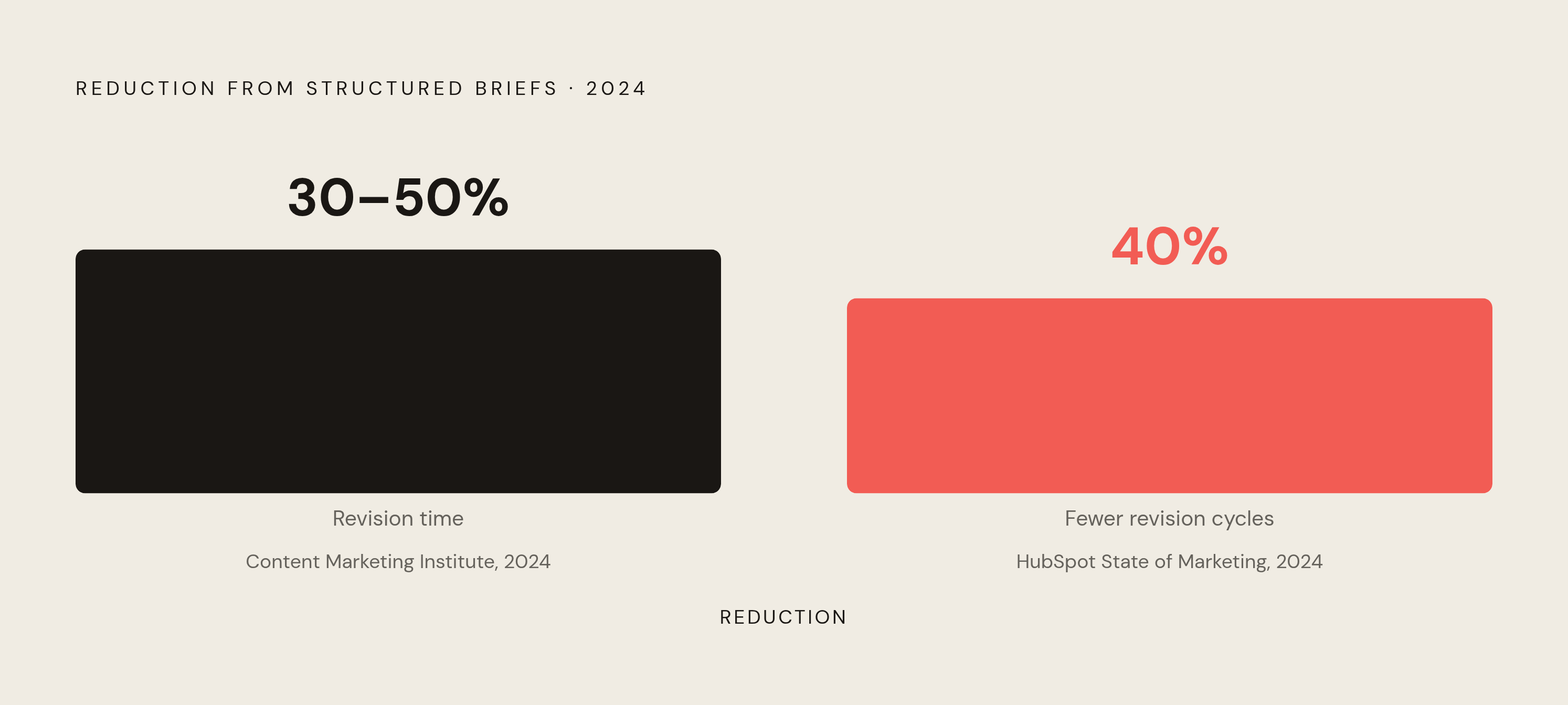
Structured briefs cut revision time by 30 to 50 percent, according to Content Marketing Institute's 2024 benchmarks. That range is worth sitting with, because revision is where most production time actually vanishes. Nobody budgets for it properly; it just eats the calendar quietly, one "quick note" at a time.
A 2024 State of Marketing report found teams using structured briefs saw 40 percent fewer revision cycles. What does that look like on the ground, concretely? Less back-and-forth over angle and scope, the kind of argument that should've been settled before a single word got written. Fewer rewrite requests that trace back to a writer genuinely not knowing who they were writing for, which happens more often than anyone likes to admit. Faster ramp-up for freelancers and new hires, who get full context up front instead of learning the account through three rounds of revisions.
Tools alone don't explain that gap. Intentional workflow redesign, more than the number of tools in the stack, is what separates high-performing content teams from everyone else. Bolt a scoring tool onto a broken handoff process and the process stays broken, just with better SEO scores attached to the mess. That's worth sitting with before any team goes shopping for software as the fix.
So which tools actually force the right inputs, and which ones generate something that resembles a brief without doing the work a brief is supposed to do? That's the question the rest of this piece answers, category by category.
How SEO-focused brief tools approach the problem: Surfer SEO, Clearscope, and Frase
This category works by reverse-engineering what's already ranking. Feed it a keyword, it pulls the top pages, extracts the NLP terms, the semantic coverage, the typical word count and heading pattern, and hands the writer a scoring system to write against. It functions as a guide to the shape of what's currently winning, with marks to hit, more than as a strategy source.
Surfer SEO reports over 150,000 customers across more than 159 countries, with named accounts including FedEx, ClickUp, and Shopify. Its Content Editor tracks NLP term usage, word count against target, and image density, providing a scoring system the writer works against. The entry tier starts at $99 a month, hard to beat on features per dollar. Yet scoring the writer in real time trains them to chase a number on a dashboard, and hitting a number isn't the same thing as understanding who they're writing for. Hitting a number on a scoring dashboard isn't the same thing as understanding who the reader is or what they came to find; the dashboard was never built to check for that.
Clearscope shows up consistently as the tool writers and editors actually prefer, mostly because its recommendations read as clean guidance rather than a keyword-stuffing checklist. It plugs directly into Google Docs and WordPress, so the guidance lives where the writing happens, no tab-switching, which matters more than it sounds like once ten different freelancers are all working unsupervised. Pricing starts around $170 a month, unlimited users but a cap on the number of content reports, clearly built for mid-sized to larger teams with real monthly volume. Where it earns its keep is consistency across a big pool of writers who aren't all sitting in the same office. Where it falls short: the brief it generates is graded, not strategized. It tells a writer how well they matched the pattern, not why the pattern should be different this time.
Frase takes a broader swing at the whole workflow: SERP research, AI-generated briefs, and a collaborative editor, closer to an end-to-end production tool than a pure brief generator. It adds something the others don't, dual SEO and GEO scoring, which matters more each year as AI-generated answers claim an increasing share of search attention. Pricing starts at $15 a month for the Solo plan (four articles), scaling to $115 a month for the Team plan, the most accessible price point among the full-featured options here. Frase works best when an editor is actually filtering the AI-generated brief before it reaches a writer. Skip that step and the brief goes straight from algorithm to freelancer, with nobody checking whether the machine's assumptions were any good.
The practical read: Clearscope for teams prioritizing consistency across a large, distributed writer pool; Surfer for teams that want a scoring system baked into the drafting process; Frase when budget is tight and AI-search visibility matters as much as classic rankings.
Where strategy-layer tools fit: MarketMuse and Content Harmony
None of the SERP-scoring tools answer a question that sits one level up: which topics get briefed first, in what sequence, against what's already published, in order to build authority across a subject rather than just rank one page at a time. That's a portfolio question, and it needs different tooling entirely.
MarketMuse does topic modeling that surfaces adjacent subjects a single-page tool would never flag, built for editorial strategy across an entire site rather than optimizing one article in isolation. Its Site Inventory feature crawls the whole domain and recommends which pages need a full rewrite versus a light update, a genuinely different function from anything a scoring tool offers. Add a Personalized Difficulty score, a Content Plan that prioritizes what to write next, and Strategy Documents for mapping topic clusters, and the picture that emerges looks more like a roadmap than a single brief. Pricing scales with that ambition: Standard runs $149 a month for one user plus $25 per brief, Premium runs $999 a month for unlimited users and briefs, and a free tier caps out at 35 queries a month, fine for early testing, not for running production. This fits mid-sized agencies, roughly three to ten users, publishing 30 or more briefs a month. Below that scale, Surfer or Frase covers the same ground for a fraction of the spend, and MarketMuse becomes complexity without the volume to justify it. That's the trap worth naming outright: paying $999 a month for a roadmap tool when the volume isn't there to justify it is money spent on a problem the team doesn't have yet.
Content Harmony solves a different problem: consistency rather than scoring. Its whole value case is making sure a brief looks and behaves the same way whether it came out on a Monday from one strategist or a Friday from another, across writers who may never interact directly. Pricing runs from $50 a month for five workflows up to $599 a month for 100, with enterprise plans starting at $1,000 a month for 200-plus workflows and API access. The design treats the brief as the actual handoff document, the thing that locks structure, coverage, tone, and intent before a single word gets drafted, rather than something reviewed after the fact.
That raises a fair question for any team eyeing this category: at what volume does strategy-layer tooling pay for itself, versus just adding a new layer of software to manage on top of everything else?
Brief-first tools built around the writer handoff: BriefIQ and what the category gets right
This category treats the brief itself as the finished product rather than a preliminary step toward one, aiming to hand a writer everything needed to write it well.
BriefIQ generates over 150 keyword options with difficulty scores, intent classification, and quick-win flags in a single pass, then turns a chosen keyword into a full SEO brief in roughly 30 seconds. The brief-first approach matters most at freelancer and agency scale, where a new writer, someone who's never spoken to the strategist and never will, needs to open one document and have search intent, competitor benchmarks, required topics, and tone guidance all sitting right there. That's the back-and-forth Content Marketing Institute's revision numbers describe, cut off at the source instead of absorbed later as edits. The pitch is agencies scaling output without scaling headcount: the brief stands in for the briefing conversation instead of supplementing it.
What this category gets right is treating the brief as the deliverable itself, giving a writer what's needed on arrival, rather than a scoring dashboard the writer has to reverse-engineer into an actual plan from a list of missing keywords. Tone and strategic framing travel with the document to the writer's desk; they're not left as an exercise for the writer to reconstruct from a bare list of terms.
What it leaves open, though, is the harder question: brief-first tools move fast, but they assume the editorial decisions already got made somewhere upstream. They encode inputs well, yet they don't generate the strategy those inputs came from, and that gap lands the whole discussion at an uncomfortable spot: no single tool across any of these categories handles editorial strategy, brief generation, and on-brand writing as one continuous chain. That gap is the actual practical problem, and it's the one the next section works through.
Matching tool to team: a selection framework built on how briefs actually get used
Feature count is a weak predictor of whether a tool fits. The variable that actually matters is workflow position: where does the brief sit relative to the writer, the editor, and whoever made the original strategic call?
If a brief gets generated and handed straight to a writer with no editor checking it first, the tool itself has to enforce quality by design, because nobody else is going to. That points toward Clearscope, Content Harmony, or BriefIQ. If an editor sits between the brief and the writer and filters what gets through, more generative, AI-driven tools become viable, since a human is already catching the rough edges; that's where Frase and Surfer earn their keep. And if the brief is just one output of a larger content planning process spanning many pages and months, that's when a strategy-layer tool like MarketMuse justifies its cost, because the brief isn't the whole job, it's one piece of a bigger map.
Team size and output volume form the second filter. A solo SEO or a small team producing under 30 briefs a month doesn't need to over-engineer anything; Surfer at $99 a month or Frase's Solo tier at $15 a month covers that workload without adding complexity nobody has time to manage. A mid-sized agency or publisher running multiple writers benefits from Clearscope's unlimited-user pricing or Content Harmony's workflow standardization, both built for exactly that scale. And a content operation running at true portfolio scale, 30-plus briefs a month with topical authority as a named goal, is really the only place MarketMuse Premium makes sense; below that scale it's paying for a scope nobody's using yet.
Worth adding for 2026: AI-search readiness. Does the brief force answer clarity, explicit question coverage, and citation-friendly structure aimed at how AI-generated answers get built, not just traditional ranking factors? That's stopped being a nice-to-have and started being table stakes as more searches end inside an AI summary instead of a list of links.
Most paid brief tools land somewhere between $49 and $199 a month, and the free tiers, MarketMuse's 35 queries a month being the clearest example, work fine for early testing but fall apart fast at any real production volume. None of these tools, on their own, encode brand voice from scratch, enforce editorial standards nobody's written down, or supply the judgment about what a given piece of content is actually for. That requires a workflow the tool sits inside.
This is roughly where platforms like Letterstory, an end-to-end content automation platform that runs drafting and editorial polish as one continuous pipeline, and Verbate fit into the conversation: teams looking for AI-assisted brief generation and writing inside one strategy-first workflow, where the brief serves as the actual foundation the content gets built on top of rather than a file that gets emailed between five different tools, with editorial quality checked throughout the process rather than patched on at the very end.
Why the brief is where content strategy either gets encoded or gets lost
The tools in this piece range from real-time scoring dashboards to full handoff documents, and every single one depends on strategic decisions that had to happen before anyone opened the software. A tool can format a brief beautifully and still be built on top of nothing.
The real dividing line has less to do with features and more to do with what the brief actually contains. A brief that encodes intent, audience, angle, and competitive gaps changes what a writer actually produces on the page. One that lists keywords and a target word count changes how a writer games a scoring system instead, a different outcome dressed up in the same document format. Put the two side by side and they can look nearly identical; open the resulting drafts and they're not in the same universe.
What separates teams that get consistently strong first drafts from teams stuck in permanent revision mode has less to do with the tool logo in their subscription list and more to do with whether the brief gets treated as the actual moment strategic thinking hands off to the writer, or as paperwork filed after the real thinking already happened somewhere else, in a meeting nobody wrote down. McKinsey's point about intentional workflow redesign lands squarely here: a great tool inside a broken handoff just produces broken output faster.
So the test for any brief tool comes down to one question, worth asking before signing up for anything: does it force the strategic inputs, intent, audience, angle, competitive gap, before it generates a structure, or does it generate the structure and quietly call that the strategy? That answer decides whether the tool actually changes what a writer produces, or just speeds up the production of drafts that still need saving.