Integrating DAM Systems With Content Production Workflows
Connecting DAM to production tools stops metadata loss between systems.
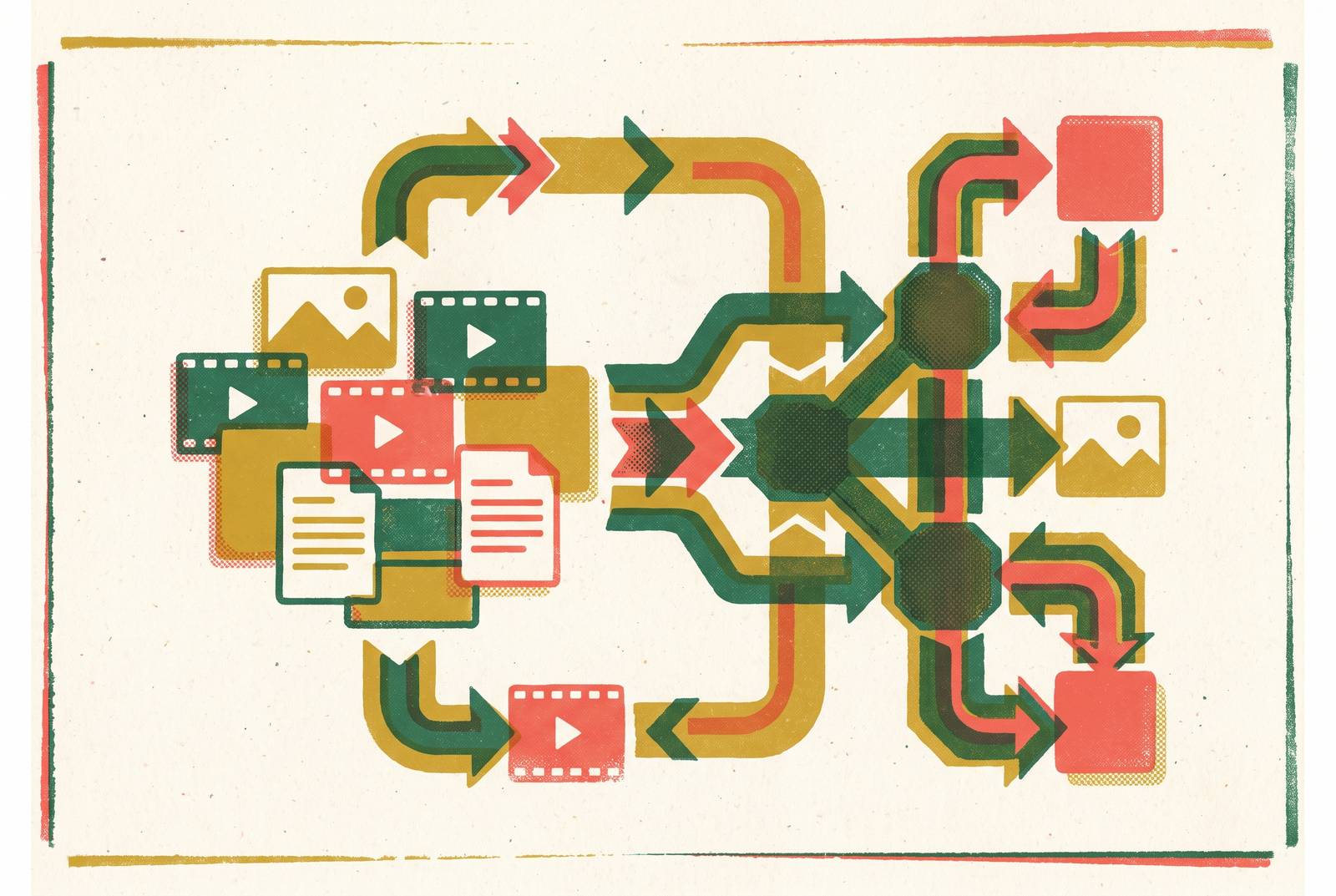
A campaign's primary visual receives sign-off in Photoshop on a Monday before landing in the DAM. One leader wants Wrike tags applied, and another requires a WordPress upload. Come Tuesday, four iterations of that identical visual float around, leaving no one certain which copy holds approval. A 2026 MediaValet report highlights this very situation to push back against prevailing assumptions in content operations, noting the file itself was never missing. Three individuals each grabbed that asset, gave it a new name, and pushed it into separate platforms since their tools never communicate.
That is how the dysfunction looks across content operations overall. The asset sits in one place, its metadata in another, and a third tool handles sign-off. Licensing and rights information lives in a fourth. Whenever an asset has to pass from one system to another, a person must reconstruct by hand the links that ought to have moved along with it all along, applying fresh tags, confirming who signed off, and re-checking whether it remains approved. MediaValet puts it in plain terms: the issue for most groups isn't the content itself, but the broken links between systems.
Whatever the scale, the pattern holds, whether the work is one campaign piece or its many localized offshoots. If the sanctioned source file can't be found, designers end up rebuilding the work from zero. Since licensing details for a picture live in a spreadsheet or one person's memory rather than on the file, teams hold up a launch or ship blind to what they may use. And local branches produce regional versions that stray unnoticed from the sanctioned original, since no governed handoff carries updates downstream. The problem isn’t storage failures, because the files are already there. What’s absent is the framework enabling those files to carry their rights status, metadata, and approval state wherever they go.
Most teams bridge that divide with human effort masquerading as workflow: pulling a file from one system, renaming it locally, pushing it to the next destination, then manually re-entering whatever contextual details they can recall or piece together. MediaValet's findings confirm this pattern through an insight worth reconsidering when diagnosing workflow friction: teams identify human transfers between systems as their primary content operations hurdle, surpassing even automation shortfalls, metadata inconsistencies, governance breakdowns, and reluctance to adopt new tools. Content quantity isn't the problem. What's missing is the connective tissue among the platforms that handle this material.
What modern content operations require from a DAM
Treating the integration of content as a problem of coordination, not storage, means rethinking what the word "content" signifies in day-to-day operations. A file sitting alone in a folder cannot be used as an asset. MediaValet's report puts it almost like an equation, defining Content as Asset plus Metadata, Context, Rights, Expiry and Usage Rules combined. Should even one of those pieces be absent, the file cannot function at scale, however strong the image or video might be on its own. Metadata that exists but fails to follow the asset into the next system is functionally no different from metadata nobody ever created.
The report’s term "activated content" describes a file that bundles those pieces so it can pass from one system to another ready to use, preserving its metadata and rights information and automatically launching the appropriate downstream process at each lifecycle stage. That is a much higher standard than the one most DAM deployments were created to satisfy, and it helps explain the friction teams now feel from decade-old platforms aimed at basic storage and retrieval.
In its 2026 guide for enterprise buyers, Orange Logic names six elements a modern DAM must handle together rather than one by one: applied AI, integrations, rights and permissions controls, workflows, metadata, and digital assets. Because they lean on each other, doing any one of them poorly weakens the other five. A system with deep metadata but shallow integrations still leaves teams re-keying data by hand every time an asset moves out of the system. A system that automates workflows well yet governs rights poorly can still approve and share an asset whose license has already run out. Older systems were built around fixed metadata models and basic step-by-step approval chains, and their thin integrations assumed only a few users and a few file types. Once an organization is handling content across many regions, many channels, and many formats at the same time, those assumptions fall apart.
A few clear pressures are causing this change. With distribution outlets multiplying, each now demands a uniquely tailored creative file built to distinct specifications. Personalization pushes campaigns to use far more versions of each asset for every audience segment than teams had to produce half a decade ago. Obligations governing intellectual property, usage permissions, and data practices have tightened rather than relaxed. Meanwhile, staffing levels across the majority of marketing and creative operations groups fall far short of what production volumes require. According to MediaValet's report, the combined weight of those four pressures is why companies are shifting beyond content management into what it terms content activation.
Aprimo's workflow guide states the core idea in plain terms: a proper DAM process connects both sides of the organization to one shared version of the truth, instead of sitting on the shelf as a place people skip because logging in costs more time than it saves. What separates a DAM that people rely on as infrastructure from one that turns into an unused storage drawer is whether work is routed through it or around it. Orange Logic's 2026 guide frames the change in precisely that way: content orchestration is the modern DAM's job, stitching together every workflow that carries an asset from its creation through its reuse, delivery, long-term storage, and compliance review. Storage, in other words, was never what made DAM hard. Keeping every downstream system aligned to one governed source of truth is what actually makes DAM hard.
The full content lifecycle a DAM workflow must cover
Orchestration only matters if it spans every phase of an asset's existence. Bringing a DAM into the creation workflow ensures continuity at each step, preventing tasks from scattering among disconnected platforms lacking any common history.
The lifecycle stays connected or begins to leak at intake. As creative teams send assets into the DAM, they need metadata fixed to them during ingestion rather than tacked on later from a hazy memory of the campaign's purpose. For this stage, Aprimo frames machine-created metadata as an essential workflow capability: machine learning can inspect images, extract wording from video, and produce useful tags and descriptions, taking a job that once used real staff time when people did it by hand. Smarter recognition adds another layer, detecting people, items, written copy, and brand cues in each incoming asset so compliance concerns surface early, ahead of any human review.
In practice, review and approval is where coordination failures pile up. When teams rely on email to route sign-offs, reviewers often edit outdated drafts while the history of each authorization gets buried in unsearchable message threads. As Aprimo's collaboration guide explains, native DAM features enable reviewers to annotate and authorize assets in place, eliminating reliance on inbox chains while keeping each item's status transparent. The system logs every modification, preserves prior drafts rather than replacing them, and lets local groups derive regional variants from the sanctioned source while documenting who altered what. Automated workflows triggered by the item's category, initiative, or geography ensure materials requiring legal clearance land in the proper queue without relying on human memory.
Compliance and rights checks work best when the workflow includes them as a formal stage, not when someone reviews them only after an asset is already set to publish. That is why the guide from Orange Logic's names rights validation as a lifecycle stage. If teams handle sign-off, asset data, and usage permissions in separate tracks, enterprise content operations feel the drag most in high-volume, multi-region publishing on tight deadlines.
Integration depth becomes most apparent during Distribution and reuse, since assets must reach their intended outlets fully authorized and properly formatted. Enabling teams to locate assets instantly instead of rebuilding them for each campaign fundamentally alters production economics. According to Orange Logic's guide, repurposing materials ranks among the most powerful indicators of mature workflows, proving a DAM functions at true enterprise capacity instead of serving as a costly digital archive.
The architectural distinction between automation and orchestration
In DAM marketing, teams often blur automation with orchestration, but the distinction matters because mixing them up creates systems that seem connected at first yet still fail where the parts meet. Automation takes care of individual actions, such as moving an asset into a queue, alerting someone before a deadline, or adapting an image for another channel. Orchestration instead links the workflow end to end, letting metadata, permissions, governance rules, integrations, rights status, and distribution continually shape one another rather than run as isolated processes.
This distinction becomes most important when AI is brought into the workflow. Before an AI agent can decide reliably about a given asset, it must have the asset's approval state, rights eligibility, and distribution rules together in one view. Without that fuller picture, the system cannot act on any asset with confidence, since it cannot tell if the file before it has been approved for release or is still stuck in legal review. Only when it runs within a governed framework that hands it permissions, approvals, rights data, and distribution eligibility all at once does an agent that routes assets unaided, auto-fills metadata, or kicks off localization become genuinely useful. That governed backdrop is what makes an AI's call auditable instead of arbitrary.
Aprimo's workflow guide points to predictive workflow optimization as a concrete case where orchestration achieves what automation by itself cannot. By mining past workflow records, AI can forecast likely choke points, recommend the fastest approval route for any given asset, and flag reuse openings that a human reviewer could overlook. Isolated task logs can't support any of that. The foundation it needs is data that is structured and connected across the entire lifecycle, something orchestration delivers but task-level automation never does.
The same distinction shows up in how companies lay out their day-to-day work. A process-based design that hands each step to a department tends to clog up the pipeline, since the asset sits idle through every hand-off until the next team releases it, even when the work itself is already done. Design around the readiness conditions an asset must satisfy in order to move forward, and the work starts flowing at real speed. Orange Logic's guide lays out the contrast without hedging: organizations that structure workflows around readiness conditions bring down approval cycle times, raise governance compliance, and pull more reuse out of existing content, against those that only optimize for which department owns each step.
Which integrations make the DAM the connective layer
Orchestration starts as a design choice, but it works in practice only when the DAM sits inside the systems people already use, not off to the side as another place they have to send work. When the DAM asks the rest of the workflow to bend around it, day-to-day users will still choose the fastest workaround over coordinated control.
Adobe Creative Cloud, Figma, and similar creative tools form the starting point of this pipeline. Designers who can pull approved assets right inside their design workspace stop digging through local folders, desktop caches, or last campaign's files, which is what creates the version chaos from MediaValet's Tuesday example. Aprimo's collaboration guide observes that generative AI fills in metadata fields right inside the design workspace, capturing enrichment when an asset is born instead of attempting to rebuild it later.
At the distribution end sit CMS platforms like WordPress and Drupal. When web teams push content straight out of the DAM's approved assets instead of hunting down copies on their own machines and uploading them manually, rights compliance and version control kick in at the moment of publication, not after the content has gone live. On the same theme, Aprimo's guide argues that integration has to run deep: a DAM needs real connections to CMS platforms, to systems that manage product information, and to creative suites before it can genuinely shape the customer's view and experience. If an integration passes along nothing but a thumbnail, with no metadata or rights status riding along, the governance gap remains open. It merely shifts the problem to a place where it is less visible.
Sales and CRM tools apply the same controls to client-ready content that DAM plans often miss. A rep who adds vetted imagery to a pitch document or slide deck is still putting the asset into circulation, creating versioning and compliance risk on par with a public rollout, even when the exchange is limited to one customer. Downplaying that scenario lets obsolete assets and lapsed licenses reach the very customers where a mistake would cost the brand most.
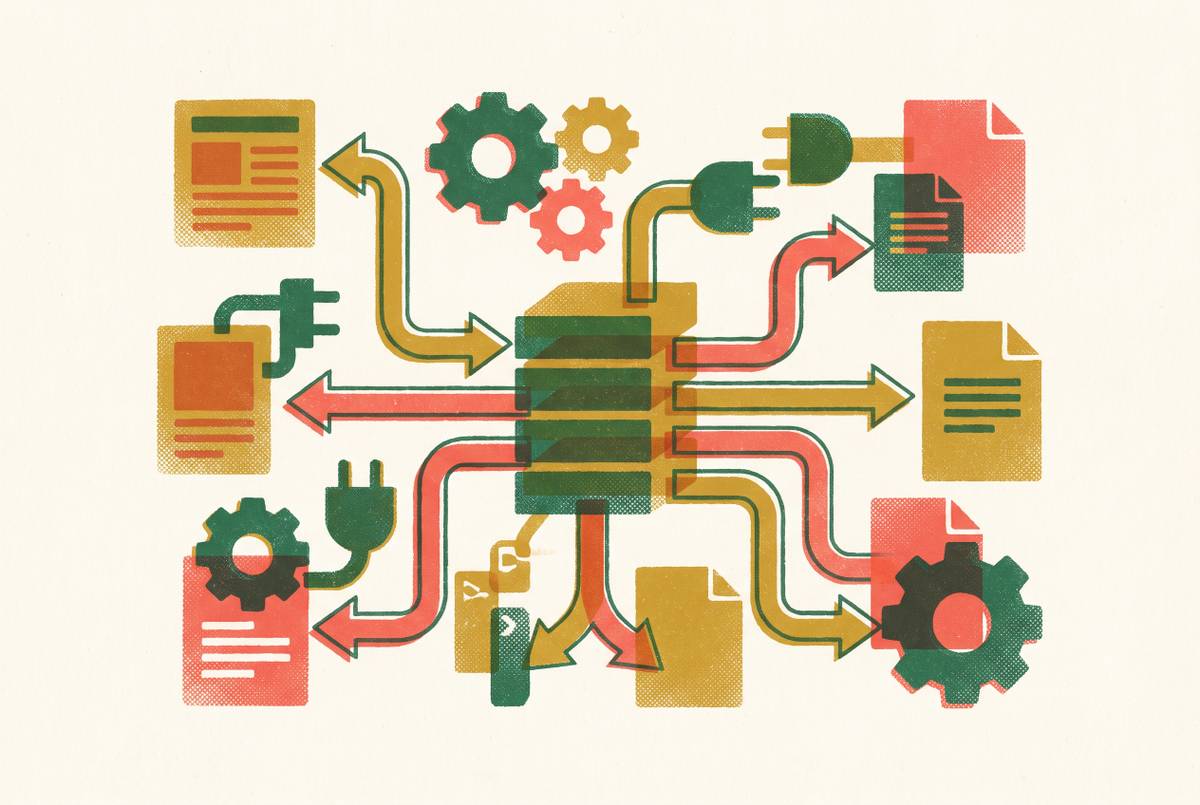
Automation for marketing and planning platforms for projects or campaigns occupy this pipeline’s center, as teams connect assets to specific campaigns, monitor timing, and pass them along before they arrive in a design tool or enter a CMS. These integration points do not work separately from one another. Their importance mirrors orchestration’s architectural role: as an asset travels within these tools, the descriptive data, sign-off state, and usage permissions tied to it stay attached rather than being lost when it enters another system.