Content Localization Workflow for Multi-Market Campaigns
Restructure campaign planning to embed localization from day one, not as an afterthought.

The English campaign launches on time. Two weeks on, multiple regional-language versions remain awaiting approval, leaving the marketing lead to explain to executives why so many markets were absent on launch day. The problem starts with sequence: campaign planning locks the source in one language first, then brings in localization teams afterward for follow-on execution once the main work is treated as complete. Under that handoff model, localization becomes last-mile execution instead of being embedded in campaign planning from the outset.
The cost of this model's appears as a recurring constraint that manifests in each operational iteration. Each market must pause for headquarters-approved source content prior to initiating its own localization efforts, meaning upstream holdups amplify downstream, leaving the regions most distant from headquarters bearing the greatest exposure. Adobe's localization scaling guide identifies the true bottleneck: coordinating stakeholders rather than technological limitations. Headquarters constructs campaigns centered on particular brand standards, regional offices require flexibility to modify those campaigns for local audiences, and lacking a defined process linking them, outcomes range from generic global content falling flat universally to off-brand regional efforts headquarters must retract.
An Adobe blog’s retirement-product example makes the stakes plain. One market needs the retirement product framed around safety and steadiness; another needs it framed around what a family leaves behind. They speak to separate emotional worlds, not a shared concept in alternate wording, so late polish on one English master cannot deliver both before the sprint closes. That market-specific work needs to be treated as a creative challenge on day one, or one of the two audiences ends up with a campaign made for someone else.
What localization requires beyond translation
Treating localization as mere translation ignores its true nature as a structural design challenge. Because creative materials, distribution choices, legal requirements, and cultural fit all intersect here, upgrading translation speed or precision addresses just a single piece of that four-part puzzle. Neglecting those remaining dimensions means campaigns achieve linguistic accuracy while failing in practice.
Transcreation occupies the outermost point of this spectrum, bearing almost no relation to converting words between languages. Instead, it crafts entirely new material to carry the core purpose and emotional resonance into a different cultural setting. Adobe's localization guide highlights Intel's Brazil campaign as the clearest case: the "sponsor" slogan lost its meaning when rendered word-for-word in Portuguese, prompting Intel to completely rework it as "Apaixonados pelo Futuro," which translates to "In Love with the Future." The concept needed recreation, not conversion.
Creative assets face a similar challenge in another guise. Visuals, typography, and color palettes often hold political or cultural significance in one region that carries no meaning in another, and an image that seems harmless at home may appear deeply insulting abroad. The selection of distribution channels adds another layer of difficulty: ActiveCampaign's guide to localized marketing observes that certain markets favor SMS, others in-app messaging or email, meaning that sending carefully tailored material via a uniform worldwide distribution strategy risks sabotaging all that tailoring work prior to anyone encountering it.
This is not a spectrum. Technical documentation may only require accurate translation, while a brand campaign seeking to evoke emotion demands full transcreation, complete with a dedicated creative brief, asset review, and channel plan. Each follows its own workflow and its own checks, and none of those four areas, namely creative assets, channels, compliance, and cultural resonance, can be attached to a finished source asset. Instead, they must be built in from the outset, and that necessity is precisely why the workflow itself needs restructuring.
The global brand framework that makes localization possible at scale
To localize effectively across many markets, establish a solid global base before teams begin tailoring work for individual regions. Otherwise, local teams either create off-brand work or pause every step to get headquarters approval, bringing back the very bottleneck the workflow was designed to remove.
Think of the global framework like a core software platform. The brand's purpose, tone, look, structural guidelines, key themes, and market placement never shift from one territory to another. Localization then functions as a collection of regional add-ons running on that foundation, instead of requiring each territory to begin from scratch. As DropSure noted in its 2026 multi-market campaigns guide, this structure must balance a key risk: excessive headquarters oversight yields messaging that alienates regional buyers, yet granting regions unchecked freedom splinters the brand until it becomes unrecognizable worldwide. This structure navigates a path through both extremes.
The nonnegotiables are the logo set, type system, visual identity as a whole, foundational brand principles, and baseline product-quality requirements. Keeping those elements steady helps audiences recognize the brand worldwide. Market teams can adapt the local-language message, culture-specific cues, currency presentation, regional imagery, tailored promotions, and the way they communicate on each platform. Teams apply that split day to day through a style guide for each market, where regional editors see which choices are flexible and which are locked. Without that document, regional teams rely on local instincts, letting mismatches accumulate across markets unnoticed until an audit flags the brand. Slate outlines the foundational infrastructure supporting these efforts, offering templating and creation utilities so marketers can rapidly deliver localized, brand-consistent output rather than starting from zero in each new territory. That framework grants local groups the agility and autonomy they need.
Restructuring the workflow so localization runs in parallel, not after
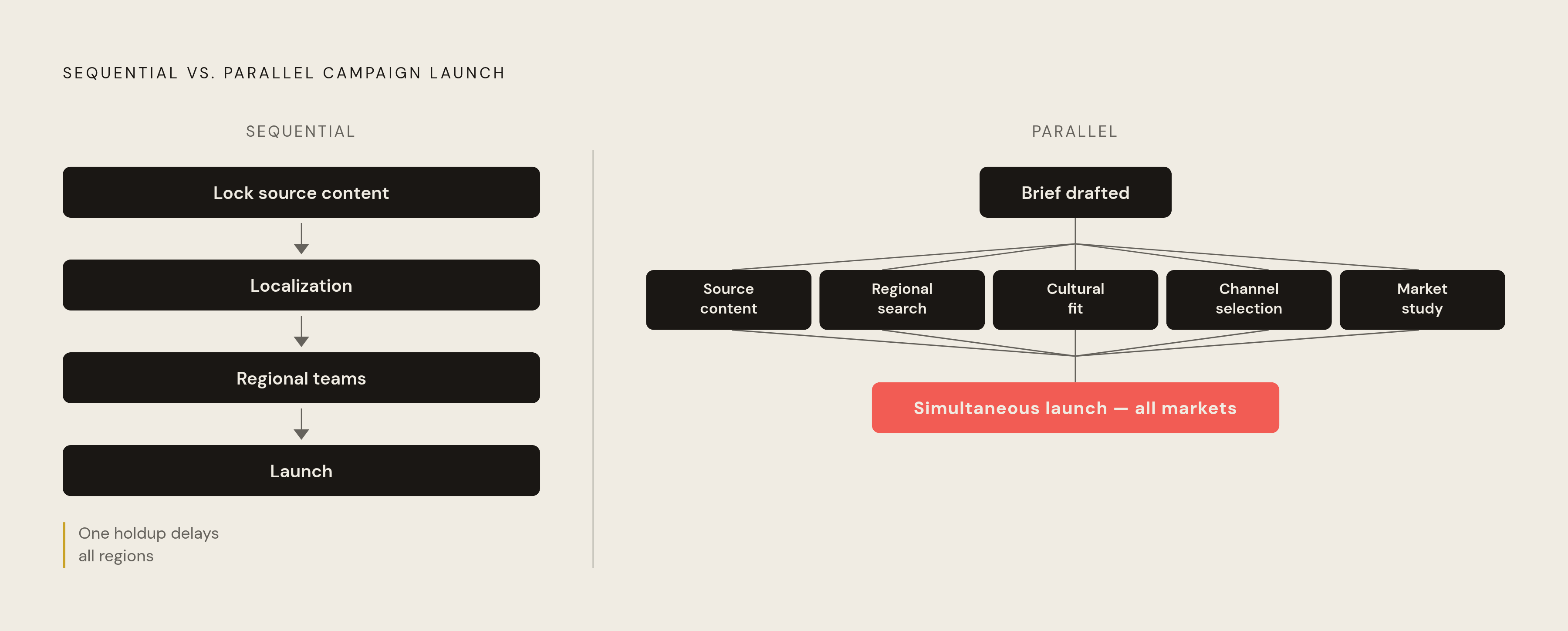
A redesign of the workflow itself puts localization teams into campaign planning ahead of source content getting finalized, not after.
In the sequential model, work moves only one way: teams lock the source content first, pass it through localization next, route it on to regional teams after that, and only then launch. It leaves markets queued behind prior handoffs, so one holdup earlier in the flow can postpone all later launches, even when a local team is otherwise prepared.
In a parallel approach, localization planning begins when the brief is drafted. Rather than waiting for source materials to be finished, teams simultaneously investigate regional search terms, evaluate cultural fit, choose distribution outlets, and study the market. ActiveCampaign's localized marketing guide notes that this phase opens by leveraging purchase records and CRM insights to rank and group regional audiences, then moves on to recording cultural norms per territory, flagging legal limits and local holidays, polling buyers, monitoring social channels, and drafting a compliance checklist. Such work demands localization specialists during strategy sessions rather than scrambling near the deadline.
Putting that principle into practice calls for a few specific changes. Bring a localization manager into the first campaign-brief conversations, giving that role a planning voice instead of treating it as a late-stage review after assets are drafted. Develop market-specific briefs alongside the global version, letting regional teams begin adaptation as soon as source files are approved instead of pausing for an official handoff. Before production begins, teams need to classify assets by whether they call for translation, localization, or full transcreation, since early routing choices prevent slowdowns later in production. Adobe says machine learning can assist with this triage: natural language processing may catch culturally sensitive phrasing that could endanger the brand, while computer vision reviews whether visuals fit each region. But the technology delivers value only when teams embed content categorization early in the workflow instead of applying it after assets are complete.
Parallel market execution creates a practical operational hazard: version control. With several local teams reshaping one campaign simultaneously, every added market raises the odds of releasing the wrong draft, asset, or version. The fix is centralizing asset management, which stabilizes parallel execution before it turns chaotic and sets up the issue addressed by AI in the next section.
Where AI fits in a localization pipeline
AI orchestration is what lets a multi-market, parallel workflow function at scale, but only if the pipeline sorts content by risk instead of pushing it all through one engine on a single setting.
This is where AI orchestration truly parts ways with machine translation. Machine translation converts text into another language and does nothing more. Orchestration instead runs the entire process surrounding it: translation with AI support, consistent terminology, quality checks, gates for human review, and publishing, kept in step across many markets simultaneously. A campaign spanning 12 languages calls for the latter rather than the former.
A few AI capabilities let teams translate, review, and publish simultaneously for every market. By processing massive amounts of text almost instantly, machine translation lets teams launch campaigns everywhere at once rather than trickling them out market by market. NLP evaluates register, voice, and regional subtleties, surfacing cultural issues for human review prior to release. As AI models absorb a company's unique vocabulary and voice, output uniformity steadily improves, reducing the edits reviewers must handle. LocalizeJS's guide illustrates the real-world workflow: material flagged for translation is automatically routed into a machine learning engine and queued for human review. That is how the pipeline delivers quality.
That pipeline still relies on irreplaceable human expertise at several points. Linguists compile and maintain the terminology databases powering these engines, ensuring accuracy for specialized fields and individual brands through effort no software can replicate. They also verify machine-generated text against brand rules plus regulatory requirements, a step proving vital for healthcare messaging, legal filings, and high-risk promotional campaigns, since errors there create liabilities beyond what any automation budget covers. Welocalize illustrates this with Mouser Electronics, whose jointly developed multilingual campaign workflow using AI accelerated localization and shortened launch timelines while keeping human oversight embedded throughout instead of eliminating it. According to ActiveCampaign's guide, local experts should examine every creative asset prior to going live whenever feasible. While AI speeds up content generation, the final quality gate still depends on local expert judgment.
The principle is simple: automation takes on bulk and pace, human review takes on brand risk plus cultural judgment, and neither role fights the other once routing logic directs each piece of content correctly.
How localization decisions now determine AI visibility by market
Deciding which content to adapt, along with the process managing that adaptation, determines a brand's presence within AI-generated answers across any specific market. So the localization workflow is really a matter of brand visibility, not just production.
AI answer engines are turning into the first place shoppers across global markets discover products, and visibility in one language does not automatically transfer to another. A company that dominates English-language AI responses may be completely invisible in Portuguese, Japanese, or Arabic ones, since every language operates through a distinct citation framework.
That architecture has to be built separately in each market. AI systems in each language pull primarily from localized Wikipedia entities, presence on region-specific review platforms, and participation in local community forums. Owned material such as blog entries, landing pages, and product documentation grounds the citation base, yet it is digital PR, review-site visibility, and publisher ties in each language that ultimately secure mentions inside the answers these systems produce.
Winning citation share does not make it permanent. AI systems continually shift which sources they surface to keep answers varied, current, and comprehensive, meaning visibility earned in one answer can vanish by the next. That instability makes localized publishing a continuous upkeep obligation instead of a one-time launch milestone. Citation slots and competitive intensity differ across markets and languages: a brand dominant in English may be nearly invisible where local AI platforms and publishers shape responses.
In-language blog content, reshaped for local norms and referencing nearby happenings or nationally known people in the brand’s field, strengthens the market’s citation network. This is how localization turns into market-specific material that AI systems can recognize and connect back to the brand.
Running the restructured workflow in practice: sequence, roles, and checkpoints
Running localization in parallel calls for a defined order of steps, owners for each, and gates that control the transitions. Lacking this framework, the redesign remains a slide-deck intention instead of an operational reality.
The process opens by studying each regional market and dividing its audiences in time to steer the campaign, not answer it after the fact. Next, teams establish the worldwide brand system and local market style guides, giving all later choices a shared reference. The campaign brief takes shape with a localization manager involved at the outset, instead of being added once the creative direction is already fixed. Teams prepare the market-specific creative briefs alongside the global one, instead of holding off until it is done. Teams classify each asset as localization, transcreation, or translation ahead of production, so routing calls are settled early rather than improvised on the fly later. From there, the AI pipeline handles every category differently, embedding human oversight wherever brand and compliance stakes run highest instead of tacking it on as a final step. The run ends by launching all regions at once, the very goal of reworking the process from the start: every market moving together, not held back waiting for the English version.
That sequence only holds together when responsibilities are defined before the coordination burden starts to pull it apart. From the initial brief, the localization manager steers the work, connecting global brand standards with regional adaptation needs and keeping each market from splintering the shared framework. With that structure in place, localization becomes less a failure point for multi-market campaigns than the point at which they are designed to work across all markets, beyond the original launch market.
Sources
- The Ultimate Guide to Localized Marketing in 2026
- Scaling content localization without sacrificing quality
- Multilingual and Multi-Market Campaigns: How to Balance Global Strategy with Localized Creative Content - DropSure - Make Dropshipping Sure
- Global Content Marketing: Strategy, Localization, and Execution at Scale
- How to Build a Localized Marketing Strategy
- AI-Driven Localization: Transform Multilingual Marketing Workflows