Integrating CMS and Marketing Automation for Content Personalization
Connecting your CMS and marketing automation unlocks behavior-driven personalization at scale.

When CMS data is missing, marketing automation amounts to a calendar for email sends; when platform signals do not reach the CMS, it becomes a rigid publishing layer that treats every visitor alike no matter their identity or past actions. It can report opens and pace outbound emails, yet remains blind to on-site behavior. A CMS can render polished pages, but it cannot read a visitor’s stage in the buying journey, their segment, or the next best action. Contact details stay siloed in separate systems, leaving the company without one person who can understand a lead’s full story.
Teams doing B2B marketing tend to assume a platform is at fault here, and that buying the next tool will fix it. That belief rarely survives scrutiny, since the stack succeeds or falls apart on how well its pieces are integrated. Even with a well-chosen CMS and automation platform, a team can watch a lead arrive via the website, sit in marketing automation, never make it into the CRM, then exit analytics with no record of the campaign behind it. Nothing was wrong with the tools; the connection between them just wasn't there. The practical work is building a data layer that moves behavior from the CMS into marketing automation, returns decisions the opposite way, and that layer is what everything ahead covers.
The data layer between CMS and MA
In practical terms, a CMS connects to a marketing automation platform through a JavaScript tracking layer on the site, which relays behavioral events to that system as they happen. That layer is the basic plumbing behind everything that comes later. Without it, the rest of this piece has no raw material for behavior-triggered workflows, changing content, or personalization powered by AI.
From the CMS, marketing automation needs a defined set of signals: page visits, form submissions, content downloads, time on page, and repeat visits. Embedded in each CMS page, a tracking script triggers the moment one of those actions occurs, sending an event straight to the automation platform so the contact's profile within the database grows with every new signal. Instead of a flat "subscribed"/"unsubscribed" label, every visitor is now a profile that stacks up product-page visits, a whitepaper pull, and minutes spent weighing options on a comparison page.
Without this layer, marketing automation workflows run using nothing but email opens, the weakest signal available. The strongest one, someone actually visiting the site, never reaches the system at all. As Code and Peddle demonstrate when examining connected setups, the CMS logs a pricing page visit, which raises a lead score inside marketing automation and subsequently fires a sales alert in the CRM. Every tool handles its own task and passes the result straight to the next system.
Even though this layer is foundational, it remains the most consistently underdeveloped component of the entire stack. A team might invest weeks polishing email workflows while the connection between site and MA stays largely unchecked. The typical breakdown is that form fills are captured since they're simple to instrument, while page depth and returning visitor behavior fail to pass through. Visitors showing strong interest through extensive browsing, yet never submitting a form, remain unseen by downstream workflows, so lead scoring reflects an incomplete picture.
Turning CMS behavior signals into MA trigger workflows
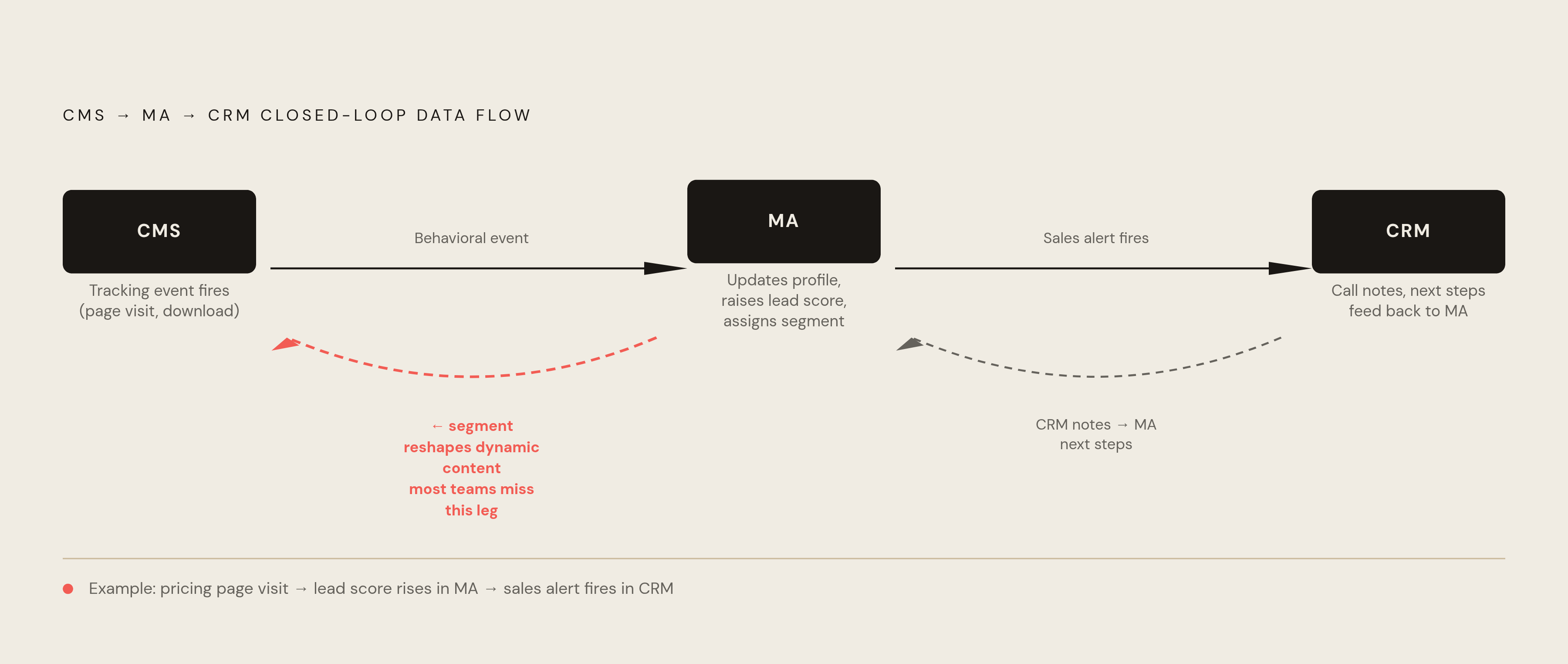
Once behavioral data from the CMS starts reaching the system that automates marketing, messaging changes structurally. Now Workflows can respond to a contact's real behavior, not just the static list they were assigned to when imported. Take a segmented blast: it asks one question, who belongs on this list? Every member receives an identical message at an identical time, no matter their actions a day or five minutes earlier. A trigger workflow poses an entirely different question, one about the event that just occurred. Its reply is a message tailored to whatever just happened.
Watch the mechanics. On If someone grabs a third download on one topic, the system enrolls them in a nurture track tailored to that subject rather than a one-size-fits-all message. When someone lingers unusually long on a single page, the system raises their lead score a tier, which shifts how sales ranks the account. No one has to sort contacts into fresh lists by hand. The behavior sorts contacts into segments on its own, the instant it happens.
The CMS uses dynamic content to close the loop. When marketing automation assigns someone to a segment, that status returns to the CMS to shape the page experience for a recognized repeat visitor. When marketing automation places a three-download contact from one category at the mid-funnel stage for a specific industry, the homepage can show status-aware messaging instead of the standard experience for an unknown new visitor. A circuit like this, where behavioral events leave the CMS and content choices return there, turns personalization into something deeper than changing an email subject line. Looking at the CRM end, the integration analysis by Code & Peddle shows the loop again: after-call sales notes guide subsequent marketing automation steps, with each platform completing its role before handing the outcome neatly onward.
How modern CMS architecture affects this integration
The amount a team can assemble without writing custom code depends entirely on the underlying CMS structure supporting an integration. Whether a system uses traditional coupled platforms or headless and hybrid ones, the distinct interfaces each offers for tracking events and serving dynamic content dictate the overall schedule.
In tightly integrated CMS setups such as WordPress or Drupal, marketing automation trackers are commonly added by plugins, while dynamic content delivery depends on plugin-level customization or external scripts placed above the core system. Teams can still personalize experiences, but in practice they usually add material to a page already in place instead of reshaping the underlying content model. Ingeniux's 2026 CMS roundup says WordPress offers minimal built-in handling for modeled content and headless publishing, a real concern because automation tools rely on queryable structure to fill dynamic content blocks.
Sanity, Storyblok, and Contentful are among the headless and hybrid platforms that serve content via an API instead of a rendered page, letting marketing automation tools pull straight from the content model for dynamic delivery keyed to segment attributes with far greater precision. The front end handles the rendering, and it ends up housing the personalization logic as well. Enterprise digital experience platforms ship with personalization and their marketing automation hooks built in natively rather than tacked on afterward, though that brings greater implementation complexity and a steeper price. A 2026 CMS guide assigns a top digital experience management platform to this group precisely because the product is defined by personalization built in natively plus experimentation and optimization out of the box. A 2026 CMS comparison ranks a top combined content plus marketing platform first for teams whose priority is business integrations, citing automation, CRM, and personalization bundled natively together, which is relevant here because the integration challenge this piece keeps describing gets much smaller once the CMS and marketing automation already operate on a shared data model.
The market itself is moving toward resolving this at the platform level rather than the integration level. Salesforce's acquisition of Contentful in September 2026 signals the industry folding CMS and CRM together into a single owned system rather than leaving teams to build and maintain the connection themselves. When CRM and CMS merge at the platform level, the behavioral event layer becomes something internal to one vendor's system rather than something stitched across two. That reduces the surface area where integration can fail, but it raises the cost of ever switching off that platform later.
Where AI fits into the CMS-MA stack
Native AI features inside the CMS change what behavioral data can do, though only when the data layer linking CMS and MA beneath them already works. AI strengthens a stack whose pieces already link up, yet it cannot save one whose CMS and marketing automation never communicated to begin with.
When the data layer in a stack is working, AI brings three capabilities. Predictive selection looks at how comparable contacts acted in the past to find the content block with the highest statistical chance of converting a given person. Auto-generated tags and metadata help the CMS surface the right dynamic block whenever marketing automation requests one. Personalization also reaches a depth of audience specificity that hand-crafted rules cannot feasibly sustain. The guide to AI CMS from Acquia explains the mechanics behind this: machine learning models forecast which material resonates best with each visitor, enabling tailored suggestions and focused communications through native split testing, behavioral tracking, and segmentation tools that require no custom code.
What matters more than what AI changes is what it doesn't. The model still requires behavioral event data moving from the CMS to marketing automation as its foundation. If that feed isn't there, the model has nothing to work with, no matter how advanced the algorithm is.
Launched in January 2026 on Mastra, Sanity's Content Agent holds each AI recommendation as a draft requiring human sign-off prior to advancement. Contentful likewise funnels mass AI edits past a review screen prior to live CMS publication. With CoreMedia KIO, editors must sign off on each AI proposal since fully automated publishing is never allowed, routing those checks along the same path as human-authored material.
Three vendors arriving at the same pattern is no incidental caution. Human oversight at each significant checkpoint is what keeps AI-driven personalization distinct from the danger of machine-made material going unmonitored. Acquia's AI CMS guide spells out the principle: AI should act as a strategic helper, not a stand-in, since strategic oversight, human creativity, and brand voice are what make the system work at all.
Measuring whether the integration is producing personalized experiences
From the outside, an integration with no measurement looks no different from one that fails. CMS behavior sent to marketing automation, plus the returning content choices, should be tracked separately to prove that personalization is really happening and that visitors are actually converting.
When measuring traffic from the CMS toward MA, focus on event capture rate, or what share of meaningful page interactions actually land in marketing automation; how lead score distribution changes once the integration is live; plus workflow trigger counts split out by event type. Tracking the reverse flow requires monitoring segment-level variant delivery, comparing engagement across tailored versus generic content versions, and measuring downstream conversion per content block. To complete the feedback cycle, marketing automation attribution data must feed the analytics layer, tying content spend to pipeline rather than halting at engagement metrics. According to Code & Peddle, B2B firms must master three integration categories, including analytics for revenue reporting and attribution.
A further measurement question now sits above the CMS-MA stack, one many teams still miss: whether its content is cited in ChatGPT, Claude, Gemini or Perplexity as part of the AI discovery layer that now precedes many website visits. Strong Google visibility does not guarantee presence in AI-generated responses, making this a separate kind of visibility that calls for dedicated content planning and measurement tools. Tools built for this purpose now sit outside classic SEO tracking: Profound, Mentionova, Ahrefs Brand Radar, Semrush's AI Visibility Toolkit and Otterly.AI report how often brands are cited or named in major AI engines.
Spotlight's 1.8-million-response study benchmarks how much per-engine variation a single aggregate score can paper over: for a given set of queries, a brand might surface in nearly every Claude answer while Google's AI Overviews mention it in under half of their responses to the same queries. One blended "AI visibility" figure wipes that spread out entirely, making engine-by-engine tracking a must rather than a bonus for any team counting on content to pull in early-stage search traffic. The content itself offers structural levers that influence citation: pieces built as tables, lists, or numbered walkthroughs get cited meaningfully more often than prose alone, and FAQ sections beat every other format tested, choices a CMS-MA stack is able to bake into production across the board.
Tools that monitor real activity across a website, triggering events and updating contact profiles as they happen, are central to bridging the divide in what teams can see. Letterstory, a platform that distributes material through its own properties while monitoring how audiences engage back through the automation system, exemplifies this tracking discipline applied to prospect evaluation and content effectiveness. The measurement framework outlined here, spanning how often events fire, how many triggers run, how variants convert, and citations from AI engines, provides the sole method for verifying the integration performs as intended.
Sources
- Top Content Management Systems for Websites in 2026
- 18 best CMS tools in 2026: tested, compared & ranked - Guideflow Blog
- The Complete Guide to AI Content Management Systems in 2026
- The 6 Best CMS Platforms to Power Your Marketing Strategy in 2026
- Integrating Marketing Automation with CRM, CMS, and Analytics Tools