When to Hire a CRO Agency vs Build the Capability In-House
The right structure depends on what's bottlenecking your testing, not just who executes it.
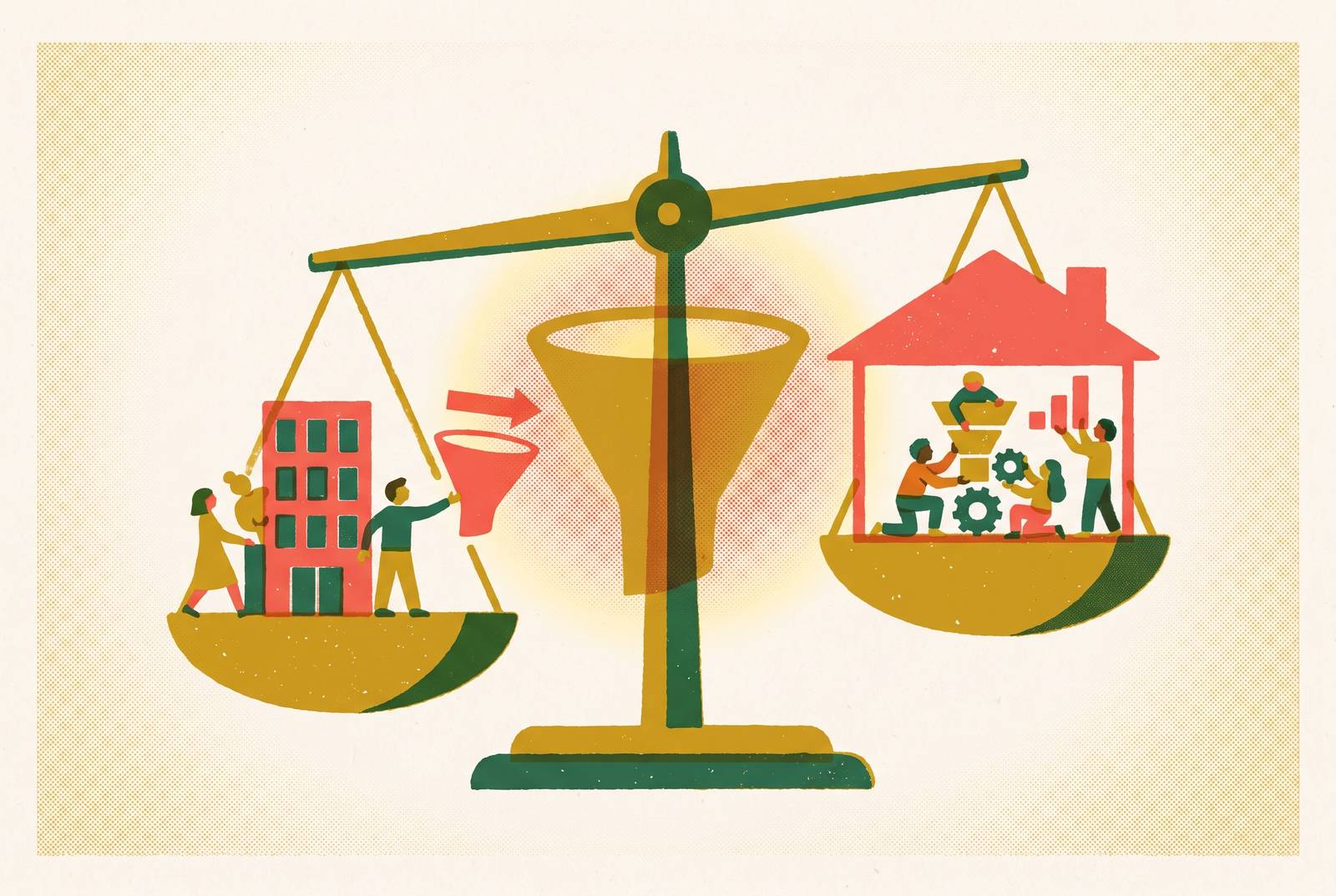
Choosing between a CRO agency and an in-house team is a decision about what is slowing experimentation down. The right structure removes that bottleneck at the company’s current stage, budget, and traffic volume, while giving the business ownership of what its experiments teach.
Why the agency-vs-in-house question is usually asked wrong
A team is six months into an agency relationship and still cannot ship a test without the agency. Is that a failed engagement? Not if the company hired the agency to run the tests. But if the company expected to build its own experimentation capability, the arrangement has left the central problem untouched.
That distinction changes the question from “Who will run the tests?” to “Who will own the strategy and learning?” Doing CRO and building a capability are different goals. An agency can deliver experiments for years without leaving the client able to prioritize, measure, or interpret them independently. The decision therefore starts with diagnosing what is missing, whether that is execution capacity, product knowledge, or someone who knows how to build a testing program.
What a serious CRO program actually requires across all three models
Modern CRO spans several kinds of work. User research, session recordings, behavioral analytics, heatmaps, and funnel analysis help explain where people struggle. Hypothesis prioritization uses that evidence to choose which questions to test. A/B and multivariate experiments test those questions, and technical implementation puts the winning variants to work. Each task needs its own skills, even when one person oversees them all.
The three main structures distribute those responsibilities differently. An agency supplies an external team for research, test design, development, and analysis, while the client provides context, access, and approvals. An in-house program places ownership with employees and needs CRO specialists with access to design, development, and analytics. A hybrid separates internal strategy and learning from selected external execution. Its internal requirement is a senior lead who can direct the work and integrate the results.
Three questions that determine which model fits before looking at cost
How deep into the product must experiments go? Landing pages, marketing sites, and sign-up flows can suit external execution without requiring deep knowledge of the core codebase. Checkout flows, in-app features, and product-led growth experiments need more context. Testing a homepage headline is different from improving an upgrade flow when the reasons users resist it are not yet understood. The closer the work sits to product decisions, the stronger the case for internal ownership.
Does traffic support statistically significant tests? Low traffic limits what quantitative experimentation can establish, regardless of who operates the testing platform. Paying an agency for inconclusive tests leaves the company with the same doubts and less money. Internal teams can instead use support tickets, sales calls, session recordings, and churned-user interviews to come up with stronger hypotheses. When traffic is low, in-house or freelance work is usually a better fit than an agency-led quantitative testing service.
Can the team build a program from scratch? Having encountered CRO at a previous employer is not the same as establishing prioritization frameworks, measurement protocols, and iteration cycles. Senior people who have built these systems can likely do so internally with suitable tools. Without that experience, an agency can supply the missing methodology. This filter separates a shortage of hands from a shortage of know-how.
What agencies actually deliver well, and what they structurally cannot
An agency’s distinctive advantage is pattern recognition across clients. Its team can draw on tests that have succeeded or failed in different contexts. A strategist, UX researcher, designer, developer, analyst, and copywriter can be available without separate hiring processes. Established workflows can shorten the time to bring the first test live from months to weeks. Visible early results can also help leadership support continued investment in experimentation.
Flexible agency spending allows a company to increase support around a launch and reduce it during quieter periods. However, an external team cannot quickly reproduce the product and customer knowledge employees accumulate through years of daily work. “Strategy” also needs a precise definition, because test prioritization is a narrower service than embedding experimentation into the company’s operating model.
Contracts also need to spell out who owns what. When testing accounts, analytics, and documentation belong to the agency, historical data can become inaccessible after the engagement ends. Require client-owned accounts and documentation from day one. Lucia van den Brink, founder of The Initial, describes the goal as “Our goal is to help internalize experimentation as a capability within the organization”. An engagement serving that goal needs a defined scope that includes momentum, a documented testing system, and a handoff.
What in-house CRO actually costs and what makes it worth it
An internal program costs more than one salary. A minimum viable team includes a senior full-time CRO Manager/Strategist, a half-time UX designer allocation, and a half-time front-end developer allocation. Testing licenses and analytics tools cost extra, and the amount depends on the platform, stack, and scale. Benefits, equipment, and other overhead add to base pay. Those commitments continue even when testing slows.
The investment earns its place through sustained demand. Running ten or more tests per month consistently is a useful signal that constant execution capacity may justify dedicated headcount. Deeply integrated SaaS experimentation strengthens that case because the work requires daily contact with product and engineering. The budget must cover the lead hire and everything else the program needs. The costs work out differently for a team that only tests marketing pages now and then.
With each experiment, the team learns more that stays within the company. Working together cuts out repeated briefing and external onboarding and keeps knowledge of customers and the product close to those making decisions. Yet the program is still at risk when it depends on one person. Leave, recruitment by another employer, or burnout can stall the work. A hybrid arrangement or agency backup contract can reduce that single point of failure.
Where the freelance or consultant option actually fits in this decision
A senior freelancer is not simply a cheaper agency. This option fits an existing team that needs a specific skill or help building its experimentation capability. Freelancers typically serve fewer clients at once and can embed more deeply for the engagement, without layers of account management. That makes them useful for strategic guidance and internal upskilling.
The distinction between strategist and developer is decisive. A freelance strategist builds frameworks and improves how the team makes decisions, while an experiment developer builds and deploys tests within an existing program. Hiring one to solve the other’s problem leaves the gap open. Neither replaces a complete team where no supporting capacity exists, because one person cannot simultaneously lead strategy, design, development, and analysis.
The decision thresholds by company stage and revenue
The broad progression is agency, then hybrid, then in-house. An early-stage company in a lower revenue band may need an agency to establish methodology and supply execution it cannot yet staff. A growth-stage company can combine that momentum with an internal lead. At scale, sustained demand can support a dedicated team built on those foundations. These are relative stages with approximate revenue boundaries.
Product depth and traffic can override that progression. A lower-revenue B2B SaaS company that runs experiments deep within its product may already need to own that work in-house, while a larger DTC brand that tests mainly marketing surfaces may still be a good fit for an agency. When traffic is low, the team should start with internal qualitative research before hiring an agency. Conversely, a scaled business without program-building experience may still need agency help to establish methodology. Revenue indicates resources, but it does not diagnose the work.
The hybrid model in practice and what makes it work
For a hybrid to work, the internal lead must have the power to make decisions. An agency may initially run the program for the first year or more, build momentum, ship foundational wins, and document the testing system. The company then hires a senior lead to internalize learning. As internal capability develops, the agency moves into lighter advisory work or execution on demand. The transition has a defined point when the business no longer needs the agency to run the program.
Nominal ownership breaks that sequence before the handoff happens. If the lead has no say in decisions, the agency still makes every call, even when the organization chart says otherwise. Unclear responsibilities produce similar friction, while separate definitions of success make disagreements about results difficult to resolve. The practical requirement is a clean division in which the internal team owns strategy and prioritization and the agency executes agreed tests. Client-controlled tools, documented hypotheses and findings, and a shared reporting cadence make that division usable.
A twelve-month framework for building CRO capability regardless of starting model
For a team putting this choice into practice, the first three months should establish the foundation. Answer the diagnostic questions with evidence about experiment depth, traffic, and internal experience. Put tooling and documentation under client ownership from the first day. Use revenue impact as well as test win rate to decide what counts as a win. Before quantitative testing begins, use session recordings, support tickets, and customer interviews to base hypotheses on what people actually do.
Months four through nine should develop velocity and learning. Focus execution where the chosen model works best, with agencies on marketing surfaces and internal teams on deeper product work. Record each experiment’s result and what it teaches about users. Revisit fit as traffic and internal skills change. If an agency still has to participate in every test, assess whether that reflects a continuing capacity need or a handoff that has not happened.
Months ten through twelve are the capability assessment. Can the internal team prioritize experiments independently? Does documentation live inside the organization, and does experimentation influence product and business decisions? Use those answers to extend, restructure, or transition the arrangement. The first-year goal is ownership of the capability, even if selected execution remains external.
How AI content pipelines and answer-engine visibility fit into the CRO decision
Product pages, comparison content, and category pages serve human buyers, but AI answer engines also evaluate them when deciding which brands to cite. The CRO team often produces or approves that content. Persuasive copy does not automatically provide clean, verifiable statements that an AI system can extract. A conversion-focused agency may therefore leave a separate visibility gap.
Internal teams have an edge here because they know the product well. Answer-led pages, clear paragraphs, and verifiable data with citations make a citation more likely, and entity details that match across sources help keep that information trustworthy. Names, descriptions, founding years, and services need to match across the owned site, LinkedIn, and industry directories. Ranked best-of listicles are the most-cited format by volume in AI responses, although original-data studies and comparison pages earn higher per-page citation rates. The content that brings conversion traffic can therefore serve discovery as well.
For B2B SaaS and dev-tool teams, a consistent content pipeline can support both goals through owned properties and distribution to authoritative third-party publications. Measurement remains a separate responsibility from publishing. Tracking whether ChatGPT, Claude, Gemini, and Perplexity name and cite the brand needs instrumentation that most CRO agencies do not currently provide. Internal teams or measurement systems built for the task need to cover that gap, since conversion reporting alone cannot be assumed to do so.
Making the call with a practical decision checklist
The practical choice starts with the missing capability. Choose an agency when the team needs methodology, there is enough traffic for testing, and most of the work is on marketing surfaces where it helps to move quickly and scale support up or down. Choose in-house when deep product work requires daily context and sustained testing demand justifies the full fixed cost. If a supporting team already exists but lacks a strategist or builder, a freelancer can fill that narrower gap. A hybrid fits growth-stage companies that need external momentum while a senior internal lead takes ownership.
Before signing, ask what ends or changes the arrangement. A useful answer identifies when the company can run its own program, what support will remain, and who controls the accumulated learning. Without that transition point, capability-building can become dependency. The model that fits is determined by where the business is, what is slowing it down, and what kind of learning it needs to own. Not by which option sounds more serious.