Why Outsourcing Your Content Strategy Usually Backfires
Keeping strategy in-house while outsourcing execution protects what makes your brand trustworthy.

Most debates about outsourcing content start from the wrong question. Brands ask whether they should outsource content at all, when the real question is which layer of the work to hand off and which layer to keep. Execution is the production of content artifacts: blog posts, landing pages, email sequences, social copy, the tasks that can be specified in a brief, checked against a style guide, and delivered on a schedule. Strategy decides which topics a brand owns, which questions it is positioned to answer better than anyone else, and what institutional knowledge gets encoded into everything published under its name.
The hybrid model that took shape by 2026 reflects this distinction directly. Brands keep marketing strategy and brand positioning in-house while outsourcing planning, production, implementation, and reporting to an external partner, a split the industry itself now treats as standard practice. Content types built for handoff, blog posts, infographics, product descriptions, email campaigns, social copy, transfer cleanly because they are artifacts with definable specs.
Strategy resists that kind of handoff, since it is a set of ongoing judgments rather than a deliverable. It is a set of ongoing judgments about what the brand knows that nobody else does, and those judgments cannot be captured in a creative brief no matter how detailed. The confusion between the two layers is what makes outsourcing arrangements expensive in ways that only become visible later. A brand that hands over execution is usually getting what it paid for: faster production, lower headcount cost, broader coverage. A brand that unknowingly hands over strategy gives away control of whether anyone trusts what gets published, whether search engines and AI systems treat the brand as authoritative, and whether the content compounds into a durable asset or evaporates the moment the retainer ends.
Institutional knowledge is what agencies can't carry
Institutional knowledge is a specific, inventoriable body of material that marketing departments invoke to justify head count. It is a specific, inventoriable body of material: proprietary data collected from the brand's own customers, named subject-matter experts with real track records inside the company, the reasoning behind product decisions that were made for reasons no outsider observed, and the texture of a voice that comes from people who have actually built, sold, or supported what the brand sells.
Buyers now ask for this material outright rather than tolerating its absence. The research categories buyers consistently work through before a significant purchase, cost, known problems, competitive comparisons, reviews, and best-in-class options, all demand specific and honest answers that only come from insider knowledge. A generic answer to "what does this actually cost to run" or "what goes wrong with this in practice" reads as evasive, and buyers who sense evasion move to the competitor willing to answer directly. An outside team can research a market thoroughly and still never replicate the experience of having built, sold, or supported the product being described, and that gap is the one a buyer notices first.
The quality risks that follow from outsourcing this layer are structural rather than accidental. Agencies serving many accounts at once routinely staff junior writers on work sold at senior rates, simply because the economics of running an agency require spreading talent across a roster. Misalignment with brand voice and values tends to follow not from carelessness but from physical distance: the agency does not sit in the product meetings, does not hear the customer support calls, and has no way to absorb the small corrections that shape how a brand actually talks about itself. Time-zone and cultural gaps between brand and vendor add another layer of signal loss on top of that distance. None of this is a matter of hiring a better agency. It is a structural consequence of where the knowledge lives and who has access to it, and the longer that arrangement runs, the more institutional knowledge accumulates outside the brand's walls, making it progressively harder for the brand to reclaim what it never should have given up.
How AI answer engines changed content strategy's responsibilities
Content strategy used to be judged mainly by where pages ranked in search results. It is now judged by whether a brand gets named at all when an AI system answers a buyer's question, a different and considerably higher-stakes outcome. AI answer engines, including ChatGPT, Perplexity, Google AI Overviews, and Claude, now handle a significant share of top-of-funnel discovery, and a brand that never appears in those answers is invisible at the exact moment a buyer's shortlist takes shape.
Ranking well no longer guarantees inclusion in that shortlist. A page can hold the top organic position and still go entirely unmentioned in the AI answer that appears above it, because ranking and citation are different outcomes requiring different strategy. The practices built to address the citation side go by the names Generative Engine Optimization and Answer Engine Optimization, GEO and AEO, and both describe the work of structuring content and brand presence so that AI systems choose to cite and recommend the brand when generating an answer.
That work is overwhelmingly strategic rather than technical. It depends on positioning, on a coherent presence across the ecosystem the AI system draws from, and on brand authority accumulated over time, exactly the dimension that outsourcing arrangements sacrifice first when they compress the relationship down to deliverables and deadlines. GEO forces a convergence across PR, content, SEO, and product marketing, because an AI system forms its understanding of a brand from all four functions at once rather than from any single channel. An external agency, kept outside the internal conversations that happen in product meetings, PR strategy sessions, and executive planning, cannot execute that convergence no matter how skilled its writers are, because the access it would need simply does not exist inside the arrangement. Engines also do not behave alike: citation patterns differ meaningfully across them, and treating GEO as one uniform playbook rather than a set of engine-specific calibrations produces systematic underperformance, a judgment call that belongs inside the brand rather than embedded in a vendor's standard workflow.
The traffic-collapse pattern that emerges when AI-scaled agency content runs without strategic ownership
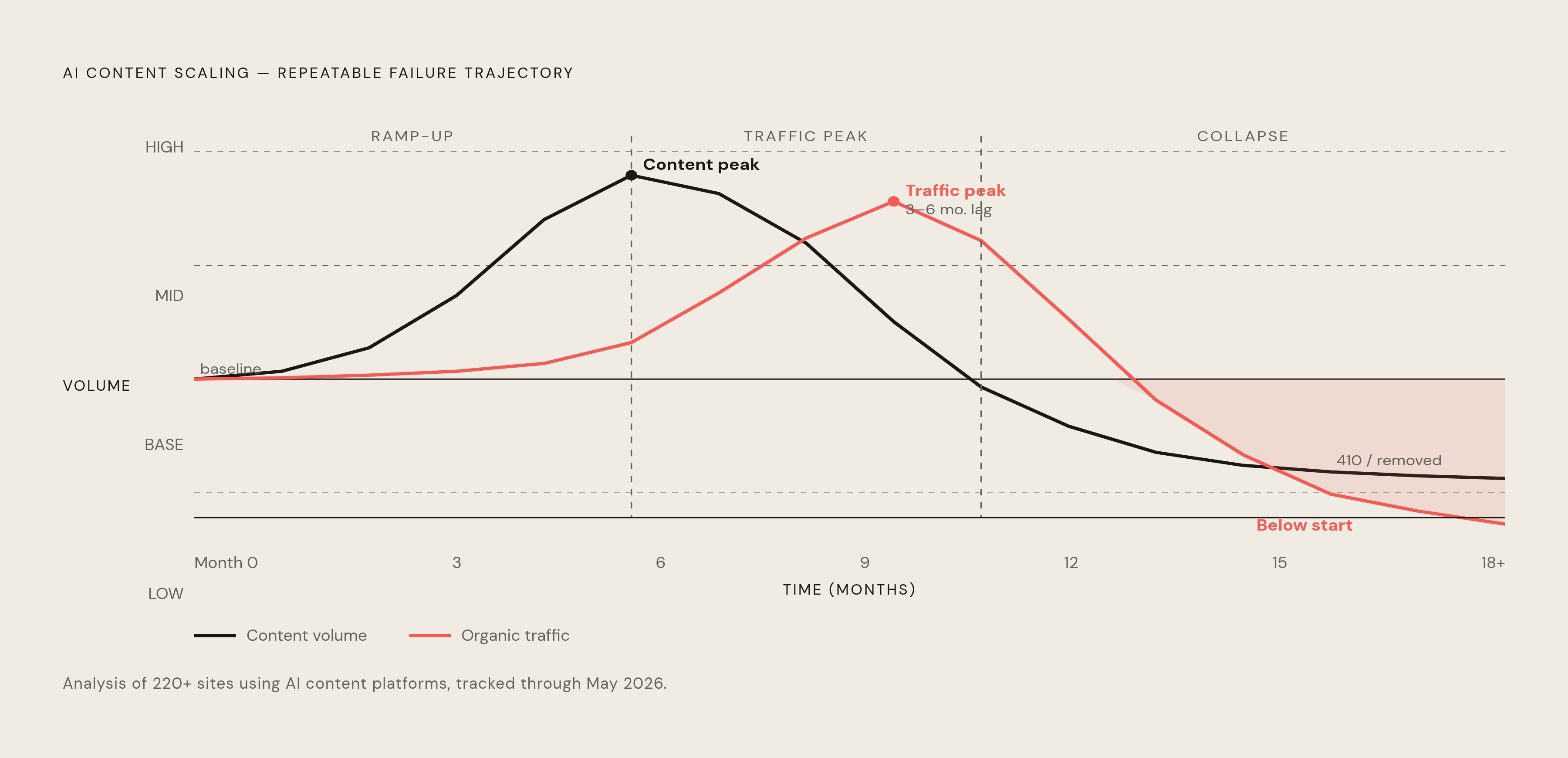
The consequences of this gap are not theoretical. Scaling content production through an agency using AI tools, without internal strategic control over what gets published, produces a recognizable and repeatable failure trajectory: rapid apparent gains followed by a collapse that erases those gains and frequently drops traffic below where it started.
An analysis of more than 220 websites publicly identified as customers of AI content creation platforms, tracked across third-party SEO measurement tools as of May 2026, shows this pattern holding consistently rather than appearing in isolated cases. An organic traffic peak falls within roughly three to six months of the content peak. A substantial number of these brands went on to shrink their own content footprints in 2025 and 2026, removing, redirecting, or returning 410 status codes on many of the same pages their vendors had previously showcased as success stories.
The collapse traces to how AI systems retrieve information. What damages a page's standing in traditional search damages its standing in AI search as well, largely because retrieval-augmented generation draws on the same visibility signals that search ranking depends on. Content that loses search visibility loses the signal that would have made it citable by an AI system in the first place. None of this amounts to a case against AI tooling itself. The pattern is a verdict on what happens when production runs at scale without the strategic layer that decides what is worth publishing, positions it correctly, and checks its quality before it goes live. Tooling did not cause the collapse. The absence of ownership over what the tooling produced did.
Why outside agencies can't produce content that earns AI citation
AI systems do not cite a page because it ranks well in a search index. They cite pages they can extract a clean answer from, cross-check against other sources, and attribute to an author or entity they judge credible. That standard raises the bar on exactly the inputs an outside agency has the hardest time producing honestly: specific statistics, sourced citations, named expert quotations, and prose clear enough to extract cleanly.
Named experts have to be real people with genuine credentials inside the brand or closely tied to it, not placeholder bylines assembled to satisfy a content calendar. Statistics have to come from real proprietary research or carefully sourced external data, because vague or fabricated figures damage credibility more than omitting figures. The entity signal that makes on-site content citable gets reinforced by what happens off the brand's own site, participation on Reddit, thought leadership on LinkedIn, a presence on review platforms, guest contributions elsewhere, all of which depend on an authentic institutional voice that an agency cannot convincingly perform at scale.
The architecture producing these citations spans a brand's entire footprint, not any single page. The largest share of citations inside AI-generated responses comes from sources a brand directly controls or strongly influences, its own site, its listings, its reviews. The brand has to architect both what it owns and what gets said about it elsewhere. Off-site signals make up a meaningful share of that GEO effort, and they depend on authentic institutional voice, proprietary data, and named spokespeople, resources an outside agency has no way to manufacture on a brand's behalf. Consumer skepticism compounds the exposure here: a majority of consumers already question whether content they encounter online is real, and content generated at scale by an outsourced partner with no human editorial ownership behind it tends to confirm that suspicion rather than dispel it.
Measurement brands don't own hides the damage
Outsourcing strategy carries a second cost that rarely gets discussed alongside the first: it usually takes the measurement framework with it. Agencies paid against traditional traffic KPIs have little incentive, and often little capability, to track AI citation as a distinct and increasingly central metric in its own right.
Traditional SEO tools were never built to answer the question that now matters most: how does a brand appear when someone puts a question to an AI system rather than a search box. With AI Overviews appearing in a near-majority of Google searches and AI assistants reaching hundreds of millions of monthly users, the space between what a rank tracker reports and what a real user actually sees has widened into a genuine strategic blind spot.
A measurement category built specifically to close that gap has emerged in response. These tools run predefined prompts and topics on a regular schedule to track brand mentions, citation frequency, sentiment, and competitive standing across engines. Tools tracking this category follow brand mentions and citation frequency broken out by engine. Profound, the enterprise leader in the category, closed a large Series C funding round in early 2026, showing how quickly this measurement discipline is maturing and how central it has become to brand marketing.
The four metrics this category tracks, mention frequency, mention position, citation rate, and AI share of voice, only become useful once tied back to internal analytics: referral visits, conversion data, the closed loop that tells a brand whether a citation actually moved a buyer. That closed-loop analysis depends on data an agency typically does not hold. Outsourcing strategy, in practice, means outsourcing the ability to know whether the strategy is working in the one channel that now shapes brand discovery more than any other.
The strongest case for outsourcing content in the GEO era
The case for outsourcing content deserves to be taken seriously rather than waved off, because it rests on a real constraint: internal teams are stretched thin, content demands keep rising, and an agency can produce faster and at higher volume than a lean in-house team ever could. A large majority of content marketers already rely on external help for at least part of their production. The capacity pressure driving this decision is widespread rather than a fringe concern. The benefits on offer are genuine: immediate access to specialized skills, faster speed-to-market, the ability to scale output up or down as needed, cost savings relative to building an equivalent team in-house, and coverage across time zones that an internal team alone could not sustain.
That argument holds up until volume stops correlating with value, and in the GEO era it does exactly that. Publishing at high volume without citability is now worse than publishing less. High-volume outsourced content that lacks named experts, proprietary data, and institutional authority actively lowers a brand's probability of AI citation, because it dilutes the entity signals AI systems rely on to identify which sources are authoritative. AI systems favor evidence-backed, authoritative material over content that simply appears often. AI-generated or AI-assisted content scaled at volume has shown a consistent pattern: short-term gains followed by losses that exceed the original peak. The capacity win an agency delivers is temporary, but the damage to the brand's standing is not.
The specific error agencies fall into here is structural rather than a matter of individual skill. Many optimize for AI systems directly, building content around the mechanics of citation before the content itself is any good, rather than writing for human readers first and layering GEO elements, answer capsules, FAQ sections, sourced statistics, onto material that is already clear, useful, and well-made. Structure makes strong content more citable. It does not make weak content strong.
The right model: in-house strategy paired with AI-assisted execution and human review
The resolution to this argument is a clear division of labor, not a wholesale retreat from outsourcing or a rejection of AI tools in content production. It is a clear division of labor that keeps the strategic layer inside the brand while recovering every legitimate benefit of external capacity and AI-assisted speed.
Strategy stays in-house because it is the only place it can live: the decisions about which topics the brand owns, which named experts speak for it, what proprietary data gets published, and how the brand wants to be understood by both human readers and AI systems have to be made by people with direct access to the product, the customers, and the leadership making decisions about all three. That group does not need to grow large to do this work. It needs to hold the pen on positioning, on which claims are true and defensible, and on which pages carry the brand's name.
Execution can scale using AI-assisted tools without surrendering quality, provided a human editor with real institutional knowledge reviews everything before it publishes. AI tools can draft faster, restructure for clarity, and format content into the answer-capsule and FAQ structures that make it easier for AI systems to extract, but none of that replaces the judgment of someone who knows whether a statistic is defensible, whether a named expert's quote is accurate, and whether the brand's voice survived the drafting process intact. An outside partner can still contribute meaningfully here, handling planning logistics, production support, formatting, and reporting, provided the strategic decisions and the final editorial check remain with people who sit inside the brand.
That architecture is what the traffic-collapse pattern and the citation research both point toward. Brands that lost ground did not lose it because they used AI tools or worked with outside partners. They lost it because the strategic layer, the decisions about what deserved to be published and why, was never in a position to catch problems before they compounded into a collapse that erased months of apparent progress. Keeping that layer in-house, while letting execution scale with every available tool, is the model that holds up under the scrutiny AI answer engines now apply to every brand competing for a citation.