AI Content Engine ROI Measurement for Marketing Programs
Most marketers using AI skip the measurement framework that proves content actually drives revenue.

A 2026 survey found that most digital marketers now use AI in their daily workflow, but only about one in five track AI-specific KPIs. AI content engines do produce value, but the measurement built around them is too thin to capture what they actually do.
Why most AI content programs cannot prove their value
AI tools have been absorbed into the daily rhythm of content teams faster than the systems meant to evaluate them have caught up. The vast majority of digital marketers now use AI in their workflow every day, drafting outlines, generating variations, accelerating research. But only about one in five of those same marketers track KPIs specific to that AI work. The distance between those two numbers describes a field that has scaled production well ahead of its ability to account for what that production is worth.
That distance carries consequences beyond an awkward board slide. Teams that can show which pieces moved pipeline, which earned citations in AI answers, and which merely added to publishing volume are the teams that will keep their budgets intact when scrutiny arrives. Teams that cannot make that case will find their AI content spend treated as a discretionary expense rather than a revenue driver, regardless of how much it actually contributed. The gap between adoption and accountability is where competitive advantage concentrates in 2026, because measurement, not output, is what separates programs that compound from programs that stall.
What a complete AI content ROI framework covers
Most content teams measure exactly one layer of their operation: production efficiency. They track how fast content gets made and how much it costs, and they let that single number stand in for the full value of the program. That substitution is why so many ROI calculations understate or distort what content is actually doing for the business.
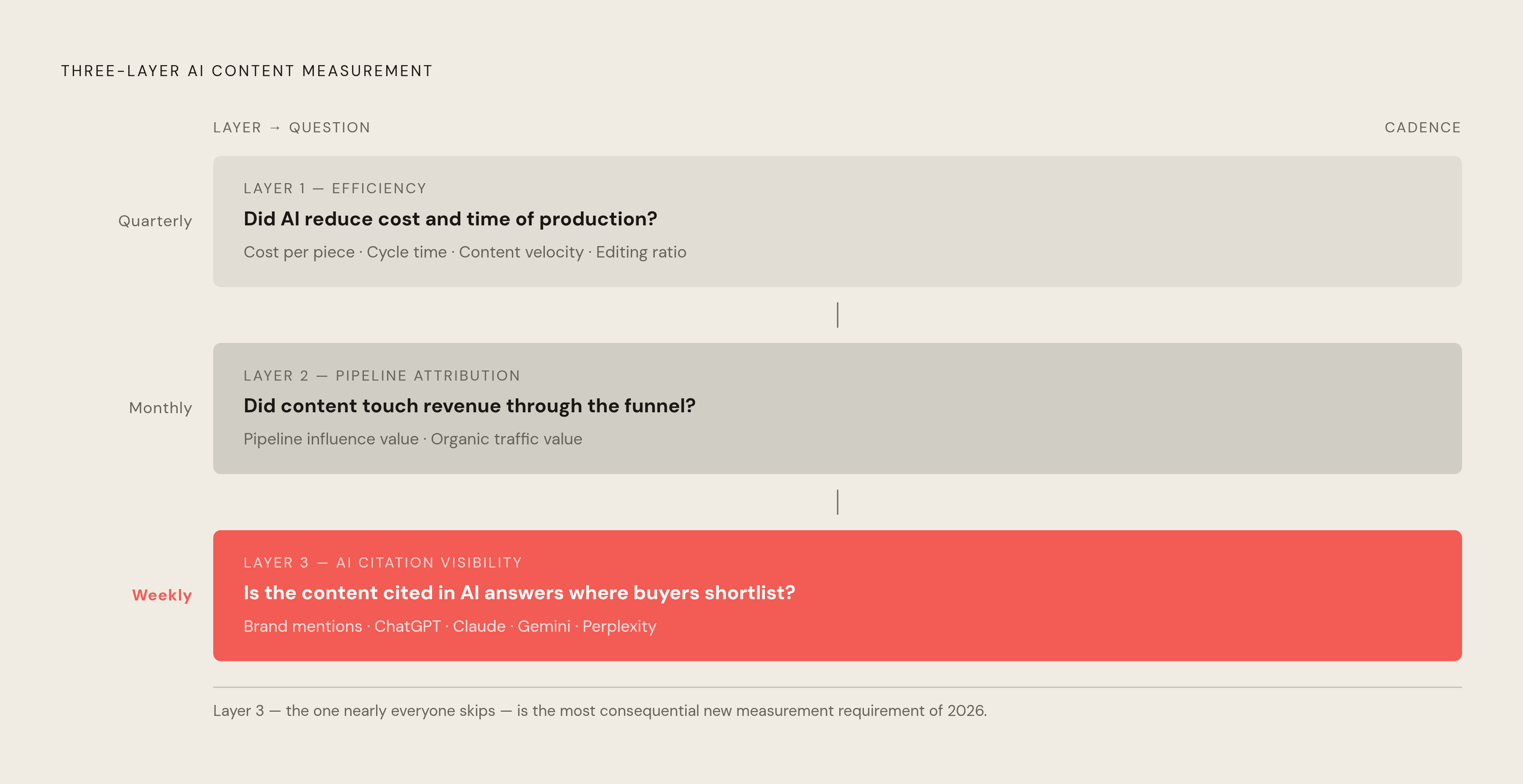
A complete framework needs three distinct layers, and each one has to answer a separate question. The first asks whether AI reduced the cost and time of producing content. The second asks if that content moved prospects through the funnel and touched revenue that closed. The third layer is the one nearly everyone skips: it asks whether the content gets cited inside the AI answers where buyers now do a meaningful share of their product discovery. A 2026 content ROI framework breaks this out further into six value channels: direct revenue attribution, pipeline influence, organic traffic value, AI citation value, brand lift, and cost avoidance. The first three of those get tracked with some consistency. The last two are almost universally ignored.
Part of what makes this hard is that content value doesn't arrive on a predictable schedule. A post published in one month might not rank for several more, might influence a deal that closes even later than that, and might generate AI citations that produce zero measurable clicks while still building brand familiarity among people who never appear in a session log. Last-touch attribution, the default model in most marketing stacks, misses nearly all of this. Building a framework that captures all three layers isn't a matter of adding more dashboards; it's a matter of accepting that content value is distributed across time and channel in ways a single metric cannot represent.
Efficiency metrics: what the production layer measures
Every team already tracks efficiency metrics, because this layer is the easiest one to instrument. Cycle time from brief to publication gives another. Content velocity, the pieces published per week or month at a consistent quality bar, is also simple to chart. Each of these answers one question: did AI reduce the cost and time of production? That question matters operationally, but it's the least commercially interesting one a CMO needs answered, because it says nothing about whether the content generated any return.
One efficiency metric deserves more attention than it typically gets: the human editing ratio, or the share of published word count that passed through human review before it went live. This number functions as a performance predictor, not just a quality checkbox. When AI content was paired with human editing, bounce rates dropped substantially, but when it published without that review, it showed no improvement. The measurable lift comes specifically from the human edit, not from the AI draft on its own.
The right posture toward this entire layer is to treat it as an operational health check. If cost per piece keeps falling while pipeline impact stays flat or declines, the efficiency gains aren't reaching the business; they just make it cheaper to produce content that works no harder than before. Once a team can confirm production is healthy, it has to ask whether that content is doing anything commercially meaningful once it's out in the world.
Pipeline attribution: connecting content to revenue your CFO recognizes
Pipeline attribution is where AI content programs earn their budget or lose it, and most marketing teams cannot close this layer. A majority of B2B marketers say they struggle to attribute ROI to content efforts and to track the customer journeys that content influences, even as they name ROI demonstration a core priority for their teams. The gap isn't a failure of effort; it reflects a structural problem in how content influence actually behaves.
Content rarely converts anyone on a single touch. Influence gets distributed across many interactions with a prospect, so it isn't concentrated at the final click that attribution models love to credit. A buyer consumes pipeline influence content earlier in the journey and never gets direct credit for the eventual sale, so this number tends to run several times larger than what direct attribution models record, and you need multi-touch modeling, not last-click counting, to capture it. B2B deal cycles compound the problem further: a given post's influence on a closed deal can appear months after that post was published, long after most teams have stopped looking back at it.
This calls for a modeling approach that treats the problem as solvable through estimation. Organic traffic value estimates what a brand would have paid in search advertising to generate the traffic its content earns organically, so it works as a defensible proxy, and it translates content reach into a number finance already understands, even when direct conversion data is thin. If you're a B2B SaaS team, you close this loop by connecting CMS and content analytics platforms to the CRM at the contact level. Without that connection in place, pipeline influence stays invisible no matter how good the content actually is. A documented, consistent attribution methodology, even one built on estimation rather than exact tracking, produces far better decisions than treating the whole layer as unmeasurable and giving up on it.
AI citation visibility: the measurement layer teams are missing
The most consequential shift in content measurement in 2026 is the emergence of a discovery channel that existing measurement stacks are almost entirely blind to: AI answer engines, where buyers increasingly form their shortlists before they ever open a traditional search results page.
Earning a citation inside an AI answer and earning a high organic ranking on Google are two different jobs, and content engineered for one doesn't automatically win the other. A brand can hold strong, stable rankings in traditional search while it stays almost entirely absent from the AI answers its own buyers read at the exact moment they form a shortlist. The platforms diverge enough that measuring just one of them can actively mislead you. Only a small fraction of the domains cited by ChatGPT also appear as citations in Perplexity. Google's AI Overviews and Google AI Mode cite the same URLs at a low rate, even when the two surfaces reach the same conclusion on the same query. Each platform runs its own sourcing logic: some weight brand-owned content heavily, while others lean on third-party directories, industry publications, and customer reviews over brand assertions.
AI citations generate brand exposure, impressions and mentions in front of a buyer, even in instances where they produce zero referral clicks back to the site. A measurement stack built only to track traffic will systematically undercount the value of simply being cited. A 2026 content ROI framework formalizes this by treating AI citation value as its own metric: estimated AI impressions multiplied by an equivalent CPM, which puts citation reach on the same comparative footing as other forms of paid media. The practical requirement that follows is straightforward: monitor brand mentions and citations across ChatGPT, Claude, Gemini, and Perplexity on a set cadence. That monitoring isn't a vanity exercise. You will never see these buyers in a web analytics platform, but you can read discovery-stage presence off this leading indicator. Once a team accepts that this layer needs measuring, the next question is what kind of content actually earns the citation.
What content gets cited by AI answer engines
Citation isn't random, and it isn't purely a function of domain authority the way organic ranking often is. It follows patterns that a content team can plan around. Building the measurement layer and the content strategy layer together is what makes both work.
The citation landscape reveals a two-track requirement. Brand-owned content, when it's well-structured, factually dense, and kept current, becomes a viable citation candidate on platforms that lean on primary-source material to construct their answers. Third-party corroboration, meaning citations that appear in independent publications, industry reports, and review platforms, is what drives citation on platforms that weight consensus and verification over a brand's own claims about itself. A content strategy built around only one of these tracks will win citations on some platforms and stay invisible on others.
Publishing cadence compounds this exposure over time. Brands that publish and optimize content consistently build a larger citation surface area than brands that publish in bursts, even when the individual pieces are comparable in quality, simply because there's more well-structured material available for an AI system to draw from. Human review isn't optional in this equation. These systems select for content that's authoritative, specific, and verifiable, so volume without editorial quality functions as a liability. The March 2026 Google core update showed unreviewed AI content published at scale losing visibility rather than gaining it, but Google made no official statement that named AI-generated content as the cause. The pattern in the data is consistent with what the citation logic already suggests: editorial rigor is what makes content worth citing in the first place, on any platform.
How to build the measurement stack in practice
A complete measurement stack is three connected layers, each requiring its own instrumentation, and the order in which a team builds them matters because each layer feeds information to the others.
The first layer to build covers efficiency and pipeline together. That means you connect content analytics to the CRM at the contact level, establish consistent cost-per-piece and cycle-time tracking, and define a pipeline influence methodology well before you need it to defend a budget conversation in front of finance. The second layer is AI visibility monitoring: running structured queries across ChatGPT, Claude, Gemini, and Perplexity for the product categories, use cases, and buying questions relevant to the brand, then tracking brand mention frequency and citation presence on a regular schedule. You need to track platforms separately rather than average them together, because citation presence is platform-specific, not universal. The third layer closes the loop: using AI visibility data to see which content types and topics are earning citations and which aren't, using pipeline data to see which content is actually moving deals forward, and using both together to decide what gets produced next. Measurement in this model informs production rather than simply reporting on it after the content has already shipped.
Governance holds the whole structure together. You need to put every AI-generated piece through a human review gate before you publish it. That requirement isn't a quality ceremony; reviewed content measurably outperforms unreviewed content on every downstream metric this framework tracks, and the capacity to stop a piece before it ships is a prerequisite for a measurement system anyone on the team actually trusts. Cadence matters too, and it isn't uniform across layers. AI visibility metrics move faster than organic traffic metrics, which argues for weekly or bi-weekly monitoring of AI answer presence, monthly reporting on pipeline attribution, and quarterly efficiency benchmarking. That rhythm matches how often the platforms themselves change, giving a team enough signal to adjust strategy before a quarter closes.