Top AI Content Optimization Tools for Search Visibility
AI answer engines now intercept search traffic, making citations matter more than rankings.

AI answer engines, ChatGPT, Perplexity, Gemini, Claude, and Google AI Overviews, now intercept a large share of high-intent commercial queries before a user ever clicks a result. That changes what visibility means: the real prize is citation inside the answer itself, not position on a results page. These systems synthesize an answer and deliver it in-session, so many users never proceed to a results page, and a brand absent from that answer is absent from the consideration set, regardless of where it sits in organic rankings.
Traditional rank trackers cannot see this problem because they measure position on a page an increasing share of buyers never reach. Clickstream research from early 2026 found that roughly two-thirds of U.S. Google searches ended without a click. One study found that 93% of AI Mode sessions end without a click, pushing the number further still and signaling a shrinking fraction of search activity that funnels through a traditional results page. Closing that gap requires a different set of capabilities than the ones built for a page-ranking world, and naming those capabilities is the starting point for everything that follows.
The three capabilities an AI visibility stack needs
Getting found in AI-generated answers depends on three distinct capabilities, and none of them substitutes for another. A brand needs to know where it is being cited (monitoring), it needs content structured so AI systems can retrieve, trust, and cite it (optimization), and it needs the publishing cadence that keeps that content current enough for AI systems to keep favoring it. Monitoring without optimization just produces a report of absence, and optimization without cadence decays within weeks, so skipping any one of the three causes the other two to lose most of their value [1][2][3].
When you track citations instead of rank, the basic unit of measurement changes. The unit is a prompt rather than a keyword, the outcome is cited or not cited rather than a position between 1 and 100, and the surface spans six or more AI engines, each of which sources content differently. Mature AEO tools track citation rate per prompt, source URL frequency, whether a brand is actually named in generated text, and how a brand is framed relative to competitors. A tool that reports only an "AI Overview presence" flag as a binary yes-or-no is not a monitoring platform in any meaningful sense.
Optimization means structuring content so AI retrieval systems can extract, trust, and cite it. Google's May 2026 guidance calls this "non-commodity content": first-hand, expert perspective that goes beyond common knowledge. That same guidance confirms that GEO and AEO remain SEO, built on the same index and the same quality signals. The surface changed. The underlying discipline did not.
Google's guidance also retired a set of tactics that had accumulated around AI search as though it needed its own separate playbook: creating AI-specific text files, chunking content into bite-size pieces, rewriting prose to sound "machine-friendly," manufacturing inauthentic brand mentions, and treating structured data as a citation cheat code. In their place, Google points to genuinely non-commodity content carrying first-hand expert perspective, broad topical relevance across a cluster of related questions rather than a single keyword, and the standard SEO fundamentals that make pages retrievable.
Publishing cadence closes the loop. AI systems, Perplexity especially, favor recently published content heavily, so a one-time optimization pass loses ground fast, because the set of cited domains shifts month to month across active categories. A brand that optimizes once and stops has built something that depreciates on a schedule it cannot see.
How AI engines source content differently
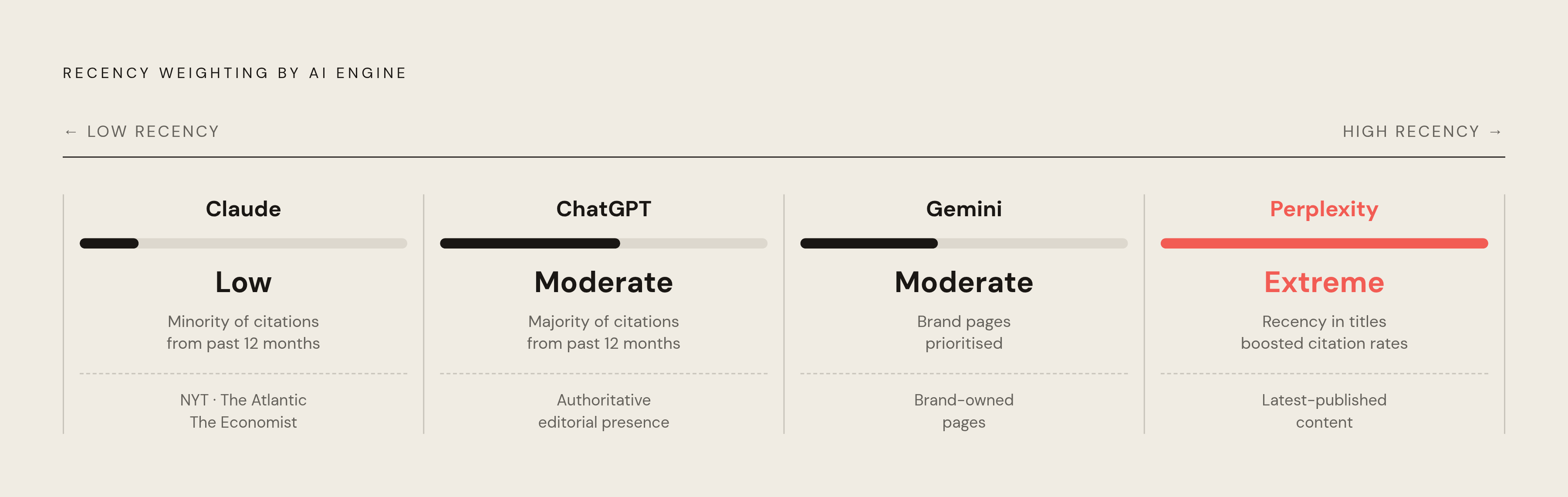
Citation behavior varies sharply across AI engines. A brand's visibility on one platform predicts very little about its visibility on another. Claude leans toward legacy editorial brands such as The New York Times, The Atlantic, The New Yorker, and The Economist, and only a minority of its journalism citations come from the past 12 months, compared with a majority for ChatGPT. Perplexity, by contrast, cited recently published content at a very high rate in 2026 analysis, and visible recency signals in titles improved citation rates meaningfully, making publishing cadence especially consequential for any brand trying to show up there.
These differences carry a direct consequence for content strategy. Brand-owned pages tend to serve Gemini well. Structured comparison and documentation content serves Claude. Recent, citable factual content serves Perplexity. Authoritative editorial presence serves ChatGPT. A single content type built for one engine does not transfer cleanly to the others, so a strategy optimized only for Perplexity's recency preference, for instance, may do little for Claude's preference for established editorial sourcing.
The same logic applies to tool choice. A platform that monitors only one or two engines cannot give a team an accurate picture of its actual AI share of voice, because the engine it is not watching may behave entirely differently from the one it is. Multi-engine coverage is a baseline requirement for any monitoring tool worth adopting, not a premium add-on.
What makes a monitoring and citation-tracking tool worth using
A monitoring tool earns its place in a marketing stack only if it tracks citations at the prompt level, spans multiple engines, and distinguishes between a brand being cited as a source and a brand being named as a recommendation. Those two outcomes look similar on a dashboard and mean very different things to a buyer.
Two failure modes show why that distinction matters. The first is a distinction between two things that look similar but are not: a citation is a link present in the AI response, while a brand mention is just the brand name appearing somewhere in the generated text, and a visibility report that collapses the two into a single metric overstates actual brand exposure in a way that can mislead an entire marketing team about its standing. The second failure mode is that a brand can be cited as a source and still lose the sale if the AI ultimately recommends a competitor for the actual purchase decision. A mature monitoring tool surfaces that distinction.
Prompt-level tracking matters because a single product category can require tracking hundreds of prompts to reach statistically meaningful coverage; keyword-level monitoring misses the variation in how buyers actually phrase their questions to an AI system. Competitive framing matters just as much: whether a brand is named as the recommended choice, mentioned as a runner-up, or placed inside a comparison where the AI steers the user toward a competitor instead. Sentiment and framing per prompt is the signal that drives action, not mere presence in a response. Multi-engine coverage, again, is table stakes. Platforms that cover the major AI answer engines, ChatGPT, Claude, Perplexity, Google AI Overviews, Gemini, and Copilot, start from a reasonable baseline. The tools examined below are measured against these standards: prompt-level granularity, multi-engine coverage, and the ability to separate citation from mention and from competitive framing.
Letterstory: monitoring, optimization, and publishing as one connected system
Letterstory is built on the idea that monitoring AI citations, producing citation-ready content, and publishing at cadence are not three separate vendor relationships to manage. They form one system, and the moment a team splits them across separate tools is the moment gaps open up between what gets measured, what gets written, and what gets published on time.
Its measurement layer tracks whether ChatGPT, Claude, Gemini, and Perplexity actually name and cite a brand inside the generated answer itself, which makes the distinction between ranking on a page a user never reaches and being surfaced in the answer that ends the search. Rather than functioning as a vanity dashboard, it operates as a measurement instrument that treats AI share of voice as a number that can be tracked over time and moved deliberately.
On the production side, Letterstory runs multi-stage AI pipelines that pair drafting with human editorial review, or, if a team chooses, it can operate in full-autonomy mode. The same system built to publish at scale is also built to produce work worth putting a brand's name on.
Publishing cadence is where many brands stumble, because AI systems, Perplexity especially, favor recently published content, and a one-time optimization effort decays as the set of cited domains shifts month to month. Letterstory addresses this directly through phantom sites and client blogs that research and publish on a set cadence, along with standing watchers that draft the moment something relevant happens in a given category. That infrastructure is built around the same recency signal that Perplexity weighs so heavily.
The underlying strategy rests on real, retrievable content that a brand publishes and owns, rather than attempts to game a single prompt or a single hero page. It also avoids the manufactured brand mentions that Google's May 2026 guidance flags as ineffective. Every capability in the system is reachable by an agent through an API, not only by a person through a user interface, so it fits inside a marketing team's existing stack instead of requiring a team to replace what it already has. Human review stays part of the design by choice: every AI-generated suggestion is reviewable and reversible before it ships, so automation never costs a team its ability to say no to something before it goes out under the brand's name.
The tool fits B2B SaaS and developer-tool marketing and content teams that have moved past treating AI visibility as an afterthought bolted onto old SEO content, and are ready to treat it as its own discipline with its own infrastructure.
Semrush: broad SEO data combined with AI visibility tracking
Semrush extends an established SEO platform into AI search through its AI Visibility Toolkit, giving teams that need both traditional rank data and AI citation data access to them inside one platform.
The toolkit covers ChatGPT, Gemini, Google AI Overviews, Google AI Mode, and Perplexity, and it reports brand sentiment, narrative drivers, and AI share of voice alongside the citation data itself. Its MCP connector brings Semrush's search intelligence directly into Perplexity's workflow, linking the two systems at the protocol level. The underlying data draws from hundreds of millions of prompts, updated daily, across more than 117 regional databases, giving the toolkit a scale that matches the breadth of Semrush's existing SEO product.
The best fit for this toolkit is an enterprise SEO team or agency that needs keyword research, competitor data, and AI visibility together in one platform, and that already has content production handled through a separate system. Measured against the three-layer framework, Semrush is strong on monitoring and on the SEO side of optimization, but it does not provide the publishing-cadence infrastructure or the human-in-the-loop content pipeline that sustained AI citation requires at scale.
Ahrefs Brand Radar: AI citation tracking built on a large SEO index
Ahrefs extends its SEO index into AI search through Brand Radar, so teams get citation-level visibility data at a scale few purpose-built GEO tools can match on their own.
Brand Radar covers AI Overviews, AI Mode, ChatGPT, Perplexity, Gemini, Copilot, and Grok, though Grok's data collection is currently paused. Its AI Visibility Index draws from more than 447 million monthly prompts across six AI indexes, so it has one of the larger data foundations among tools built around citation tracking. A study published by Ahrefs found that fewer than half of AI Overview citations come from pages that already sit within Google's top 10 organic results, down from a large majority of citations a year earlier. That finding confirms the SEO-GEO connection described in Google's own May 2026 guidance: the surface for discovery has shifted even as the underlying ranking signals remain tied together.
If a team already works inside the Ahrefs ecosystem and wants to add AI citation tracking without switching platforms, Brand Radar suits them. The index data behind it is strong, but the product carries no publishing layer and no content-pipeline layer of its own.
Surfer: content optimization and GEO scoring in one workflow
Surfer sits at the intersection of content quality and AI citation, so it helps content teams that need optimization guidance alongside production, not just a standalone monitoring dashboard.
Its Content Score measures both Google ranking signals and AI citation likelihood, the latter based on content structure signals rather than live AI citation data pulled from the engines themselves.
Surfer fits content teams that need to produce and score content for AI citation eligibility, and who want one tool connecting writing, optimization, and visibility data. It does not replace a publishing-cadence system, so a team relying on it still needs a separate mechanism for sustaining the recency that AI engines, Perplexity in particular, reward over time.
Profound: enterprise-grade AI citation tracking at the page level
Profound is built for large brands that need granular, page-level AI citation data across multiple markets, a depth of monitoring that general-purpose SEO platforms have not yet matched. Where Semrush and Ahrefs extend broad SEO indexes into AI visibility as one feature among many, Profound narrows its focus to AI citation tracking itself, trading the breadth of a full SEO suite for depth at the page level. That tradeoff suits enterprise teams operating across many markets and many pages, where the practical consequence for tool choice outlined earlier applies with the most force: monitoring only one or two engines, or only a surface-level view of citation, leaves blind spots large enough to misstate a brand's actual standing in the answer economy that buyers now rely on to make their decisions.