AI Content Engines Versus Traditional Content Agency Models
AI systems now cite sources differently than search engines rank them.

Most modern AI search engines run on Retrieval-Augmented Generation: the system pulls candidate documents from the web, then writes a single composed answer that cites some of those sources and leaves the rest out. That second step is the one that matters for anyone building a brand. Getting indexed puts a page in the pool of candidates; it does not put a brand in the answer. The two used to be close enough that ranking well and being seen were nearly the same event. Now they're separate steps, and a brand can win the first and lose the second.
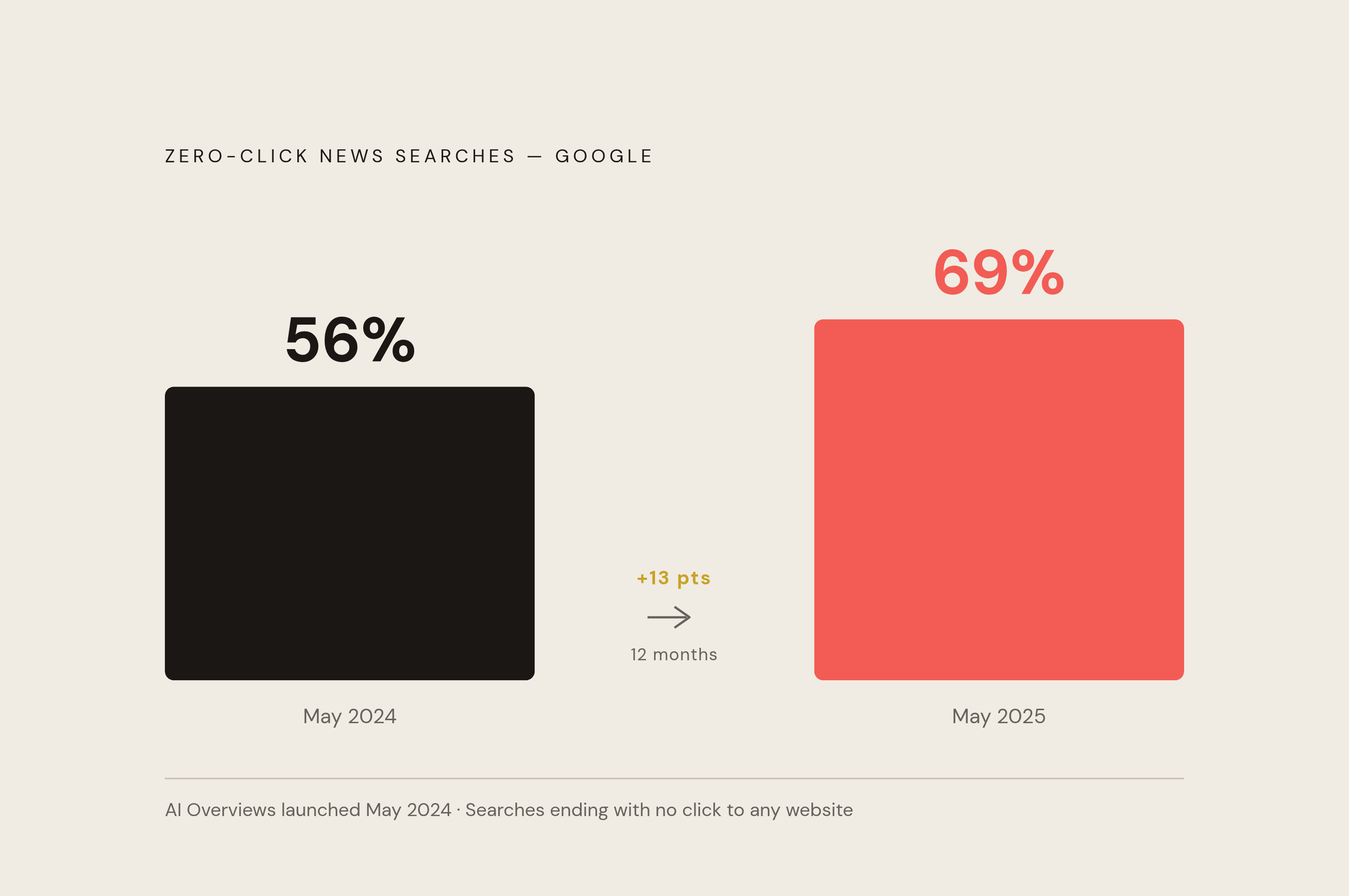
Similarweb's zero-click research shows how fast the ground has moved. In May 2024, 56% of news-related Google searches ended with no click to any website. A year later, in May 2025, that figure had risen to 69%, a 13-point jump in the twelve months after Google's AI Overviews rollout. If you still count organic clicks as the main scoreboard for content performance, you're tracking a pool that keeps shrinking under you. Years of SEO work built that traffic, but now it gets absorbed into answers that send no visitor anywhere.
A brand that earns no citation in an AI answer gets no click, no impression, and no awareness from that interaction, even if its own pages rank on page one of Google for the same query. Being indexed is necessary but not sufficient to be cited, and that gap is why measuring AI visibility has split off into its own discipline, separate from SEO tracking. Platforms like Letterstory watch whether ChatGPT, Claude, Gemini, and Perplexity actually name and cite a brand, rather than only checking whether its pages rank in Google, which lets a team see the real distance between search performance and placement inside an AI answer. That distance is the reason the rest of this argument matters: the model a brand uses to produce content now decides whether it exists in the answer.
What Generative Engine Optimization requires from content
Earning a citation from an AI answer engine calls for content built to be pulled apart and reused, confirmed across more than one platform, and kept current enough that a model trusts it as a live source. None of those three demands map cleanly onto what ranked-link SEO asked for, because it rewarded a single well-optimized page that sat at a stable URL for years. Generative Engine Optimization, or GEO, is the name for the discipline that answers these new demands: structuring content and building brand authority so that AI platforms select, cite, and surface a brand in their responses. Researchers at Princeton University, IIT Delhi, Georgia Tech, and the Allen Institute for AI formalized GEO as a distinct optimization framework in a 2024 paper presented at KDD 2024, giving the practice an academic basis.
Similarweb lists four outcomes that show GEO is working: citation with a source link, brand mention, positive sentiment, and a high share of voice. None of the four appears in Google Analytics, because none of them is a session, a click, or a ranking. If a brand chases them through a standard analytics dashboard, it's looking in the wrong place.
Content needs to meet specific structural requirements to earn those outcomes. Content needs self-contained paragraphs that make sense pulled out of context, clearly stated facts rather than implied ones, comparison tables, FAQ schema, and an llm.txt file that tells crawlers how to read the site. Each piece missing from that list is a measurable coverage gap, not a stylistic preference. And the gate sits even earlier than structure: the Princeton and KDD 2024 findings show that AI systems favor content that is authoritative, evidence-backed, expert-authored, and recent, while keyword density performs at or below baseline. If you stuff a term into a headline and a few subheads the old SEO way, you get nothing here.
The metric that actually tracks all of this is Share of Model, or SoM: a brand's mentions divided by total category mentions across AI answers in a tracked set of queries. It is a direct read on how often a model reaches for a given brand when it's answering a question in that category, not a measure of traffic or rank, and it's the number that tells a team whether the structural work above is landing.
What traditional content agencies were optimized for
Traditional content agencies were built to produce strong editorial work at a pace suited to ranked-link SEO, and that design is the reason they can't keep up with the volume, structural precision, and multi-platform spread that AI citation now demands. That sequence turns out well-crafted individual articles. It wasn't built to run continuous, high-cadence publication across dozens of topic clusters and several channels at once, and when you run it that way, it strains past its design.
The metrics an agency reports on tell the same story. Organic traffic, keyword rankings, and click-through rate measure outcomes that AI answer engines simply don't produce. An agency handing over a monthly report full of those numbers is describing a different channel than the one where a brand actually gets chosen or skipped inside an AI answer now.
Data from Ahrefs shows just how far the two channels have pulled apart. A substantial share of ChatGPT's most-cited pages carry zero organic visibility in Google, and fewer than one in ten sources cited across ChatGPT, Gemini, and Copilot rank in the top ten Google results for the same query. Strong SEO performance and AI citation are close to uncorrelated. A page can dominate a Google search result and never once get picked up by an AI answer, and a page with no Google footprint at all can get cited constantly.
Similarweb adds a second wrinkle: roughly half of cited domains change month to month. Staying visible under those conditions calls for continuous publication and a presence across multiple platforms, not a campaign that runs for a quarter and then goes quiet. GEO also pushes PR, content, SEO, and product marketing toward each other, because all four now shape how an AI system understands and describes a brand. An agency organized around delivering content assets in a silo has no natural way to coordinate that convergence, since coordinating it was never the job it was hired to do.
Even if an agency adapts its workflow to GEO's requirements, it still runs into a ceiling built into the business model itself. Agencies deliver work product and bill against a retainer. They don't instrument AI visibility as a standing measurement, they don't publish on an autonomous cadence, and they don't own the layer that shows whether citations are actually accruing over time. That's a structural limit, not a failure of effort or skill.
What an AI content engine does differently
An AI content engine built for GEO does three things a traditional agency model cannot do at the same scale: it publishes on a continuous cadence matched to how AI crawlers actually revisit and refresh sources, it distributes across the multi-platform stack that AI systems draw material from, and it measures whether citations are actually accruing as a built-in part of running the system, not as a report added after the fact.
The structural output follows from the same design. A pipeline tuned for GEO can turn out comparison tables, FAQ schema, and self-contained factual paragraphs as the default shape of what it publishes, rather than relying on an editor to retrofit those elements into a draft during a manual pass. And because measurement runs inside the loop rather than beside it, the system tracks Share of Model, brand mention rate, and citation source across ChatGPT, Claude, Gemini, and Perplexity, then adjusts what gets published next based on what that data shows. A traditional agency reports on deliverables after they ship. An engine built this way uses the data to decide what ships.
Letterstory runs as this kind of engine. It operates phantom sites and client blogs that research and publish on a set cadence, standing watchers that draft a piece the moment something relevant happens in a category, and a measurement layer that checks whether ChatGPT, Claude, Gemini, and Perplexity actually name and cite the brand, wired together as one system rather than handed over as a stack of separate deliverables. Multi-stage pipelines inside that system pair AI drafting with human review, or run fully autonomously where a client chooses that, and the same system that publishes at scale still turns out work a client is willing to put its name on. Every capability is accessible behind an API, so the engine fits into a client's existing stack. Letterstory's measurement layer is the operating discipline that produces this: it shows whether the AI engines that matter actually name and cite the client, so visibility gets tracked as a number rather than assumed from a feeling.
Why human review inside an AI pipeline matters
Automation on its own fails the quality bar that AI citation demands, and the answer to that failure is a pipeline with human review built into it, not a retreat to fully staffed production the way agencies have always run it. If no human checks it before it's published, AI-generated content carries real risk on several fronts at once. Brand voice drifts as the underlying models shift their default tone with each update. Factual errors compound when no one checks the argument a draft is actually making. Trust erodes, both with the audience reading the content and with the AI systems that are themselves evaluating how authoritative a source is.
AI systems reward authority, but only when you pair it with recent, genuine content production. The models favor writing that's clear, expert-authored, and backed by evidence, reinforced by consistent publishing over time. Volume without that quality attached is a liability, not an asset. The GEO consequence follows directly: a page that reads as vague, contradicts itself, or carries no real authority will not get cited even if it sits fully indexed. AI systems decline to cite weak sources regularly, so low-quality automated output is a brand risk and a GEO failure at the same time.
Letterstory's position on this is direct: every AI-generated suggestion stays reviewable and reversible before it ships. Automation should never cost a team the ability to say no to a draft, and the pipeline treats that human review step as structural, built into how the system works, not as an optional setting a client can skip to save time.
Measuring whether your content is earning AI citations
AI citation tracking needs a different instrument than standard SEO analytics, but most brands don't have one yet. Only 16% of brands systematically track AI search performance, so most are deciding on AI visibility by guesswork.
The metrics that matter for GEO, Share of Model, brand mention rate, citation source, and sentiment, are absent from Google Analytics. A large share of AI-referred traffic arrives without referrer headers intact, so it lands in GA4's Direct bucket, indistinguishable from someone typing a URL in by hand. Since May 2026, GA4 has carried a native AI Assistant channel for sessions where the referrer survives, but referrer-less sessions still stay invisible in the default report.
Each AI engine also needs its own monitoring approach. Perplexity crawls the web in real time and typically cites its sources, with exceptions such as Writing mode and certain prompt types, so current third-party coverage matters most for it, and its referral traffic is trackable in GA4 specifically. A brand can rank well on one engine and be invisible on another at the same time, so tracking across engines isn't optional if the goal is an accurate picture.
A handful of tools now give brands a way to see this directly. Semrush's AI Toolkit covers ChatGPT, Gemini, AI Overviews, AI Mode, and Perplexity. The Bing AI Performance Dashboard has been public since February 10, 2026, and gives first-party data on citations and grounding queries, though Microsoft notes that only a sample of actual citation activity is shown there, not the full picture. Letterstory's measurement layer tracks whether ChatGPT, Claude, Gemini, and Perplexity actually name and cite a client, and it's built in as the operating feedback loop for the publishing pipeline itself, not bolted on afterward as a separate monitoring tool. The data it produces is the same data that decides what gets published next.
CMOs want real data and concrete recommendations on AI-driven visibility, not a guess at how a brand shows up in AI answers. That expectation is what turns GEO from a set of good intentions into a standing operating discipline.
Choosing the right content model for AI-era visibility
The choice between a traditional agency and an AI content engine isn't a choice between quality and speed. It comes down to whether the content operation is instrumented for the discovery system that now decides brand consideration.
A traditional agency model still fits a brand where discovery runs mainly through editorial relationships, long-form thought leadership, or regulated industries, where you need human review at every single step because compliance demands it, not because you prefer it. Not every category has shifted toward AI-driven discovery at the same speed, and for some of these, the agency model remains the right tool for the job.
An AI content engine fits a different situation: a brand competing in a category where AI answer engines already stand at the start of the buyer journey, such as B2B SaaS, dev tools, martech, or fintech; a brand whose multi-platform publication needs outpace what a staffed retainer can realistically deliver; and a team that wants to measure AI citation directly as a performance channel.
The gap between brands that actively shape their AI narrative and brands that don't is already 9x in visibility terms, and it compounds. Brands that ignore GEO don't just slip in rankings; they risk a deeper problem, where AI systems simply don't have enough ground truth about them to cite them at all, regardless of how the brand ranks anywhere else.
A team starting from a traditional agency setup has a clear first move: audit content by topic cluster rather than by individual keyword, check which pages are technically parseable by AI crawlers, and add a measurement layer for Share of Model before changing anything else. The data from that audit will show exactly where the gaps sit. For marketing and content teams at B2B SaaS and dev-tool companies ready to stop treating AI visibility as an afterthought stapled onto old SEO content, Letterstory runs the full engine: cadenced publication, multi-platform distribution, human-reviewed pipelines, and the measurement layer that closes the loop, wired into an existing stack.
None of this works as a one-time fix. If a brand can't see whether AI engines are citing it, that brand can't manage whether they will.