AI Content Engine Output Quality Control
Catch AI's five recurring failures before they reach readers.
AI content engines fail in patterns, not accidents. A pipeline built on large language models breaks the same five ways, repeatedly and predictably. Design can catch those failures before publication.
Why AI content pipelines break differently than human-run ones
An AI content pipeline that makes the same kind of error has usually made it structurally: the same flawed prompt, the same ungrounded model call, the same missing compliance check runs across every piece that passes through it. That difference in kind, not just scale, is what separates human-run content operations from AI-run ones, and it's the reason quality control for each has to look completely different.
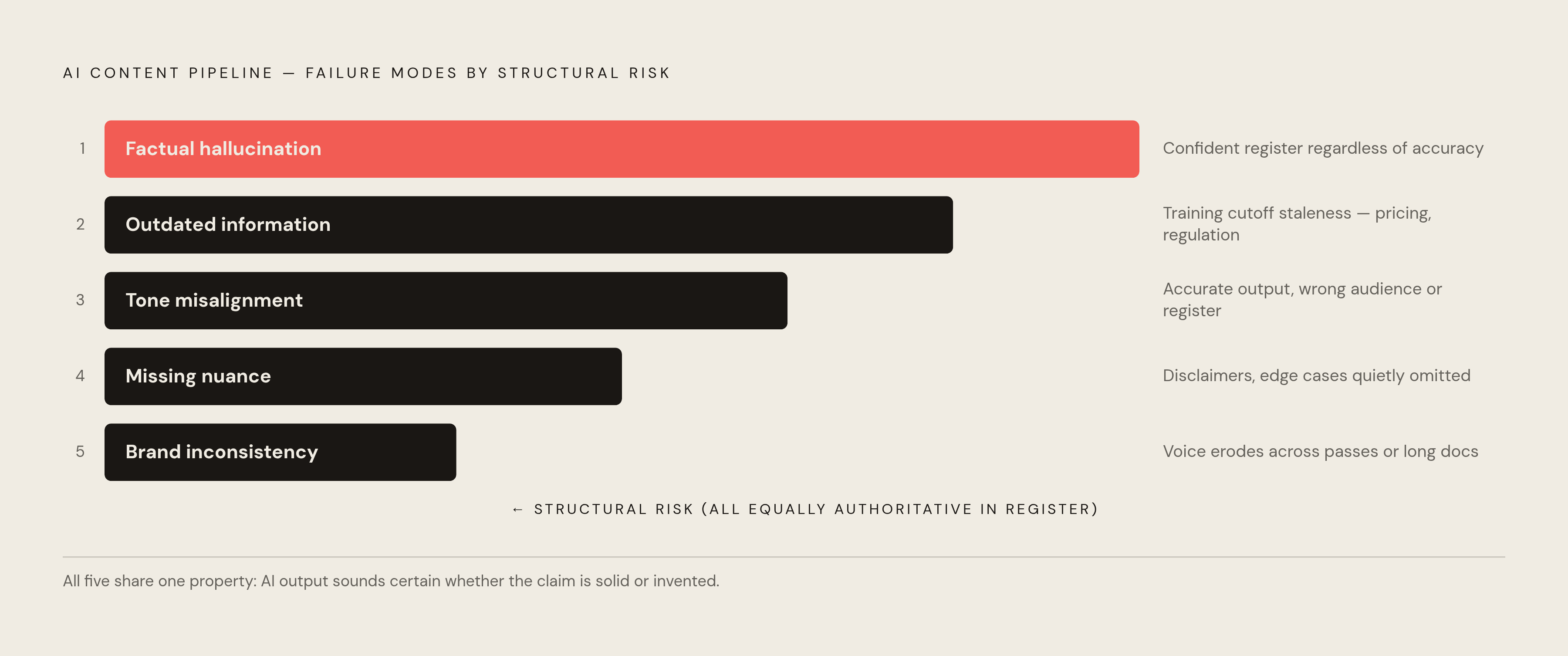
Five failure modes recur across production AI deployments. Factual hallucination tops the list: models state incorrect information with the same confident, fluent register they use for correct information, which makes errors nearly impossible to catch by tone or style alone. Outdated information follows close behind, since every model carries a training cutoff, and content touching pricing, regulation, or competitive positioning can be stale the moment it's generated, regardless of how well-written it reads. Tone and brand misalignment occurs when technically accurate output is pitched at the wrong audience or in the wrong register for the publication running it. Missing nuance appears when a model optimizes for clean, readable prose and quietly drops a legal disclaimer, an edge case, or a safety caveat that made the original source material more cumbersome to read. Brand inconsistency rounds out the list: voice guidelines and terminology preferences erode across a long document or across multiple generation passes, even when a single prompt tried to enforce them.
What ties these five failure modes together is that AI-generated text sounds authoritative no matter how accurate it is. A model has no equivalent tell. The confident register is uniform whether the underlying claim is solid or invented, so an error embedded in a prompt or a process doesn't produce one bad sentence. It produces that same bad sentence, or its structural equivalent, in every piece the pipeline touches afterward.
The costliest structural mistake: QA bolted on at the end
Most teams running AI content pipelines already know about these five failure modes. The mistake they make is an architecture that places quality control at the very end of the process, after a piece is fully drafted and ready to publish, where fixing a problem costs the most and skipping the fix is easiest to justify under a deadline.
End-of-line review was built for a different era of content production, when one or two writers produced everything and a single editor could realistically read every piece before it went out. That model breaks the moment AI tools, freelancers, and multiple contributors generate content in parallel, because volume outpaces a single reviewer's capacity long before anyone notices the backlog forming. A reviewer sitting at the publish gate faces a binary choice when a problem turns up: fix it under deadline pressure, or ship it anyway. A reviewer who encounters the same problem at intake, well before publication is on the clock, has time to route it, correct it, or kick it back without anyone feeling the deadline breathing down their neck.
The practical result of QA-as-inbox rather than QA-as-workflow is that flagged content sits unresolved, and unresolved content ships. Nobody decides to publish a flagged piece outright; it simply ages past the point where anyone has the bandwidth to deal with the flag, and it goes out the door by default.
A second structural failure compounds the first: most organizations have no single source of truth for what "on-brand" actually means. Brand voice and terminology preferences live in someone's head, in a document nobody has opened in months, or scattered across old Slack threads. Automated checks need something consistent to run against, and if the standard itself is inconsistent or inaccessible, no amount of tooling at the back end of the pipeline will catch what the standard never clearly defined.
A third failure compounds both of these: there's rarely a feedback loop that takes what review actually finds and feeds it back into the standard itself. The same issues get flagged over and over, piece after piece, because nobody closes the loop between what reviewers catch and what the brand standard or the automated check is actually looking for. The standard stays frozen while the errors repeat.
A quality control layer built into every stage of the pipeline
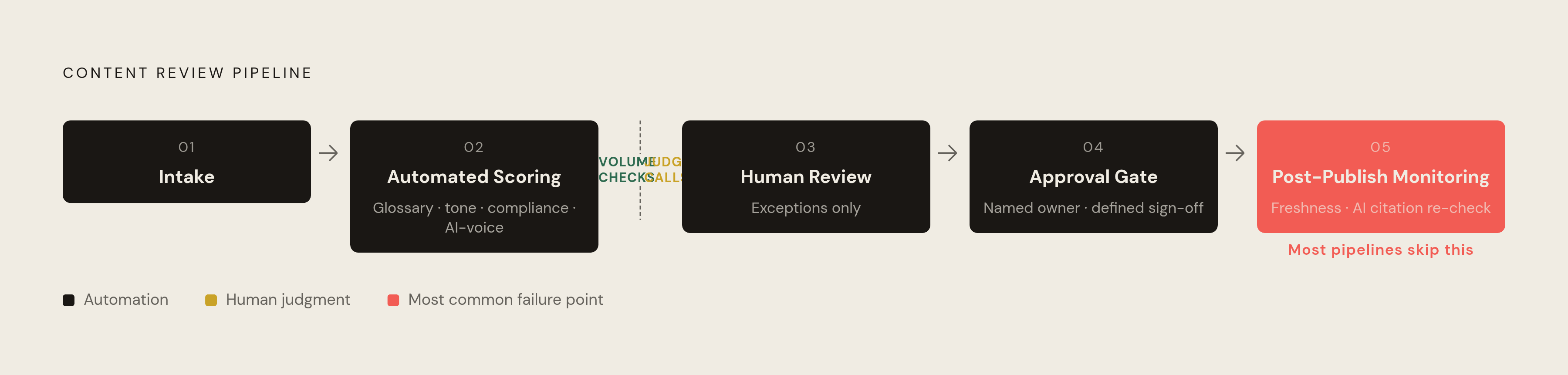
The architecture that solves this has five stages: intake, automated first-pass scoring, human review, an approval gate, and post-publish monitoring. Skipping any one of them is where brand drift and factual error start to creep back in, because each stage exists to catch a specific category of the failure modes described above.
A QA process that only covers part of the content stream, say, only AI-drafted pieces and not freelance copy, is a gap with a name attached to it.
Automated first-pass scoring comes next, and it runs before any human reads the piece. At this stage, the draft gets checked against the brand voice standard, the approved terminology glossary, compliance requirements, and detectors built to flag generic AI-voice patterns. What belongs in this automated layer is anything that can be checked against a defined standard at volume: terminology against an approved glossary, tone scoring at the phrase level, claims and compliance language flagged for review, and patterns associated with ungrounded or generic AI output. What stays with a human is judgment that requires context the automated system can't see: strategic calls on borderline content, final brand-risk sign-off, resolving conflicts between what the automated system flagged and what the context actually calls for, and deciding when the standard itself needs to change. The governing principle is straightforward: automation handles what's checkable at volume, and judgment calls that require context beyond the standard stay with a person.
Human review is the third stage, and it only works if the first two stages did their job. The automated pass surfaces what needs attention, and the human makes the call on the specific items the system couldn't resolve on its own. That's what keeps human review from becoming the bottleneck that end-of-line QA always turns into: the human is reviewing exceptions, not re-reading everything from scratch.
The approval gate is the fourth stage, and it needs a defined sign-off point with a named owner attached to it. "Looks done" is not an approval gate. A specific person accountable for what passes through is one.
Post-publish monitoring is the fifth stage, and it's the one most pipelines skip. Facts go stale, terminology shifts, and a piece's visibility in AI search results changes after launch. Content that was accurate and well-positioned on publication day needs periodic re-checking, which makes freshness management a core function of quality control rather than an afterthought bolted on when someone notices a problem months later.
Agentic pipelines that embed quality control as a property of the architecture
The most advanced AI content pipelines don't treat quality control as a stage that follows generation. They build it into the architecture itself, into how individual agents are specialized, how they hand work off to each other, and where a human is positioned relative to any action that has real consequences.
The agentic structure the field has converged on assigns each function to a distinct agent. A researcher agent gathers context before anything gets drafted. A critic agent then reviews that draft against brand and SEO rules, functioning as the automated first-pass described in the previous section, built into the pipeline's architecture itself. A publisher agent stages the finished result for human approval. It does not publish on its own.
That last point is the governing principle for where humans belong in an agentic system: reads can be broad, but writes are narrow, typed, and interruptible. Nothing publishes without a human approving it, and every write-back to a content management system is scoped and permission-aware: the agent can gather and draft freely but cannot push a consequential action through without a person in the loop.
A Claude-based pipeline described in current production architectures illustrates this concretely, with six discrete stages: a Discovery Agent, a Performance Analyzer, a Transcription Bridge, a Voice-Aware Scriptwriter, a Human Review Gate, and a Publishing Layer. The human review checkpoint sits between the scriptwriter and the publishing layer, positioned close enough to the point of generation to catch tone-deaf output before it travels any further, and hands-off enough that the rest of the pipeline runs unattended around it.
The distinction that matters is between a tool, a single agent, and a genuine agentic pipeline. A single agent generating content without a critic and without a governed write layer has no structural quality control built into it. It just generates faster than a human would, with every one of the five failure modes from section one still fully intact.
Risk-calibrated review depth: matching the intensity of human oversight to what is at stake
Human review works best when its depth is tiered to the risk level of the content, not applied uniformly across everything the pipeline produces. Uniform scrutiny, the same depth of review on an internal memo as on a regulatory filing, is what turns review into a bottleneck in the first place and gives teams a reason to skip it under deadline pressure.
A three-tier model addresses this directly. Internal drafts, low-stakes and limited in their blast radius if something goes wrong, get a single reviewer. Customer-facing copy, carrying real brand risk, gets a structured checklist review, checked against a defined standard rather than left to a single reader's impression of whether it feels right. Legal and compliance documents, where the exposure is regulatory and the blast radius is largest, get multi-approver workflows with full audit trails, a record of exactly who approved what and when.
That audit trail does more than satisfy a compliance requirement. It's also a data source the pipeline can learn from: who flagged what, what decision got made, and whether a pattern of repeated flags points to a gap in the upstream standard.
None of this works without thresholds set in advance, defined before content starts flowing through the pipeline, specifying what auto-passes and what routes to a human reviewer. Getting that threshold right is what makes risk-calibrated review viable rather than theoretical: review time gets spent on content that actually needs a human judgment call, not on re-reading pieces the automated check already cleared.
AI-generated content that passes internal QA but fails in AI answer engines
Passing an internal brand review proves a piece is accurate and on-voice. It proves nothing about whether an AI answer engine will ever cite it. The quality requirements for AI visibility are structurally different from the requirements for human readability, and most internal QA processes were never built to check for them.
The core problem is one of redundancy. AI-generated content, by its nature, tends to cover ground the underlying model already absorbed from millions of other sources during training. To earn a citation in an AI-generated answer, content has to offer something the model cannot simply reproduce on its own: original survey data, a proprietary case study, a named expert's opinion from an actual conversation, structured and extractable formatting, and primary-source citations that give the content standing across multiple platforms.
What AI answer engines actually draw on reinforces this. Research cited in SimilarWeb's guide to generative engine optimization found that 86% of citations in AI-generated answers come from brand-controlled or brand-adjacent sources, making a brand's own content its primary citation asset. Earned media accounts for the large majority of what gets cited in AI answers, while paid and advertorial content accounts for a negligible share. Content that reads like a press release or an advertisement is at a structural disadvantage in AI answer engines no matter how factually sound it is.
Citation decay adds a further obligation that internal QA was never designed to track. Content cited in AI-generated answers tends to skew recent. Freshness management isn't a one-time publication task but a continuous function running alongside the rest of the pipeline, since content that was citation-worthy at launch can lose that status simply by aging in place.
Measuring whether the pipeline is working across ChatGPT, Claude, Gemini, and Perplexity
AI visibility should be measured directly rather than assumed, and a distinct category of measurement software now exists to do exactly that. There's no longer a defensible reason to treat a brand's presence in AI-generated answers as something unknowable.
The primary metric is Share of Model, brand mentions divided by the total number of AI answers in a tracked set, which functions as the AI-era equivalent of share of voice. Platform fragmentation is the central challenge in measuring it: an analysis of 680 million citations found that only a small fraction of domains get cited by both ChatGPT and Perplexity, so tracking visibility on one platform reveals almost nothing about performance on the others.
Statistical reliability complicates the picture further. AI answers vary from one run to the next, so a single-percentage-point swing in a visibility score can be noise. Measurement platforms that apply confidence intervals address that variability directly, though a 2026 review found that only a minority of platforms publicly document whether they do. A measurement platform worth adopting needs coverage across ChatGPT, Claude, Gemini, Perplexity, Google AI Overviews, and Google AI Mode, the ability to convert keywords into the conversational prompts people actually type into these systems rather than tracking keywords alone, and a direct connection between citation data and content performance signals.
That last requirement is what closes the loop. Measurement data needs to flow back into the content pipeline itself: which formats are earning citations, on which platforms, with what recency profile. QA standards can then be updated based on evidence of what's actually working in AI answers, not just on what cleared internal review. Measurement without a pipeline built to act on it is just reporting. A pipeline without measurement feeding back into it is running blind. Quality control is complete only when the two are connected, and the standard itself keeps changing based on what the evidence shows.