Measuring Thought Leadership Impact on Pipeline
AI citations and sales data together reveal which ideas actually shape buyer decisions.

Measuring thought leadership impact on pipeline requires a layered signal system. Buyers form preferences in channels that traditional attribution cannot see. AI citation tracking, account-level content history, deal outcomes, and sales feedback together provide a defensible picture of that influence and a feedback loop for improving it.
Why thought leadership now determines pipeline outcomes, not brand perception
More of the contest for a buyer’s business now takes place before the buyer contacts sales. By the time a vendor conversation begins, the buying group has already researched the category and formed a shortlist. Thought leadership helps determine who enters that shortlist and which ideas frame the evaluation. Internal influencers also help shape decisions without speaking to sales, so content is a way to reach people the sales team cannot reach directly.
The Edelman-LinkedIn 2025 study finds that a strong majority of decision-makers say thought leadership prompted them to explore a product they had not previously considered. It also finds that a similarly large share of C-suite executives reconsidered staying with an existing supplier. These are changes in commercial preference. As AI makes generic content abundant, original, expert-led positioning becomes scarcer and more commercially valuable.
Workato made this shift concrete with its first dedicated thought leadership hire, Alex Lamascus as Senior Director of Thought Leadership. The role sat closer to the sales floor than the communications team and was measured on win rates, deal velocity, and average sales price. Lamascus described the underlying principle plainly. “The primary value of content is not only gaining attention — it's building business infrastructure”.
Why standard attribution models produce a systematically wrong picture of thought leadership's contribution
First-touch, last-touch, and multi-touch attribution count observable interactions around conversion. Thought leadership often shapes what a buyer prefers before any such interaction takes place, so the asset that changes the buyer’s view never makes it into the attribution record. Multi-touch does not solve that mismatch because it still requires a trackable touchpoint. Anonymous research in AI answers, peer communities, and dark social can leave no cookie, UTM, or session to credit.
Applying campaign ROI logic to this activity therefore measures the wrong commercial function. MQL counts and cost-per-lead figures describe outputs while leaving the formation of preference largely unexamined. Reporting only those outputs reinforces the idea that thought leadership is marketing overhead. Budget decisions based on those outputs can cut programs just as engagement starts to grow, before the programs have time to affect pipeline and revenue.
The pre-engagement period: what happens before a deal enters the CRM
The pre-engagement period is the stretch of research, comparison, and opinion-forming before a prospect interacts with a brand’s owned channels. During this time, buyers turn to peer communities, analyst content, category publications, and AI answer engines. Most CRM setups receive no first-party data trail from that research. By the time the opportunity record begins, buyers have already made judgments that matter to the sale.
Measurement must extend backwards into this period rather than merely refine the attribution window after contact. Pre-engagement content interaction fields on the CRM opportunity record can capture what the buying group encountered before becoming a tracked prospect. Sales qualification can include a standard question about which content the buyer has already seen. This self-report supplies evidence that a session-based model cannot reconstruct, including exposure among buying-group members who never contact sales themselves.
A buyer can ask ChatGPT, Perplexity, or Gemini which vendors to consider and form a shortlist without visiting those vendors’ sites. In that path, there is no owned-site session, referral source, or UTM to explain the resulting preference. Understanding the influence requires visibility into the answers themselves.
AI answer engines as an untracked pipeline channel — and what monitoring them reveals
An AI citation is a pipeline-relevant event because it can place a brand inside a buyer’s consideration set. GEO, or Generative Engine Optimization, and AEO, or Answer Engine Optimization, concern presence inside AI-generated answers. A brand can rank first on Google and be absent from ChatGPT’s answer to the same query.
Semrush’s AI Visibility Toolkit tracks brand appearances across ChatGPT, Gemini, Google AI Overviews, AI Mode, and Perplexity. Ahrefs launched Brand Radar in March 2025, and its tracked platforms include seven AI indexes, including Microsoft Copilot and Grok. Ahrefs derives its prompts from real search behavior. These tools make answer-engine visibility a measurable input beside CRM evidence and sales feedback.
Citation frequency shows how often a brand appears, while share of voice compares its presence with named competitors. Mention sentiment shows whether the surrounding answer is favorable, neutral, or competitive, and cited source URLs show which pages the answer draws on for evidence. Prompt-level visibility separates performance across questions and engines, allowing changes to be trended against publishing events. Because citations vary between repeated runs of the same query, continuous monitoring is more useful than a quarterly snapshot.
What content actually gets cited by AI engines and why the structure matters more than the topic
Citation depends on whether an engine can extract clear evidence from content and find it on sources it treats as authoritative. The grounding page is the central owned-site asset for this purpose. It is a factual, encyclopedic brand page built from verifiable statements, with one fact per sentence, timestamps, and no contradictions. Indexing alone is insufficient if the page offers few unambiguous statements that a model can use.
Articles should likewise put their core answer in the opening section because systems that use real-time retrieval judge relevance mainly from the start of the text. Different engines also use different sources, so the whole visibility program needs more than one canonical page. Identifying authoritative publications in the relevant category and earning mentions there extends the evidence available beyond the owned site.
This changes the role of earned media. An unlinked brand mention on a highly authoritative site can be more valuable for AI citation than a link from a low-authority source. Ahrefs’ expanded study found that YouTube mentions had a correlation of 0.737 with AI visibility, higher than brand search volume.
The CRM-side signal layer: cohort analysis, pipeline influence, and win-rate differences
AI visibility establishes that a brand appears during discovery, but deal-level evidence establishes whether content-engaged accounts perform differently. The structural center of this measurement is a cohort comparison. Classify closed-won and closed-lost deals by whether the account engaged with thought leadership before becoming a tracked prospect. Then compare deal size, close rate, and pipeline velocity between accounts with recorded engagement and those without it.
The pre-engagement fields introduced at deal entry provide the basis for this comparison. Content interactions belong in the account’s history, rather than being reduced to isolated conversion events. Pipeline influence rate then expresses the share of opportunities with thought leadership touchpoints in that history. Win-rate differential shows the gap in close rates between the two cohorts, giving leadership a commercial result to examine.
Sales cycle compression tests whether prior engagement accompanies faster deals, consistent with a lower education burden on sales. Deal size and premium pricing signals test whether average contract values are higher for accounts that engaged. MQL-to-SQL conversion rates give an earlier signal when compared with past content engagement, while CLV shows how this carries through to retention and expansion. These comparisons help make the case for a budget based on how accounts perform, without having to tie each contribution to a single attributed touch.
Sales conversation feedback as a real-time signal that analytics cannot replace
Cohort analysis reveals a performance difference, but it does not fully explain how that difference arose. Sales conversations can expose the mechanism through the framing a prospect brings, the content they cite, and the objections that no longer need to be addressed. A buyer naming an article, report, or AI-generated answer as the reason for reaching out connects an otherwise invisible encounter to a commercial action. That evidence is different in kind from either a citation count or a win-rate comparison.
Sales adoption supplies another signal. When teams choose to use a piece in pitches and follow-ups, they show that they trust it enough to share it with buyers. The frequency of those references, the objections reported in call notes, and outcomes on deals where content was shared reveal whether an argument helps the sales conversation. Showing that someone read a page gives engagement analytics no way to make that same judgment.
Weekly content and sales discussions can capture deals where thought leadership opened a door or reduced friction. Buyer self-reports, testimonials, and deal debrief notes make that qualitative evidence available beyond the individual salesperson. Collected systematically, this feedback explains the influence that quantitative reporting can otherwise show only as an association.
AI content pipelines with human review as the production architecture that keeps thought leadership credible at scale
The entire measurement architecture depends on content that buyers trust. The Global Thought Leadership Institute at APQC’s 2026 survey found that a large majority of C-suite executives say AI use negatively affects their willingness to engage with an organization producing thought leadership. If the material reads as machine consensus rather than expert judgment, increased output can weaken the authority the program is meant to build.
The thesis must remain human-authored because a genuinely original position requires a departure from what has already been written. AI can support that position without being responsible for originating it. The five-step production sequence begins with a human staking the thesis, followed by AI amplifying the research. AI then drafts a synthesis and stress-tests the argument by taking the opposing position. A human completes the sequence by verifying every statistic against primary sources, rewriting in the brand’s actual voice, and documenting AI use.
Before the system produces thousands of words, an editor decides whether the direction deserves development at all. That judgment prevents resources from flowing into content that does not serve the argument. Human review is therefore not merely a final accuracy check, but the discipline that preserves the connection between scaled production and credible influence.
A layered signal system for reporting thought leadership impact to leadership
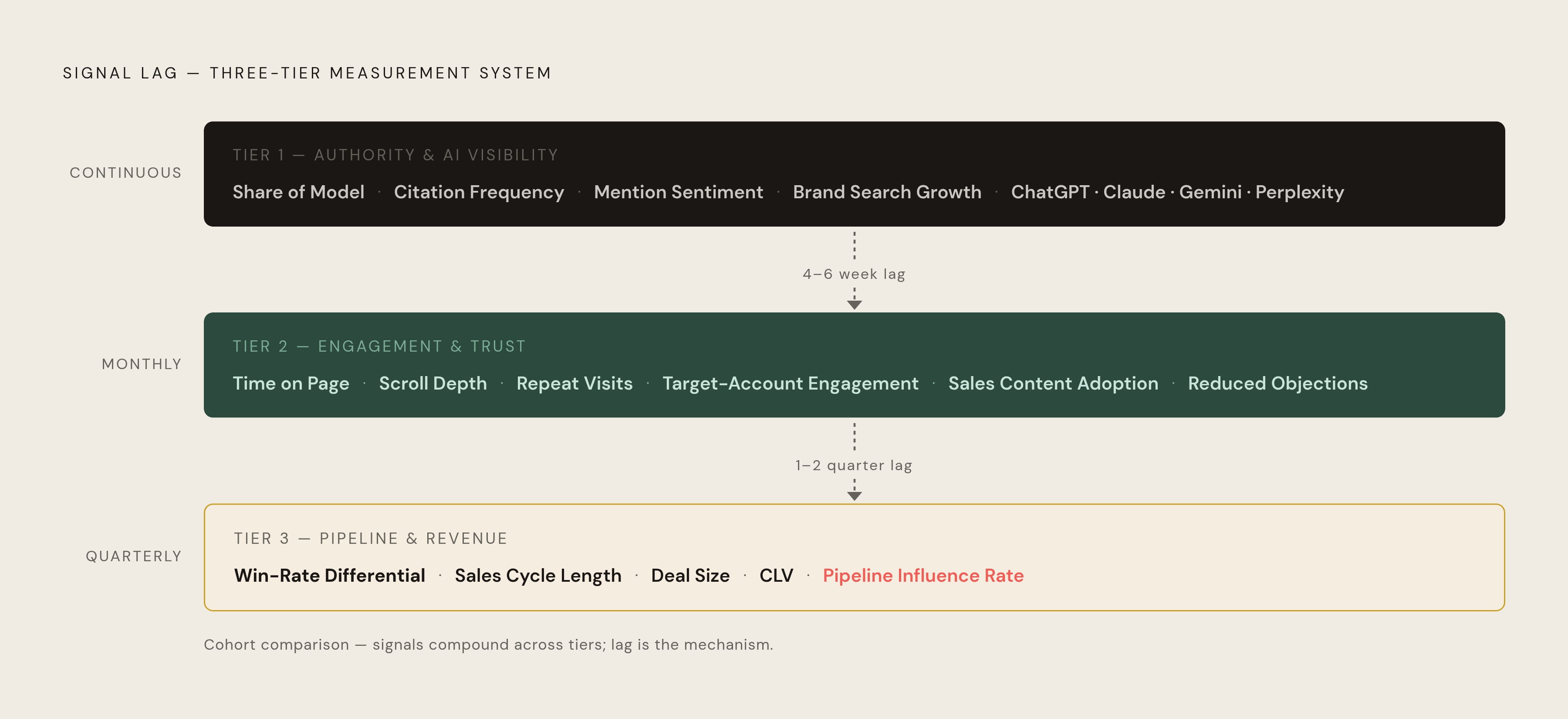
Leadership reporting should assemble these inputs into three tiers that move from leading indicators to lagging proof. The first tier measures authority and AI visibility through Share of Model across target query clusters on ChatGPT, Claude, Gemini, and Perplexity. Citation frequency, cited source URLs, and mention sentiment show the extent and character of that presence. Coverage in category publications, coverage by analysts, and growth in brand search give more evidence that the brand has authority beyond its own site.
The second tier measures engagement and trust. Time on page and scroll depth show how much people read, while repeat visits and target-account engagement in ABM programs show whether they stay interested. Sales content adoption adds evidence that the material is useful in commercial conversations. Reduced objections in sales notes help explain what that usefulness changes for the buyer.
The third tier measures pipeline and revenue by comparing cohorts on win rates, sales cycle length, deal size, and CLV. Pipeline influence rate links those outcomes to the record of each account’s past content engagement. Authority signals need to be tracked all the time, engagement and trust signals need a review each month, and revenue outcomes need to be compared across cohorts each quarter. The lag between these tiers should be explained as part of how thought leadership compounds.
No tier is sufficient on its own because visibility, trust, and revenue answer different questions. Together, they show where authority is forming, whether buyers are engaging with it, and how engaged accounts perform. As AI answer engines handle more discovery, organizations that build this architecture can use its feedback to strengthen their pre-engagement authority. Measurement becomes more than accountability when it helps a program accumulate the credibility that earns a place on the shortlist.