How to Attribute Pipeline to Content Without Gaming the Numbers
Track the signals buyers leave, then measure content's role without inflating your numbers.

Content attribution is a measurement problem before it is a modeling problem. To connect content to pipeline, teams need to record the signals buyers leave, keep what they saw apart from the influence they estimate, and avoid claiming every deal content touched. The goal is a number finance can use.
Why content teams can't connect their work to pipeline — and why attribution models aren't the fix
Finance sees a cost center, while the content team reports pageviews. Neither view shows which work helped create an opportunity. The gap is not rhetorical, so a better presentation will not close it. Pageviews, time on page, and shares dominate reporting because tools surface them readily. What would connect those activities to an account?
Behavioral tracking in GA4 is absent or misconfigured, CRM touchpoints are incomplete, and content scoring does not value engagement before conversion. The missing events never enter the record. Switching from last-touch to multi-touch attribution cannot recover them, because a model distributes credit among the signals available to it. The concrete fix begins with event capture and account records.
How the buyer journey outgrew the measurement stack most teams still run
A large majority of buyers complete most of their evaluation before speaking with sales, so the content shaping a shortlist may leave no CRM trace. Buyers also consume more content before first contact than they did even two years ago.
Larger buying committees deepen that gap. For larger transactions, more stakeholders participate than earlier benchmarks showed, and many never fill out a form. An account can therefore develop a preference before its identifiable journey begins. Consider a buyer who researches in ChatGPT, forms a shortlist, and then searches for a brand. The CRM sees only the branded-search arrival.
How can that journey be distinguished from an unprompted search? Standard tracking alone cannot supply the answer. The measurement stack needs evidence beyond clicks, including changes in branded search and the buyer’s own account of discovery.
What the dark funnel actually contains and what signals can reach it
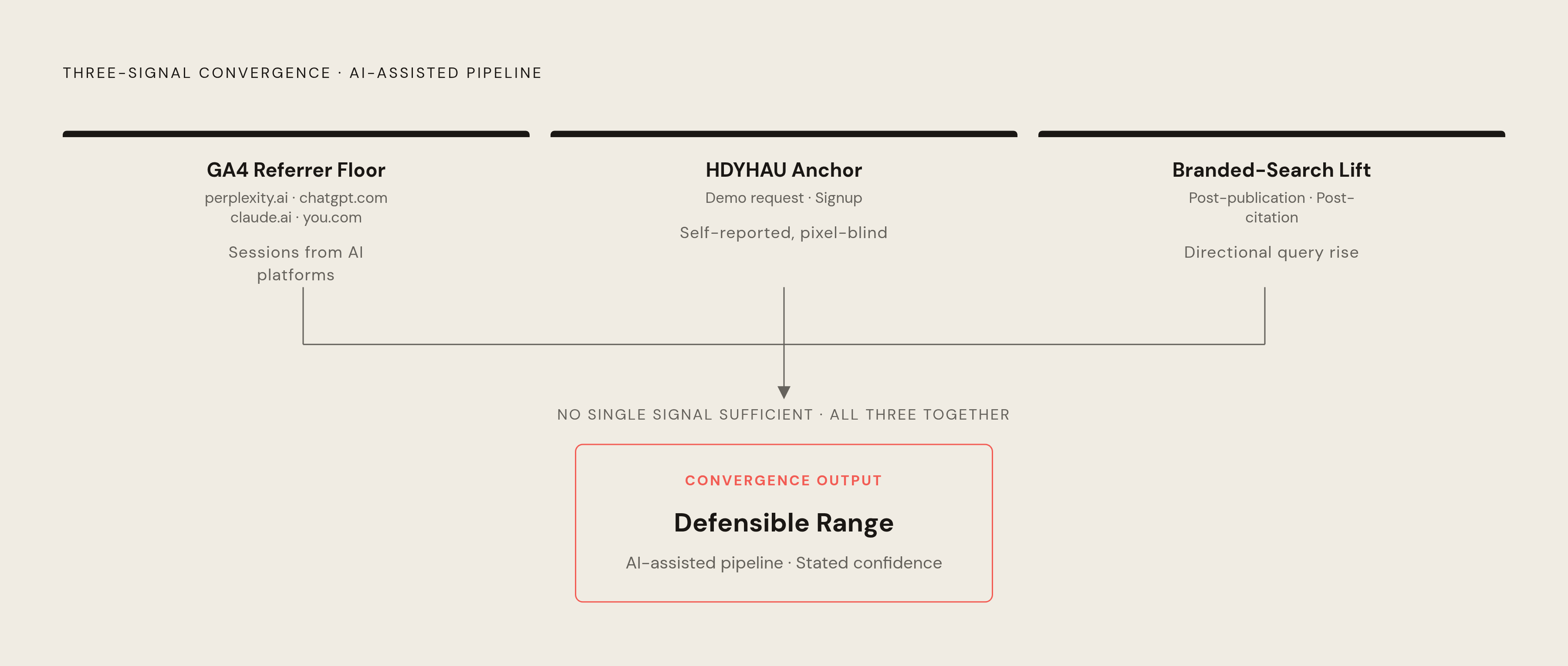
The dark funnel contains an incomplete record of evidence. A useful framework is the three-signal method, combining a GA4 referrer floor, an HDYHAU anchor, and branded-search correlation. The floor consists of sessions whose referral source contains “perplexity.ai,” “chatgpt.com,” “claude.ai,” or “you.com.” These sessions show when an AI platform appearance produces traffic, rather than every occasion on which an answer influences a buyer.
The anchor is self-reported attribution through a “how did you hear about us?” field at demo request or signup. It reaches channels no tracking pixel sees. A buyer’s recollection needs comparison with the other signals. A rise in branded query volume after publication or AI citation provides the third, directional clue.
Together, these signals support a defensible range. AI-assisted pipeline belongs in influenced reporting with a stated confidence level. Bing Webmaster Tools added citation share tracking and a Compare view in June 2026, so the baseline has another signal from the platform itself.
How AI answer engines cite brands — and why standard analytics miss almost all of it
A source link and a brand mention are different observations. An answer can name a brand without linking to its site, or link to a page without naming the brand. A session measures an arrival.
Ghost citations expose the difference particularly clearly. An engine may use a company’s page as a source and link to it while naming a competitor in the answer body. The page earns a citation, but the brand gains no named presence in the recommendation. Counting that link as brand recognition would misread the result.
Models using retrieval-augmented generation find sources first, then use that material to write answers. Models without retrieval rely entirely on parametric memory and produce no source citations. A retrieved page therefore does not guarantee that the answer associates its publisher with the category. Because platforms differ sharply in citation and naming behavior, measurement needs separate mention and citation records for each platform.
Building a prompt-based monitoring protocol that produces honest visibility data
To turn those distinctions into usable data, teams need a fixed set of buying-intent questions. The set must exist before measurement begins. Adding questions after discovering that they produce favorable answers changes the test, making apparent improvement indistinguishable from cherry-picking.
Each response needs four recorded attributes, which are whether the brand appears, its position in the answer, the sentiment of the mention, and whether a source link to the site appears. Share of Model, or SoM, divides brand mentions by total AI answers in the tracked query set. It provides a comparable measure of presence without treating a citation as a mention.
The protocol should run weekly or bi-weekly across ChatGPT, Gemini, Perplexity, and Claude. Teams track each platform’s SoM as its own series and keep the series out of a blended average. The trend lines can then connect to the three-signal method through branded search and AI referrer sessions. If more buyers are finding the brand through that rise in visibility, those downstream signals should follow. A higher SoM without them is a reason to probe.
Why attribution models debate order of operations — the instrumentation has to come first
First-touch identifies the recorded content that brings new audiences into the funnel, supporting decisions about initial demand. Last-touch shows the last recorded interaction, which helps teams judge bottom-funnel assets but leaves out what came before them. Neither answers the whole question on its own.
Data-driven attribution distributes credit according to measured contribution across the journey. Shapley-value approaches are available in GA4 and dedicated attribution platforms, but their honesty still depends on accessible events. The GA4 lookback window also needs to match the actual sales cycle, because a short window systematically excludes earlier content touches.
The reporting discipline is to run all three models, explain their different purposes, and let finance choose the lens for a decision. Selecting only the model most flattering to content is another form of cherry-picking. Before any such comparison, channel and ad-platform claims need reconciliation against CRM opportunity records. Multiple platforms can claim the same conversion, so their dashboards cannot simply be added together.
Separating sourced pipeline from influenced pipeline so neither number lies
Sourced pipeline records where content brought an account in. Influenced pipeline records where content appeared along the way. More precisely, sourced opportunities have content as their first traceable touchpoint, while influenced opportunities include a content touch by at least one buying-group member before close.
That distinction changes what finance can infer. Influenced pipeline is a legitimate, larger view, but it needs an explicit confidence label. Reports on AI-assisted influence also need to state how they use referrer sessions, branded-search correlation, and HDYHAU responses, while leaving out dollar-level attribution claims. These figures are not additive measures of new business.
Pipeline itself is potential revenue. Reporting should therefore separate sourced pipeline, won revenue from that sourced set, and its win rate. In account-based programs, touches also need grouping into one account view before influence is calculated. A VP reading a case study and a CFO attending a webinar do not constitute two content conversions.
A cohort comparison provides a further test. Comparing touched and untouched accounts on win rate and deal size assesses lift without requiring a perfect touchpoint history.
How the content itself — and where it lives — determines whether AI engines can find it and cite it
Honest instrumentation can still reveal weak visibility. Improving that result requires attention to where the evidence about a brand lives, because a large share of citations comes from outside its own domain. For evaluative questions such as whether a product is worth buying, engines systematically prefer sources other than the subject of the query. A G2 review offers independent evidence that a product page does not.
This also explains why more owned content is not a complete answer to ghost citations. The problem can be a weak association between the brand and its category in parametric memory. Publishing more pages on the same domain does not change that memory. Earned media in publications engines treat as authoritative provides a route to building the association.
Owned content still has a distinct role. It acts as the credentialing layer, while third-party coverage acts as the discovery layer, particularly where engines favor independent evaluation. Volume alone cannot substitute for either function. Google’s spam policies target scaled content that adds no value for users, regardless of whether people or AI produced it, so unreviewed expansion can undermine the visibility it seeks.
What a multi-stage content pipeline with human review does for attribution credibility
A citation is not proof of useful content. A page can earn an AI citation and a branded search, yet fail when a prospect scrutinizes its claims. Counting that sequence as an attribution success confuses initial visibility with a credible commercial contribution. A hallucination that attracts attention and then fails at the demo is not pipeline.
Human review protects the conversion events that attribution measures. A large share of AI-generated first drafts needs significant editing, and human-edited output performs meaningfully better on engagement than pure AI output. Review catches errors in the facts before the company publishes those claims under its name.
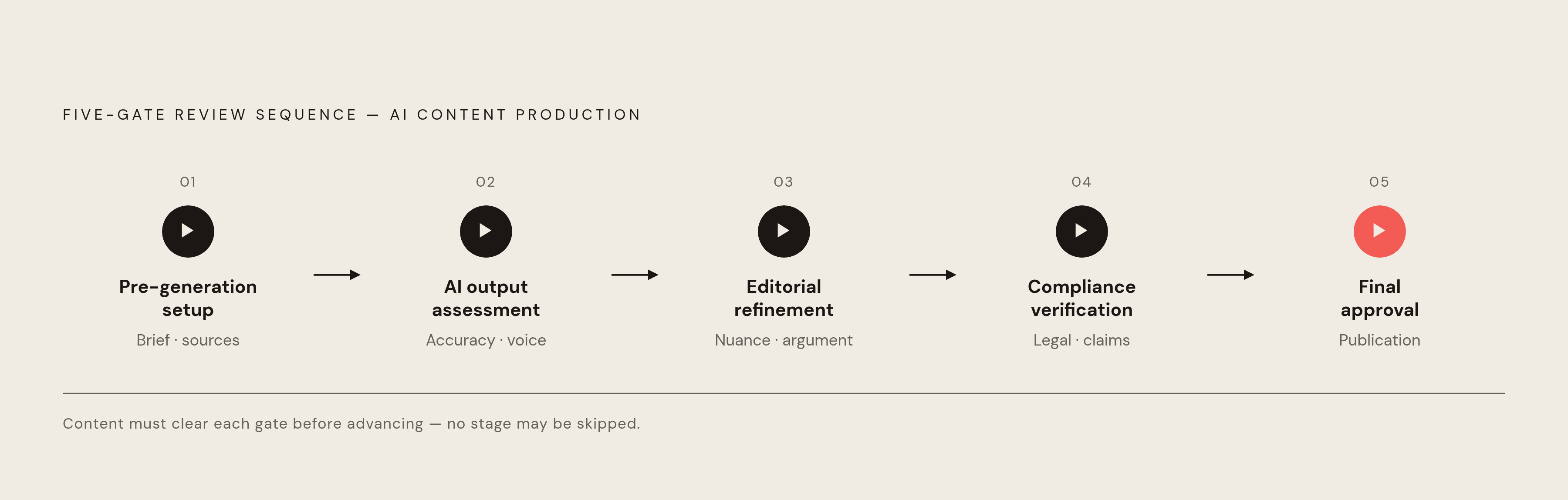
A defensible production process has five gates. Pre-generation setup establishes the brief and source constraints, while AI output assessment checks factual accuracy and brand voice. Editorial refinement works on nuance and argument, compliance verification checks legal issues and claims, and final approval decides what gets published.
Copywriting costs fall while review costs rise, but total costs do not rise proportionally as output scales. The relevant choice is reviewed volume versus unreviewed volume.
Assembling the measurement foundation in the right order
The build begins in GA4, with a 90-day lookback window assessed against the actual sales cycle. Custom events should record scroll depth, engagement time, and micro-conversions, while referral filters pick out sessions from AI platforms. UTM discipline needs verification on every content asset linking to a conversion page. These are the records later analysis will depend on.
The CRM comes next as the reconciliation point. Teams need to match ad-platform and channel reports against opportunity records before they calculate attribution, so claims for the same conversion do not get counted twice. The dark-funnel layer then adds HDYHAU to demo and signup flows, branded-search tracking in Search Console, the AI referrer segment, and a citation-share baseline in Bing Webmaster Tools.
AI visibility monitoring comes next, using the fixed prompt set, the list of platforms, the four attributes of each response, and runs on a schedule. Its SoM trends feed the branded-search correlation analysis. Reporting then separates sourced pipeline, influenced pipeline with method and confidence, and labeled AI-influenced pipeline. The AI line is a distinct, non-additive view of influence.
Won revenue and win rate from the sourced set show how much of that pipeline turned into business. Only then do parallel attribution models interpret the captured journey, with their differences explained. The test is deliberately uncomfortable. The numbers should look smaller than before because real signals replace inflated claims. If the new framework shows more pipeline than the old one, something is wrong.