Fan Engagement Bots for Sports and Entertainment Brands
Sports brands deploy AI chatbots to handle fan support at scale.
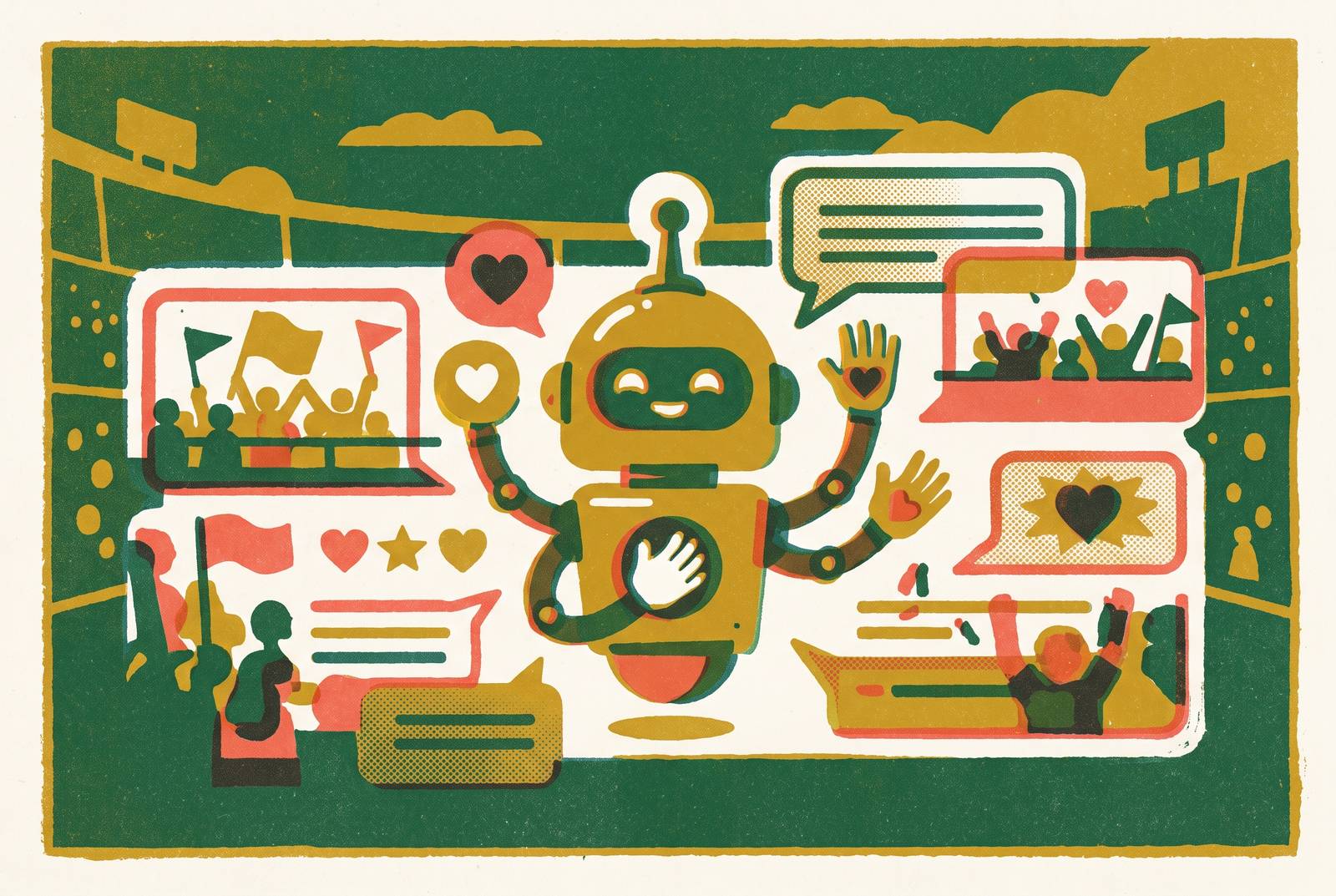
Fan engagement bots have moved past the pilot stage and into the same operational tier as ticketing systems, CRM platforms, and broadcast rights management⟦c3⟧. Stats Perform's 2026 Sports Fan Engagement, Content Monetisation and AI Trends Report, drawing on responses from 675 sports media executives worldwide, found that 81% of executives expanded their AI use over the past year specifically to gain efficiency and cut costs, showing the old staffing model no longer scales⟦c4⟧. That's a signal about cost, not curiosity. It's an admission that the old staffing model, built around human support teams answering the same questions over and over during a live event, no longer scales.
The same survey respondents expect owned apps and social video platforms to overtake websites as the primary channel for fan engagement by 2030⟦c5⟧. Bots that live inside those channels move with the audience instead of waiting for the audience to come find them on a website. SponsorUnited's platform data backs up the pace of this shift with a harder number: more than 250 brands activated AI-driven experiences across live sports and entertainment environments in 2026, up from 201 the year before⟦c6⟧. It's activity already logged.
Fan expectations have shifted alongside the infrastructure. A bot that responds within a business day used to be acceptable. Now the baseline is real-time, personalized, and interactive, and a brand that can't hit that baseline loses attention to a competitor that can. The operating question for any sports or entertainment brand in 2026 isn't whether to build a fan engagement bot ⟦c4⟧. It's whether the one being built can survive contact with an actual fan journey, from the week before an event to the morning after.
What fan engagement bots do across the fan journey
Strip away the vendor language: fan engagement bots do four things, each tied to a different moment in the fan relationship⟦c7⟧. The first is real-time information delivery: live scores, lineup changes, in-game stats, gate and parking logistics, delivered without the delay of a human checking a feed and typing a response. The second is conversational personalization, where a fan asks a question in plain language and gets an answer shaped by their team, their location, or their past behavior, a pull interaction rather than a blast notification. The third is predictive and interactive games, the quizzes, score predictions, and voice challenges that turn a fan from someone watching a screen into someone playing along with it. The fourth is transactional: ticketing questions, merchandise alerts, VIP upsells, and prize redemption handled inside the same conversation⟦c8⟧.
That single deployment touched information delivery, personalization, engagement mechanics, and a commercial outcome (the subscriber conversion) in one conversational thread.
That outcome depends on a design choice that's easy to overlook: channel agnosticism. A bot that requires downloading a dedicated app loses reach before it starts, while a bot built on RCS, WhatsApp, or social chat, the channels fans already have open, extends engagement without asking anyone to do something new⟦c10⟧. Softjourn's proof-of-concept event discovery chatbot illustrates the personalization and commercial functions well: a fan can type something as specific as "family-friendly events under $50 near me this weekend," and the bot cross-references genre, price, location, and inventory, while also surfacing underperforming events and upselling merchandise based on what the fan has already shown interest in⟦c11⟧.
None of this works if the bot only switches on for two hours during a live event ⟦c50⟧. The strongest implementations treat the fan journey as a continuous arc, pre-event hype building anticipation, in-game interaction sustaining attention, and post-event re-engagement pulling fans back for the next thing. Infobip and CMI built an AI chatbot on RCS for Claro Sports during a major global sporting event, reaching 11+ million people, generating 35,000+ fan interactions, and producing 2,600 new subscribers (a concrete illustration of all four functions operating at once) ⟦c9⟧.
The design decisions that separate working bots from abandoned ones
Channel selection has to come first, and it has to be decided by where the audience already lives, not by what's easiest for the brand's engineering team to stand up⟦c12⟧. A bot built on the wrong surface, one that assumes fans will seek out a new app, is fighting an uphill battle before a single message goes out.
Voice affects how much trust a brand builds or erodes, since a bot's tone that mismatches its audience gets noticed immediately and damages credibility. A generic-sounding bot erodes trust fast, and a bot built for an NFL franchise has no business sounding like one built for a K-pop fandom or a regional cricket board⟦c13⟧. Fans notice tone mismatches the way they'd notice a mascot in the wrong jersey. That's connected to a broader tension running through the industry right now: sports and entertainment audiences are among the most human-seeking groups a brand can market to, and when fans sense a communication is hollow or artificial, loyalty and word-of-mouth both suffer. Content providers have started treating "human-made" as a premium label in response. Bot design has to lean into transparency, being upfront about what's automated and where a human takes over, rather than trying to pass the bot off as something it isn't⟦c46⟧.
Gamification separates the bots fans return to from the ones they try once. Quizzes and polls carry a low barrier to entry and work asynchronously, so they're a safe default. Voice challenges create shareable moments that extend reach organically past the fans who engaged directly. Augmented reality games ask for more production investment but pay back in deeper loyalty, and score predictions tied to real stakes, rewards or prizes, are what keep fans opening the bot across an entire season instead of a single weekend.
None of the commercial upside is reachable without integration. A bot that can't talk to ticketing, CRM, or e-commerce systems is, functionally, a content-delivery tool and nothing more, since upsells, prize redemption, and subscription prompts all require a live connection into the brand's existing tech stack⟦c14⟧. The Claro Sports deployment demonstrates what that looks like when it's done right: rich media delivery, live updates, and subscriber capture all running through one conversational interface, built on top of infrastructure that already existed rather than replacing it⟦c15⟧.
There's a final design decision that gets skipped more often than it should: human review. Raw AI output should never ship straight to a fan without an editorial checkpoint, because brand safety, factual accuracy, and voice consistency all depend on it, and a factual error in real-time sports content spreads before anyone can walk it back⟦c16⟧. Research on AI content pipelines puts a hard number on how rare full automation trust actually is: only 4% of marketers trust raw AI output without human oversight⟦c17⟧. The bots that survive past launch pair AI's drafting speed with a human checkpoint before anything reaches the fan, not after ⟦c1⟧.
Brands across sectors, not just rights holders, activating fan engagement bots
None of this infrastructure is limited to leagues, broadcasters, and rights holders. Any brand with a real connection to a fandom can build an engagement layer on top of an audience that already exists and is already paying attention⟦c18⟧.
Food and beverage brands use bots for in-chat ordering, instant prize redemption, and pre-match reminders that pull fans back into a purchase habit tied to game day. Retail and e-commerce brands lean on augmented reality try-ons for team merchandise, gamified rewards that drive repeat purchase, and exclusive drops timed to specific match moments⟦c19⟧. Telco brands use match reminders, subscription upsells, and interactive polls during tournaments, personalized by the fan's team allegiance. Banking and financial services brands tie cashback to fan activity and run exclusive in-chat offers and prize games around major sporting events. Travel brands run augmented reality activations at destination airports and venues, unlocking prizes and VIP access for fans traveling to see an event in person⟦c20⟧.
The Pepsi, Regal, and Gladiator II collaboration on the "Pepsi COLAsseum" activation in Times Square shows what this looks like at full scale outside of sports entirely: augmented reality costume try-ons, personalized accessories, 360-degree content capture, and a 4DX screening, combined into one branded environment where identity, commerce, and content creation happen in the same interaction⟦c21⟧. This is a useful case because the brand is a beverage company and a movie studio, not a sports brand. It's a beverage company and a movie studio building a fan experience around a film release, using the same mechanics a stadium bot would use around a live match.
That expansion answers a demand that sponsors have been voicing loudly. SponsorUnited's data shows 70% of sports media executives say sponsors now want more digital content, while more than a third admit they struggle to find authentic ways to connect a sponsor to a sport⟦c22⟧. Bot-driven engagement is a direct answer to that gap: it lets a non-rights-holding brand participate in a live fan moment without needing broadcast inventory or a stadium presence, something that used to be the only entry point into fan attention.
Measuring whether a fan engagement bot is working
Measurement is where most of this infrastructure quietly falls apart. Research cited in industry coverage found that 88% of marketers use AI daily, yet only 19% track AI-specific KPIs, and that gap has a direct casualty: 42% of companies abandoned most of their generative AI initiatives over the past year, up sharply from 17% in 2024⟦c23⟧. A bot without defined success criteria doesn't fail cleanly. It limps along until someone notices the budget line and cuts it, which is a worse outcome than never building it.
The metrics that actually apply to a fan engagement bot break into a few clear categories. Interaction volume and depth show whether fans are using the bot once out of curiosity or returning across a season. Conversion events, tickets bought, merchandise ordered, subscriptions activated, prizes redeemed, tie the bot directly to revenue rather than vague engagement. Subscriber and community growth measures net new contacts flowing into CRM or a messaging list, and the Claro Sports deployment added 2,600 new subscribers as a direct, attributable outcome of the bot itself⟦c24⟧. Timing matters too: a bot that only spikes during the two hours of a live match isn't building a relationship, it's answering a question ⟦c50⟧. And sentiment or escalation rate, how often a conversation breaks down and needs a human to step in, reveals design gaps that raw interaction counts will hide.
There's a second measurement layer that most fan engagement teams haven't built yet: the brand's visibility when fans ask ChatGPT, Perplexity, or Gemini about an event, a team, or an experience⟦c25⟧. That's a distinct signal from bot analytics, and it needs its own dashboard rather than getting folded into the same report. Teams that set these KPIs during the design phase, before launch, avoid the trap of rationalizing a bot's underperformance after the fact just because it's already live⟦c26⟧. Measurement tools and dashboards should cover both the conversational bot's direct metrics and the brand's broader AI answer-engine presence (these are related but tracked separately) ⟦c27⟧.
Bot content's role in the brand's visibility in AI-generated answers
The way fans search for information has changed underneath the industry's feet. In 2026, roughly 68% of Google searches ended without a click, based on SparkToro's analysis of Similarweb data from January through April of that year, while ChatGPT reached 883 million monthly users and AI Overviews now appear in roughly half of all Google searches⟦c28⟧. A fan asking about a team, an event, or a brand experience is increasingly reading an AI-generated answer instead of clicking through to a ranked page ⟦c25⟧.
That changes what counts as a conversion. Getting named in that answer is now a conversion event in its own right: a brand cited by ChatGPT or Perplexity when a fan asks "best fan experience at an NFL game" or "how do I get early access to concert tickets" is reaching a high-intent user at the exact moment of decision⟦c29⟧. Bot interactions produce the raw material that builds toward that citation, if the content gets published in the right form⟦c30⟧.
FAQ and structured Q&A content built from the actual questions fans ask a bot is close to ideal for this purpose, because those questions are already phrased at the conversational length AI systems are trained to answer⟦c31⟧. Case study content documenting bot outcomes, reach, interaction counts, subscriber growth, gives AI systems something evidence-backed to cite, and the Claro Sports figures are exactly the kind of specific, sourced numbers that tend to earn that citation⟦c32⟧.
Academic research estimates it takes around 250 documents to meaningfully shape how a large language model represents a brand⟦c34⟧. A one-off case study won't move the needle. It takes a sustained, structured publishing habit around fan engagement outcomes and audience insight, built over time rather than around a single launch. Brand search volume itself is the strongest single predictor of AI citation, so a bot activation that gets fans talking, sharing, and searching for the brand directly is doing citation-building work as a byproduct, whether or not that was the original intent⟦c35⟧. Brands that keep a consistent multimodal presence, bot interactions, video, structured data, owned editorial working together, see higher mention rates across large language models than brands relying on text alone⟦c36⟧. Closing the loop means tracking whether ChatGPT, Claude, Gemini, and Perplexity actually name and cite the brand around fan engagement topics, a separate instrument from bot analytics that requires its own dedicated monitoring⟦c37⟧. Third-party coverage of bot deployments (press in trade publications about an innovative bot activation) carries roughly 3x more weight for AI citation than brand-owned content alone ⟦c33⟧.
Platforms and tools that power fan engagement bots in 2026
A handful of named platforms illustrate the range of what's being built right now. Infobip runs a conversational AI platform with sports and entertainment as one of several verticals it serves, supporting RCS, WhatsApp, social chat, and other messaging channels through plug-and-play integrations meant to sit on top of a brand's existing tech stack, and the Claro Sports and CMI RCS deployment is its clearest demonstration at scale⟦c38⟧. Softjourn, a software development and consulting firm with a specialization in event ticketing, built a proof-of-concept AI chatbot for event discovery capable of handling natural-language fan queries, surfacing events dynamically, upselling merchandise, and feeding analytics back to the ticketing platform it's built to integrate with⟦c39⟧.
Stats Perform's Opta Stream tool feeds real-time statistical insight into fan-facing products and supports automated content generation for broadcasters, media outlets, and apps, and it was named Best Tool or Service at the 2025 FBIN Management Excellence Awards⟦c40⟧. Fox announced its Fan OS at its 2026 upfronts, describing it as an "agentic AI native" operating system built to connect fandom insight with advertising outcomes, under the tagline "Turn Passion Into Performance"⟦c41⟧. Beyond named platforms, there's a broader category of AI content pipeline providers built around pairing AI drafting speed with human review, relevant for any brand that needs to publish bot response libraries, FAQ content, or match-day editorial at volume without letting accuracy or voice slip, and with 94% of marketers planning to use AI for content creation in 2026, that category-level infrastructure isn't optional anymore⟦c42⟧.
Choosing between these options comes down to a short set of practical questions. Does the platform reach the messaging surfaces where the target fans already spend time? Can it connect to ticketing, CRM, e-commerce, and loyalty systems without a rebuild⟦c43⟧? Does it give editorial teams a real checkpoint before content reaches a fan, or does everything ship automatically? Does it produce the specific KPIs needed to track conversion events, subscriber growth, and engagement depth⟦c44⟧? And does its publishing layer generate structured, citable content that builds the brand's presence in AI-generated answers, not just inside the bot conversation itself⟦c45⟧?
The tradeoffs and failure modes brands get wrong when deploying fan bots
The single most damaging mistake is underestimating the authenticity risk. When a fan senses that a bot is hollow, scripted past the point of usefulness, or dodging a direct question, the backfire is worse than if the brand had never built a bot at all, and the data on this is blunt: communications that feel artificial produce lower loyalty and less word-of-mouth, not neutral outcomes⟦c46⟧. Sports and entertainment audiences are unusually human-seeking, so the brands positioning "human-made" content as a premium signal are onto something real, and a fan bot that owns its own nature, admitting where it's automated, escalating cleanly to a person when a conversation calls for it, will outperform one trying to disguise what it is.
Quality drift is the second failure mode, and it's a quieter one. That drift doesn't announce itself with an error message. Declining engagement depth and rising escalation rates appear in the data, the exact metrics a brand only catches if it built the measurement layer before launch instead of after.
Brands also tend to treat channel choice and integration depth as afterthoughts rather than the foundation they actually are. A bot built on the wrong channel loses reach it can never fully recover, and a bot that can't talk to ticketing or CRM stays permanently capped at content delivery, no matter how good its personality design is ⟦c3⟧. None of these failure modes are exotic. They're the predictable result of treating a fan engagement bot as a marketing add-on instead of the infrastructure it has already become. Quality drift in AI-generated bot responses: 18 ⟦c47⟧.
Sources
- Accelerated AI Adoption, Shifting Fan Expectations and Sponsor Priorities: The 2026 Fan Engagement, Monetisation and AI Trends Survey
- Breakout Plays 2026: Tech-Led Fan Experiences Redefine Sponsorship
- Fan engagement solutions for sports & entertainment brands
- Fan Engagement in Sports, Entertainment, and Beyond
- Upfronts 2026: Agentic, outcomes and fandom are this year's buzzwords | The Current
- 2026 Sports Fan Engagement, Monetisation & AI Trends Survey - Stats Perform