Differentiating Thought Leadership from Content Marketing
Thought leadership changes buyer perception; content marketing meets existing demand.

Content marketing starts with the audience. Specifically, it starts with what the audience already cares about, what they are already searching for, what questions they are already asking. The job is to meet them there, helpfully and efficiently, across formats designed to accumulate value over time.
That accumulation is the real structural feature. Blogs, short articles, email sequences, case studies, social posts: these formats work because frequency compounds. A content library built over two years earns search equity, nurtures awareness, and influences pipeline in ways a single asset never could. The economics are favorable precisely because owned content keeps generating returns after the spend stops, unlike paid media that goes dark the moment the budget does.
The metrics reflect the mechanism. Traffic, email engagement, conversions, pipeline influence: these are the native measurements of a content marketing program. Concrete, attributable, optimizable. The Content Marketing Institute's 2024 B2B benchmarks survey put content marketing spend at roughly 26% of total marketing budgets, a figure that reflects accumulated organizational confidence in what the function can deliver. That confidence is warranted, within limits.
And those limits matter. Content marketing serves intent that already exists. It does not generate intent. It cannot change how someone thinks about a problem space; it can only show up when they are already thinking about it. That is a real constraint, and it is exactly where the second function begins.
What thought leadership is actually built to do
Thought leadership inverts the logic entirely. It does not begin with what the audience already believes. It begins with what the author believes they should believe instead, and then argues for it with evidence, with standing, and with enough specificity to make the position defensible rather than decorative.
The unit of thought leadership is not a topic. It is a point of view. There is a significant functional difference between a piece of content about supply chain risk and a piece that argues most organizations are managing supply chain risk through the wrong mental model, here is the evidence, and here is what to do instead. The first is content marketing. The second is thought leadership, provided it is backed by original evidence and a named perspective from someone with genuine standing in that category. The format similarity between the two obscures a categorical difference in purpose, which is part of why the conflation persists.
The natural formats are different as well: executive bylines, original research reports, conference keynotes, long-form opinionated essays. These carry a named perspective and accumulate credibility rather than traffic. Thought leadership is not built for frequency; it is built for weight. A single well-researched, well-argued report can reconfigure how a buyer thinks about a problem space in ways a year of blog posts simply cannot. Content marketing keeps the lights on. Thought leadership changes what the buyer sees when the lights are on.
The 2024 Edelman-LinkedIn study, which surveyed nearly 3,500 management-level respondents across seven countries, found that 73% of B2B decision-makers said thought leadership is a more trustworthy basis for assessing a firm's competence than its conventional marketing materials. Sit with that for a moment. Buyers are actively discounting the thing most organizations spend the majority of their content budget producing, and elevating the thing most organizations either do poorly or mislabel entirely.
The four structural differences that separate them in practice
Starting point
Content marketing begins with audience intent. What are buyers searching for? What questions surface in sales calls? What topics trend in the category? Editorial decisions flow from that external signal.
Thought leadership begins with the author's original perspective, frequently one the audience has not yet articulated and would not have produced on their own. The editorial question is not "what does the market want to read?" It is "what do we believe that the market does not yet understand, and can we actually prove it?" Those are genuinely different conversations, and organizations that cannot tell them apart end up running neither process properly.
What each function optimizes for
Content marketing optimizes for measurable conversion at the asset level: MQLs, traffic, click-through, email engagement. These are proximate to the transaction and legible in a dashboard.
Thought leadership optimizes for something considerably less proximate and considerably more valuable over time: invitation rate. Whether a company ends up on an RFP list. Whether a buyer reconsidering their current vendor bothers to include you at all. Whether your brand surfaces when a buyer is framing a new initiative from scratch, before any formal process has begun.
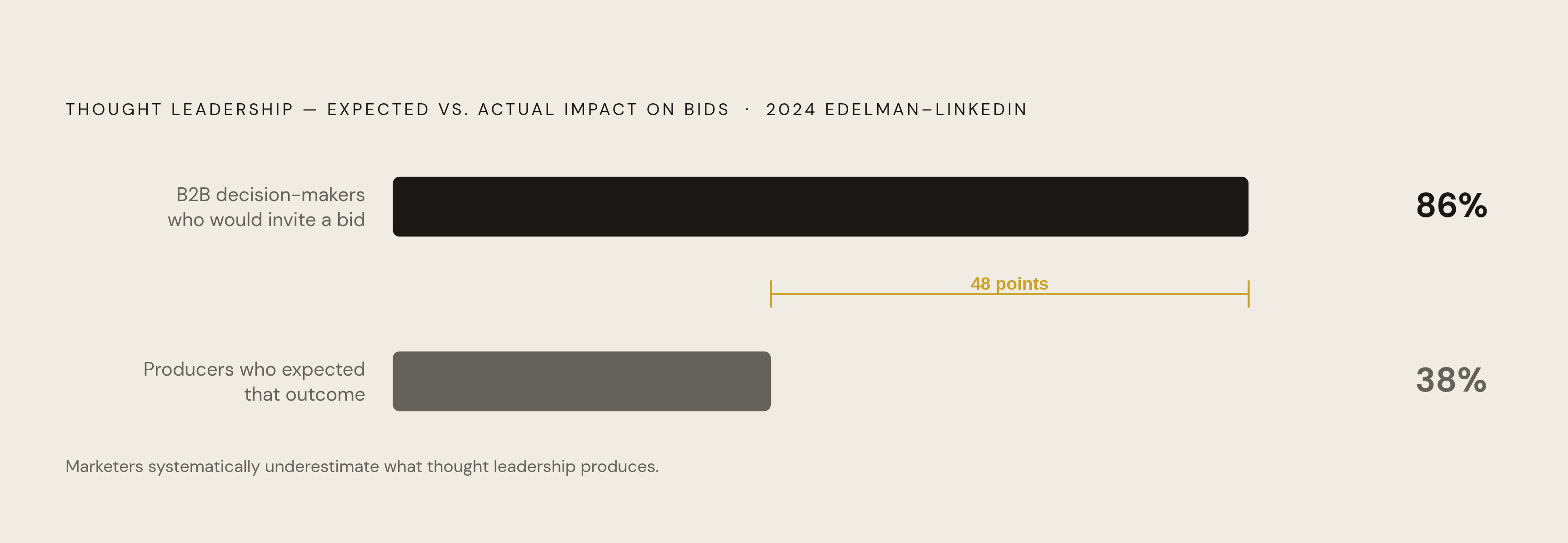
The 2024 Edelman-LinkedIn data makes this tangible. Eighty-six percent of decision-makers said they would likely invite a company to bid on a project if it consistently produces high-quality thought leadership. Only 38% of thought leadership producers anticipated that outcome. A 48-point gap between what buyers actually do and what marketers expected is not a rounding error. It is a systematic failure to understand what the function produces.
Cadence and format
Content marketing runs on frequency. Shorter formats, evergreen topics, regular publishing schedules: these are the conditions under which compounding activates. The mechanism requires rhythm.
Thought leadership runs on investment per piece. A bylined essay from the CEO, a proprietary research report built on original data, a keynote at the industry's flagship conference: these carry categorical authority that ten blog posts cannot approximate, because they carry a named perspective and evidence no competitor could replicate without doing the same underlying work. Volume is not the goal. Signal strength is, and signal strength and volume are often in direct tension with each other.
Who produces it and where it belongs
Content marketing is appropriate across B2B and B2C contexts. Thought leadership's natural home is B2B, where category authority and vendor credibility materially influence purchasing decisions made by committees, across lengthy cycles, with significant organizational risk attached.
More practically: thought leadership is executive-native. Its credibility derives from a named perspective held by someone with genuine standing in the category. When it is produced entirely by content teams, without access to executive knowledge or organizational data that only insiders hold, what comes out is content marketing dressed in borrowed authority. It looks right. It reads fine. But buyers, who are not unsophisticated, sense the absence of a real perspective even when they cannot name what is missing.
What the business case for genuine thought leadership actually shows
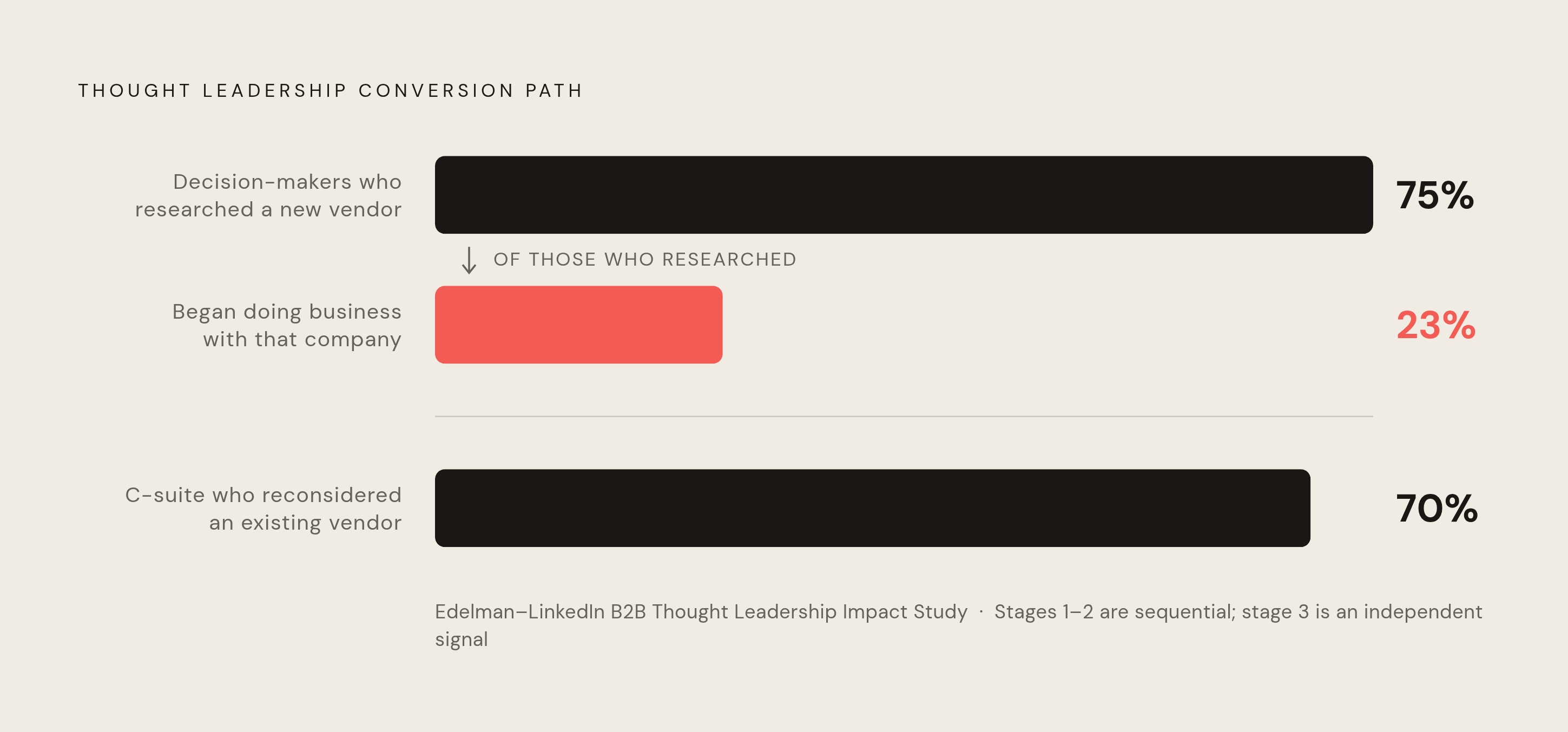
The most striking finding from the 2024 Edelman-LinkedIn study is not about pipeline. It is about displacement. Seventy percent of C-suite executives said thought leadership led them to reconsider an existing vendor relationship. Fifty-four percent said it made them realize other vendors might better understand their challenges.
These are seated relationships. Contracts already in place. Being actively disrupted by a piece of content. No content marketing asset operates on that mechanism. A blog post does not make a CFO reconsider a multi-year enterprise agreement. A rigorous, well-sourced argument about a problem the CFO thought was already solved, written by someone with the standing to make it, can. That is a different order of influence entirely.
The conversion path that follows is worth understanding in sequence. Seventy-five percent of decision-makers in the same study said a compelling piece of thought leadership prompted them to research a product they had not previously been considering, and 23% of those who went as far as researching ultimately started doing business with that company. That is a meaningful sequence initiated entirely outside the conventional funnel, without a single content marketing touchpoint required to start it.
There is also a margin dimension that marketing programs rarely discuss honestly. Sixty percent of decision-makers told Edelman-LinkedIn that high-quality thought leadership makes them more willing to pay a premium. This is not a pipeline lever. It is a pricing lever, operating at the contract level rather than the MQL level. Most organizations are not measuring for it, which is part of why they chronically underinvest in the function that produces it.
The generational signal reinforces all of this. "Being an active thought leader in the category" moved from 20th place to 3rd place globally among B2B decision drivers in 2024, per Edelman-LinkedIn data. Among Gen Z and Millennial B2B buyers specifically, it ranked second. These buyers are already in senior procurement and executive roles, making decisions now.
One dimension organizations consistently underestimate: the audience extends well beyond the primary buyer. The 2025 Edelman-LinkedIn research on hidden buyers found that 63% of finance, legal, compliance, and procurement stakeholders spend more than an hour per week consuming thought leadership, and 55% use it to evaluate vendors. Nearly identical to the 56% of primary buyers who do the same. The buying committee is reading. Most thought leadership programs are not written with them in mind.
Why most of what's called thought leadership doesn't function as thought leadership
Ninety-six percent of organizations produce content they label thought leadership. Fifteen percent of buyers rate what they actually read as very good. That gap is not a quality problem. It is a category error, executed at scale, consistently, across the industry.
The 2024 Edelman-LinkedIn study found that 71% of decision-makers say less than half of the thought leadership they consume gives them genuinely valuable insights. Dentsu's 2024 B2B brand index found that only 26% of B2B buyers give brands high marks for thought leadership quality, down from 31% in 2022. Satisfaction is declining as volume rises. Those two trends together describe exactly what happens when a label is applied indiscriminately: more content, less credibility, a market that has begun to treat the entire category with pre-emptive skepticism.
The most common failure is structural rather than executional. Organizations produce content marketing and call it thought leadership. Summarizing industry trends is content marketing. Curating best practices is content marketing. Aggregating survey data from a commissioned poll of 400 marketers is content marketing. A named, defensible claim about where the category's conventional wisdom is wrong, backed by original evidence no competitor could replicate without doing the same underlying work, is thought leadership. The distinction is not about quality of execution. It is about what the content is actually doing.
The product-push failure compounds the structural one. Buyers are 46% less likely to trust thought leadership that is overtly focused on products, per Edelman-LinkedIn data. When the content's frame is the vendor's solution rather than the buyer's problem, the credibility mechanism collapses entirely. Thought leadership earns trust precisely because it is not selling. The moment it sells, it becomes marketing. Buyers distinguish between the two, and they penalize conflation reliably.
Generative AI has made this worse in a specific way. Seventy-two percent of B2B marketers are now using generative tools, and 45% use AI to write content, per CMI benchmarks data. Grammatically polished, well-structured, topically coherent content is now the baseline, not the differentiator. Generic, perspective-less output is more invisible than it has ever been, not because it is poorly written but because everyone can produce it at the same level. The floor has risen. The ceiling, which requires original evidence and a genuine point of view, has not moved.
The personnel problem is the least discussed and perhaps the most decisive. Thirty-seven percent of organizations have under 5% of their internal experts contributing to thought leadership programs. The content is being produced without the people whose firsthand knowledge would make it credible. You cannot outsource the point of view. You can assist with production, but the perspective has to belong to someone real, and it has to come through in the work.
What makes a piece of content actually qualify as thought leadership
The buyer standard is specific. Ninety-one percent of hidden buyers in the 2025 Edelman-LinkedIn study said high-quality thought leadership helps them uncover challenges they had not previously recognized. That is the functional test, and it is a demanding one. If the content only confirms what the reader already believed, it is content marketing at best. If it surfaces a problem they did not know they had, or reframes one they thought was already resolved, it is doing something categorically different.
Three markers distinguish genuine thought leadership in practice.
The first is a named, defensible claim. Not "AI is transforming the industry," which is a topic, not a position. Something closer to: "Most organizations are implementing AI incorrectly because they are treating it as an automation tool rather than an autonomous decision-maker, and that misclassification is producing the wrong governance structures." Specific enough to be contested. A competitor could not simply adopt it without doing the same underlying work to arrive there. The specificity is not stylistic; it is structural. Generic assertions do not change how anyone thinks about anything.
The second is a source of standing. Original research, proprietary data, or firsthand experience that gives the author the right to hold the position. Worth being precise here: a finding derived from your own product data or customer behavior is structurally unreplicable because only you have access to the conditions that produced it. A survey of several hundred marketers, commissioned by any company with a research budget, is not a proprietary finding. It is a content marketing asset formatted to look like one.
The third is non-promotional intent. The piece must shift the frame of the problem rather than position a product within the existing frame. Buyers are sophisticated enough to distinguish between the two, and the data confirms they penalize conflation heavily. This does not mean the company cannot benefit from the piece; it means the benefit cannot be its visible purpose.
Formats that carry these markers naturally include executive op-eds, original research reports, conference keynotes, opinionated long-form essays, and substantive podcast appearances where the guest holds and defends a real position rather than narrating a career arc. What these formats share is a named perspective with backing: a person on record making an argument they can be held to.
How to run both deliberately rather than collapsing them into one undifferentiated program
Here is the practical frame: content marketing and thought leadership are not competing for the same budget or doing the same job. They are complementary functions with different inputs, different cadences, different success criteria, and different organizational homes. Running them without distinguishing them produces the current state of most programs, which is neither function operating at its potential.
Content marketing is the engine. High-frequency, topic-driven content that serves audience intent, supports search visibility, moves leads through the funnel, and compounds over time. AI-assisted workflows that pair production capacity with genuine editorial judgment can sustain a content marketing program without the cost structures that previously made it prohibitive. This is where scale is appropriate, and where it belongs.
Thought leadership is the signal. Low-frequency, POV-driven content that earns category authority, disrupts existing vendor relationships, and opens doors that content marketing cannot reach. It requires executive voice, original evidence, and a willingness to make a claim that is not universally agreed upon. It cannot be produced at volume without diluting the properties that make it work. Treating it like a content marketing program, with volume targets and editorial calendars built for frequency, is the fastest way to produce the category error the data already describes at industry scale.
The sequencing relationship between the two matters more than most organizations recognize. Thought leadership sets the frame; content marketing fills it in. The defensible position established in a research report or keynote becomes the strategic context that makes downstream content coherent rather than arbitrary. Without that upstream frame, content marketing is a collection of helpful topics. With it, the same content functions as evidence for a larger argument the organization is making about the category.
The executive involvement problem is the most common operational failure in practice. Thought leadership produced entirely through content teams, without the standing of a named expert or organizational leader, is structurally weakened before anyone reads it. The solution is not to make executives write more. It is to build interview and synthesis workflows that extract the genuine perspective from the people who hold it and move it through production without laundering out the point of view in the process. That distinction, between capturing voice and replacing it, is where most programs quietly fall apart.
Measurement must stay separate. Content marketing is measured on traffic, MQL volume, email engagement, and content-influenced pipeline. Thought leadership is measured on brand search lift, vendor reconsideration rates, and RFP invitation frequency. Different signals at different time horizons. Organizations that run a single measurement framework across both functions will inevitably optimize for the easier metrics and starve the function that produces the more consequential results.
The leaders who run both functions well share one habit: they resist the prestige of the label long enough to ask what job each piece of content is actually built to do. Ask that question consistently and honestly, and the operational difference between a program that merely accumulates and one that actually compounds becomes obvious.