AI Ghostwriting for Executive Thought Leadership
Authentic thought leadership requires human insight extraction, not just AI drafting efficiency.
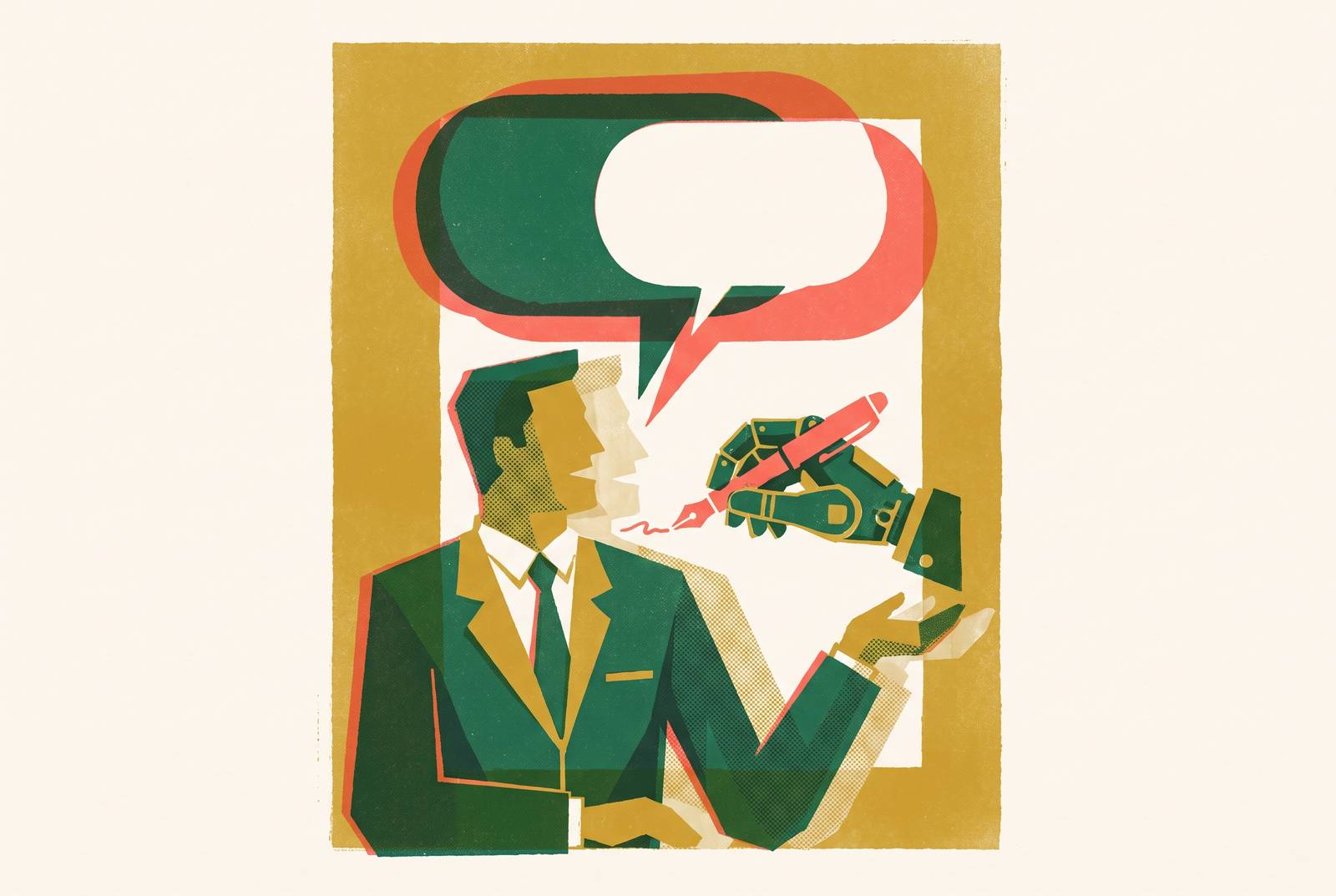
A senior executive's working week has no slack. That's not a complaint; it's a structural fact. The asymmetry is simple: the executive holds the ideas, the domain expertise, the credibility. What they don't have is three hours on a Tuesday afternoon to turn those assets into something publishable. In other words, they're time-poor but insight-rich — like a library with no librarian.
Ghostwriting is not a modern workaround. Politicians, authors, and CEOs have used ghostwriters for as long as there have been publishers to receive the copy. What makes a piece authentic is authorship of the thinking, not who types the draft. The line holds as long as the ideas originate with the executive. The ghostwriter's job is to extract, shape, and translate, not invent opinion from scratch. AI changes the economics and mechanics of that translation. It does not touch the underlying logic.
What AI Actually Changes About the Ghostwriting Workflow, and What It Doesn't
AI earns its place at specific, bounded tasks: research aggregation from transcripts and source material, first-draft generation from structured prompts, content repurposing across formats. Turn a keynote into a LinkedIn series. Turn a podcast appearance into a bylined piece. Style adaptation, once a voice profile exists. These are real gains.
Where a lot of programs get into trouble is assuming the gains extend further than they do. The extraction interview, the conversation where a skilled ghostwriter surfaces the particular, non-obvious insight the executive actually holds, requires human judgment about which question opens the right line of thinking. A bad question gets you a safe answer that reads like a press release. AI cannot exercise editorial discernment about what's worth saying versus what's forgettable, and it carries no reputational accountability. A skilled ghostwriter's professional judgment is behind the work in ways a model's simply is not.
Here is what I've watched happen repeatedly in programs that skip this distinction: AI-only ghostwriting produces content that is competent and completely forgettable. Surface fluency without the specific insight that earns real attention. The ghostwriter functions as a strategic and editorial governor, directing tone, context, and framing. AI handles the mechanical production work beneath that layer. Remove the governor and you get the machine's default output — think of it as a photograph of the average face: technically a face, but no one you'd recognize in a crowd. That average is not what a C-suite content program can afford to publish.
The counterintuitive result of AI adoption in this space is that demand for ghostwriters with genuine strategic and interviewing capabilities has actually risen. The gap between AI-assisted content and genuinely credible content is now visible enough to matter commercially, and clients have noticed.
Voice Capture as the Prerequisite, Building the Profile AI Will Work From
A genuinely useful voice profile is not a style guide. It is a living document, and it has to exist before any of this works. Without it, you are prompting into a void.
The profile is built from several distinct elements. The lexical fingerprint: the word choices the executive gravitates toward, the ones they avoid, their sentence rhythm, their register across different contexts. Structural preferences: how they typically open an argument, whether they reach for stories or data when explaining complexity, how they signal a transition between ideas. And then the opinion inventory, which is the most valuable element by a significant margin. Documented positions on contested questions in their domain. Not safe takes. Actual stances, including what they find genuinely wrong or frustrating in their industry, which is consistently the richest vein of content that doesn't sound like everyone else.
The primary inputs for building this profile are recorded conversations, prior writing or talks already in the executive's voice, and direct feedback on early drafts. Disagreements during draft review are the highest-signal data the ghostwriter can collect. When an executive says "I'd never put it that way," that is not a rejection to be smoothed over; it's a constraint that narrows the AI's output space in the direction of authenticity. Every subsequent draft gets better because of that friction, not despite it.
The profile deepens every time the executive reacts to a draft or sharpens a position during a review conversation. Once it reaches sufficient fidelity, drafts generated from it pass the "does this sound like me?" test far more reliably, and the executive's role shifts from drafter to approver and sharpener. That shift is the point of the whole exercise.
The Editorial Workflow That Keeps the Executive's Credibility Intact
The workflow is sequential. Each stage has a clear owner. Collapsing stages or running them simultaneously is where programs quietly lose the voice fidelity they spent weeks building.
Stage 1: Idea sourcing. The ghostwriter surfaces candidate topics from the executive's domain expertise, current events, and the opinion inventory already in the voice profile. The executive selects and adds their angle. AI can assist with trend aggregation and topic clustering, but the specific point of view that will make the piece worth reading must originate with the executive.
Stage 2: Insight extraction. A short structured conversation, or an async voice note if scheduling is the constraint, pulls the specific, non-obvious perspective the piece will be built around. This is where human ghostwriting skill is most irreplaceable. The right question gets the insight. A generic prompt produces a generic answer indistinguishable from what the AI would generate on its own.
Stage 3: AI-assisted drafting. The ghostwriter prompts AI using the voice profile and the extracted insight to generate a first draft. This draft is a starting point. Treating it as a finished product is the most common error in programs that consistently produce mediocre content.
Stage 4: Human editorial pass. The ghostwriter refines for voice fidelity, argument structure, and specificity. Generic phrasing gets stripped. Texture from the extraction conversation gets added back in. This is where the draft becomes something that sounds like the executive, rather than something that sounds like an executive. That distinction matters more than most content programs acknowledge.
Stage 5: Executive review and approval. The executive reads for accuracy, voice, and genuine agreement with the position the piece takes. Disagreements here are productive. They deepen the voice profile and improve the calibration of every subsequent draft.
The executive's time investment is concentrated at insight extraction and approval. What the workflow protects against is the ghostwriter becoming a buffer between the executive and the content, inadvertently translating the ghostwriter's own thinking rather than the executive's.
What LinkedIn's Algorithm Overhaul Means for AI-Assisted Thought Leadership
LinkedIn has deployed an algorithmic model designed to assess whether a post's vocabulary, sentence rhythm, and topical consistency actually match the professional identity of the person posting it. Posts that fail this assessment aren't removed; they're suppressed from recommendations, which limits distribution to existing connections and cuts off the organic spread that makes thought leadership commercially useful.
LinkedIn has simultaneously pulled back its own built-in AI writing enhancement tools, replacing them with a narrower feature positioned as proofreading rather than voice replacement. That is a deliberate signal about where the platform draws the line between AI assistance and AI substitution. They're not subtle about it.
The structural problem the algorithm is responding to is real. A significant share of long-form content on LinkedIn is now estimated to be fully AI-generated, and the behavioral engagement data on generic AI posts is poor: low dwell time, few saves, no actual discussion. The algorithm reads these behavioral signals and stops distributing the content regardless of whether it was explicitly labeled as AI-written. The suppression mechanism is behavioral before it is categorical. You cannot simply label your way around it.
As overall organic reach has contracted, creators producing authentic, expert-level content have seen stronger relative results. Algorithmic suppression is concentrating distribution toward quality, and for AI ghostwriting workflows, this is an argument for the voice-capture-first approach, not against using AI at all. Content built around a specific executive insight, written in a credible and recognizable voice, earns the behavioral engagement the algorithm uses as its primary distribution signal.
The Disclosure Question and Where the Ethical Line Actually Sits
The ethical foundations of ghostwriting apply here without modification, and they have always been simpler than the discourse around them suggests. What makes content authentic is that the ideas genuinely belong to the executive. Buyers' actual concern when they encounter executive content is whether the thinking is real, not whether the executive typed the draft.
The line is crossed when the executive is the source of none of the ideas, when the AI or the ghostwriter is inventing positions the executive would not recognize as their own. This is a failure of process as much as ethics. It's what happens when insight extraction is skipped and AI is pointed at a topic without a specific perspective to anchor to. The term "Claudefishing" has emerged in some professional circles to describe this phenomenon: executives publishing AI-generated opinion that does not reflect their actual thinking. That is both an integrity problem and a credibility risk, because sooner or later someone will ask them to defend those positions in a live conversation, and the gap will be obvious. Put simply: it's easy to ghost-write a position; it's impossible to ghost-defend one.
Regulatory pressure is moving toward explicit disclosure requirements. The EU AI Act's disclosure obligations for AI-generated content are entering into force, making the question of what was AI-assisted a legal matter in some jurisdictions. Right-of-publicity law around AI voice and likeness is developing rapidly, with civil and criminal remedies in play in certain jurisdictions.
A practical and defensible posture is to distinguish AI-assisted drafting, where the ideas are the executive's and AI accelerated production, from AI-generated content, where they are not. That distinction is ethically coherent and increasingly what platforms and regulators expect. Transparency handled with that distinction in mind is becoming a genuine differentiator; it signals that the program is run with integrity rather than obscured.
Building a Program That Scales Across Executives Without Losing Individual Voice
The unit economics shift meaningfully with AI. Building a voice profile once allows AI-assisted production at a substantially lower marginal cost per piece, which makes multi-executive programs viable where they previously were not. Traditional ghostwriting scaled linearly with writer hours. AI-augmented models decouple volume from cost in ways that change what a content budget can realistically accomplish.
Multi-executive programs require specific structural choices to work, and the choices that get skipped are predictable. Separate voice profiles are non-negotiable. The CFO and the CTO have different audiences, different registers, different opinion inventories; treat them as interchangeable and you produce content that sounds like neither of them. A shared editorial governance layer is equally necessary: someone accountable for ensuring each executive's content reflects their actual positions and does not drift toward a generic company voice over time, which is the natural entropic tendency of any program that runs long enough without oversight.
The content calendar also has to match each executive's realistic capacity for extraction conversations and approval reviews. Not an idealized publishing frequency that collapses within a quarter because it was never sustainable in the first place.
The ghostwriter's role evolves in this model. Less time goes to drafting mechanics; more goes to extraction, editorial judgment, and maintaining voice fidelity across a portfolio of executives with distinct personalities and domains. The skill set that holds its value is the one AI cannot replicate: interviewing, strategic framing, recognizing what is genuinely interesting versus what is filler, and the reputational accountability that comes with putting editorial judgment behind the work. Platforms such as Letterstory are built to pair AI drafting with that kind of editorial oversight, rather than treating generation alone as the finished product. Content marketing platforms built for strategy-first workflows that combine AI-assisted drafting with editorial oversight are increasingly the infrastructure layer for programs at this scale, replacing ad hoc agency arrangements with owned, repeatable processes that can be audited and transferred when team members change.
How to Assess Whether Your Current Approach Is Working, and What to Change If It Isn't
The diagnostic question is not "are we producing content?" It is "is the content doing commercial work?"
A program that is working generates real discussion in the comments, earns inbound mentions from buyers, gets referenced in sales conversations, and distributes organically beyond the executive's existing connections. A program that isn't: posts collect likes from colleagues, engagement is thin and obligatory, the executive rarely recognizes the drafts as sounding like themselves, or the whole thing stalls whenever the ghostwriter is unavailable because no durable process or voice profile exists underneath it.
The failure modes are specific. Skipping voice capture and going straight to AI drafting produces generic content immediately, no matter how sophisticated the prompting. Treating the executive as a final approver rather than the primary insight source leaves the content thin and the ghostwriter guessing. Running on volume targets rather than quality thresholds will always produce content that clears the publishing bar without clearing the credibility bar. I have seen all three of these mistakes made by smart people who understood the theory and cut corners on the execution.
The correction is the same in each case: go back to the voice profile. Rebuild or deepen it. Re-establish the extraction interview as the non-negotiable center of the workflow. Then ask honestly whether the AI-assisted drafts, after a genuine editorial pass, are producing content the executive would be comfortable defending in a live conversation with a senior buyer. If yes, the program is working. If not, the process is substituting for the thinking rather than accelerating it, and the output reflects that regardless of how efficiently it was produced.