Measuring the ROI of Thought Leadership Content
Thought leadership's true ROI is three to five times higher than attribution models reveal.

Nobody reads a white paper and immediately schedules a demo. That is not how B2B buying works. What actually happens is slower and harder to see: a buyer absorbs a vendor's perspective over months, piece by piece, and by the time they initiate contact, the trust has already been built. The content didn't trigger the decision. It built the conditions that made the decision feel safe.
The 2025 Edelman-LinkedIn B2B Thought Leadership Impact Report, which surveyed 1,934 professionals across seven markets, puts a specific number on something most salespeople already sense. More than 40% of B2B deals stall because of internal misalignment among stakeholders who never appear in a CRM. These are the hidden buyers: procurement leads, technical reviewers, legal, finance, the skeptical VP who isn't on any discovery call but whose opinion can kill a deal in a single internal meeting.
Sixty-three percent of hidden buyers consume thought leadership more than an hour per week, nearly equal to the target buyers your sales team is actively pursuing. Seventy-one percent say thought leadership is more effective than traditional marketing or sales materials at demonstrating a vendor's potential value. Their view of you is formed almost entirely by what you've already published, because no one from your team has ever spoken to them. And 95% say strong thought leadership makes them more receptive to outreach when it finally arrives.
The 2024 Edelman-LinkedIn survey, which reached nearly 3,500 professionals, adds another dimension: 81% of decision-makers with final budget authority say thought leadership helps their buying group align on key issues. It doesn't generate a form fill. It resolves internal disagreement before your sales team ever encounters it, compressing friction in ways that are entirely invisible to a dashboard built around conversion events.
Any measurement framework that relies exclusively on conversion-event attribution will systematically undercount what thought leadership actually does. The content's most important work happens on people who never fill out a form, and on group dynamics inside buying committees your CRM doesn't even know exist.
The Financial Scale of Influence Thought Leadership Already Creates
The IBM Institute for Business Value has produced what is likely the most rigorous published quantification of thought leadership's commercial impact to date. Their research, drawn from more than 4,000 C-level executives spanning CEOs, CFOs, CSCOs, CTOs, and CIOs, and published in The ROI of Thought Leadership (Wiley, 2025) by Anthony Marshall and Cindy Anderson, found that thought leadership content directly or indirectly influenced $371 billion in purchase decisions, with $265 billion classified as direct influence. Average ROI came in at 156%, roughly 16 times the return of a typical advertising campaign. Eighty-seven percent of all executives surveyed had made a purchase decision in the last 90 days based on thought leadership they consumed.
Here is what that means in practice: this ROI exists whether or not anyone is measuring it. Organizations without a framework are already generating it and leaving it unaccounted for, which means they cannot defend it, cannot scale it, and eventually lose budget for it because the numbers supporting it are incomplete.
The attribution gap is where the real damage occurs. If direct attribution captures only 15 to 25% of thought leadership's total pipeline influence, and the evidence suggests that range is roughly accurate, then measuring only what is trackable undercounts ROI by a factor of three to five. That is not a rounding error. It is a systematic misrepresentation of a program's value, and it produces a predictable outcome: programs that are working get defunded. Not because the content is failing, but because the ruler being used to measure it can't see most of what it does.
Why the Attribution Gap Persists Even When Teams Know It Exists
Most marketing leaders know, at some intuitive level, that last-touch attribution does not capture what thought leadership actually accomplishes. They know this and use it anyway. The reason is less about ignorance than about institutional inertia and the political incentives baked into how credit gets allocated.
Single-touch and basic multi-touch models remain dominant in B2B marketing not because marketers believe they are accurate, but because they are what the tech stack reports by default. Changing the model requires redistributing credit upstream, toward awareness and educational content published months before any deal signal appears, which requires organizational will that quarterly targets reliably erode. Last-touch attribution is popular because it flatters whoever owns the bottom of the funnel. That is its primary function.
There is also a timeline problem that compounds everything else. A new thought leadership program realistically requires six to nine months before the first clearly attributable pipeline appears, and twelve to eighteen months before the program functions as a reliable channel. Quarterly budget reviews almost always precede the window in which ROI becomes visible. The content is working. The reporting cycle just hasn't waited long enough to see it.
The conversation that actually shifts the budget dynamic is not "justify your brand spending." It is "look at what happens to pipeline velocity when brand engagement is present versus absent." That reframe moves the question from abstract brand value to observable commercial behavior, and it requires a fundamentally different set of metrics: leading indicators that signal influence before conversion, not lagging ones that confirm it after the fact.
A Three-Tier Measurement Framework That Captures What Attribution Misses
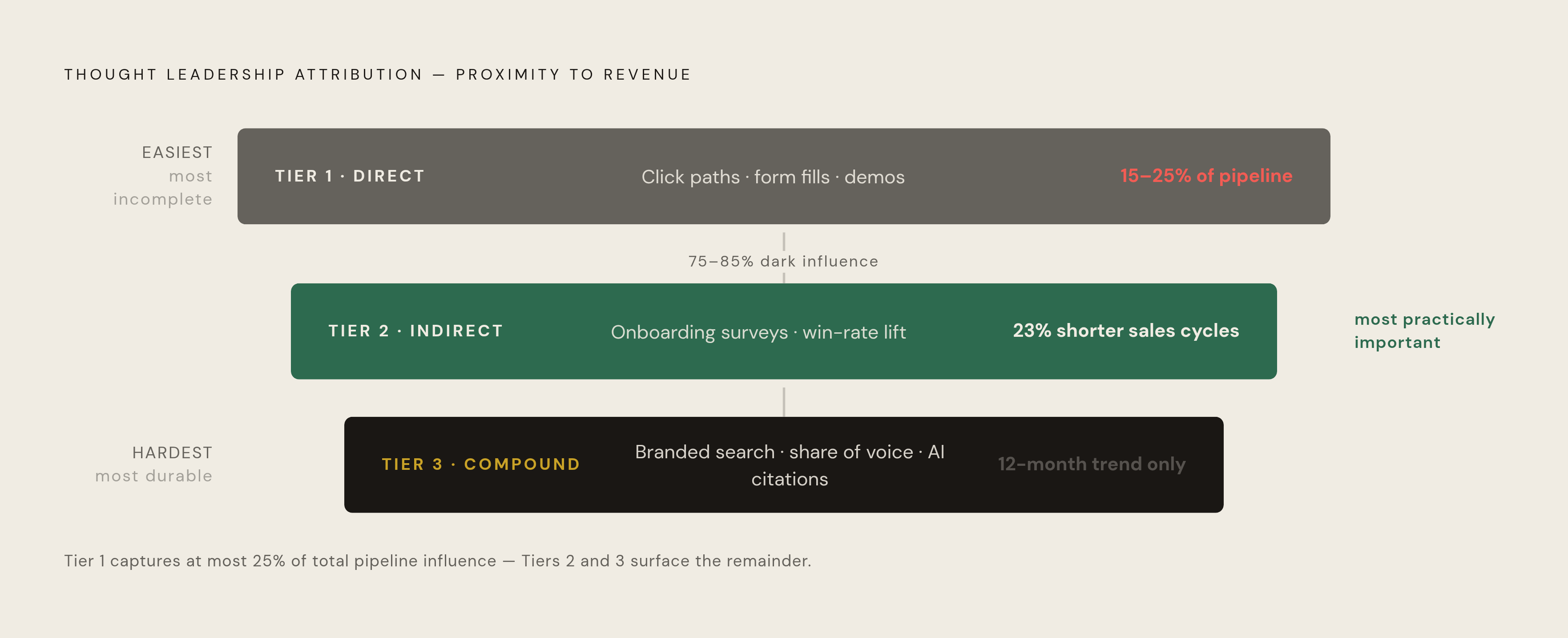
Three tiers, arranged by proximity to revenue. Tier 1 is the easiest to measure and the most incomplete. Tier 3 is the hardest to attribute and often where the most durable commercial value resides. Understanding which tier you're reporting from, and being explicit about it, is most of what separates a credible measurement program from a misleading one.
Tier 1: Direct Attribution
This tier captures content touchpoints traceable to a conversion event: form fills, demo requests, content-sourced leads where a click path exists in the analytics. Standard attribution models see this reasonably well. The ceiling is the problem. Tier 1 captures only 15 to 25% of thought leadership's total pipeline influence.
The metric most teams underutilize here is content consumption depth. Dwell time matters more than download count. A report read by 200 decision-makers for ten minutes each often delivers more commercial influence than one downloaded thousands of times and skimmed in 30 seconds. The depth signal tells you whether the content is being absorbed, not just collected. Some organizations that track this carefully find thought leadership generating engagement rates ten to twenty times higher than standard marketing content, a signal with real budget implications that rarely surfaces in presentations because teams are reporting downloads instead.
Tier 2: Indirect Attribution
This tier covers pipeline where content was a documented factor but left no trackable click path. It is the most practically important tier and the most commonly ignored, because surfacing it requires process discipline rather than new software.
The scenario is familiar to anyone who has worked in B2B sales. A buyer reads a founder's LinkedIn posts for six months, mentions on the first sales call that the perspective is what made them reach out, and closes three months later. That deal was influenced by thought leadership. Last-click reporting sees none of it.
The most practical method to surface these signals costs nothing: ask every new client a single onboarding question. "What did you read or see that made you reach out?" Log the verbatim responses in the CRM. Start doing this tomorrow. It builds an indirect attribution record from day one and requires no new tooling.
Beyond that, Tier 2 instrumentation means comparing close rates between opportunities where prospects engaged with thought leadership during the buying process and those that never interacted with it. The win-rate differential, measured consistently over time, becomes a defensible commercial signal. Companies with strong thought leadership programs report 23% shorter sales cycles due to pre-established trust, which surfaces directly in this comparison. A useful composite metric: Revenue Velocity, calculated as number of opportunities multiplied by average deal value multiplied by win rate, divided by average sales cycle length. Track this across segments with and without thought leadership engagement. If the content is compressing cycles and improving win rates, the velocity number will show it.
Tier 3: Compound and Cumulative Value
This tier tracks effects that appear in aggregate metrics rather than individual deal attribution: branded search volume growth, share of voice in category-relevant conversations, pipeline conversion rate lift across the full funnel.
One instrument worth building into any mature program is a GEO citation audit. Select ten to fifteen questions your ideal buyer realistically asks when evaluating solutions in your category. Run them through ChatGPT, Perplexity, Gemini, and Google AI Overviews quarterly. Log whether your thought leadership content is being cited in the responses. This is a direct read on AI-era visibility, and it requires nothing more than a spreadsheet and an hour each quarter.
Tier 3 metrics resist single-quarter reporting. Treat them as 12-month trends. Reporting them on a shorter cycle creates pressure to misinterpret early noise as signal, which produces conclusions that undermine the credibility of the entire measurement program.
What the Metrics Reveal About Commercial Influence Most Teams Aren't Tracking
The 2024 Edelman-LinkedIn survey surfaces specific downstream commercial behaviors that thought leadership drives, and collectively they describe a scope of influence far larger than most organizations are instrumenting.
Eighty-six percent of decision-makers say they'd be more likely to invite a company into an RFP process if it consistently produces high-quality thought leadership. That is an inbound pipeline metric measuring whether your content is expanding the universe of deals you even have the opportunity to compete for. Most teams are not tracking it.
Seventy-five percent of decision-makers said a compelling piece prompted them to research a product they weren't originally considering, and roughly 23% ultimately started doing business with that company. That is a late Tier-2 signal: influence that initiated a relationship from a cold start, traceable only through onboarding conversations and CRM-logged content references. Sixty percent say strong thought leadership makes them willing to pay a premium, which means it affects average contract value, not just pipeline count. That belongs in any honest ROI accounting.
Seventy percent of C-suite executives have reconsidered working with existing vendors after reading a competitor's thought leadership. Most organizations track churn. Almost none track the ideational shift that precedes it.
The quality dimension in this data deserves blunt attention. Fewer than half of the decision-makers surveyed said the thought leadership they regularly consume is good. Only 15% described it as very good. The commercial influence described above accrues disproportionately to the minority producing work that genuinely clears that bar. Measuring quality of output, not just publication volume, is not a soft editorial preference. It is a commercial imperative, and treating it otherwise is how programs generate activity without generating results.
The 2025 Edelman-LinkedIn data adds one more dimension that standard frameworks ignore entirely: 79% of hidden buyers say they're more likely to advocate for a proposal during an RFP if the vendor consistently produces high-quality thought leadership. People your sales team has never met, advocating for you in internal conversations you will never be invited to, based entirely on content they found on their own.
How to Build the Measurement System in Practice
Start with what's already in the CRM before acquiring any new tools. Map existing closed-won deals against content engagement records to establish a baseline indirect attribution rate. Most organizations find they've been generating Tier-2 influence for years without counting it. That baseline number anchors every subsequent budget conversation, because it demonstrates that the ROI was already happening — you just weren't logging it.
Add the onboarding question immediately. "What did you read or see that made you reach out?" One field in your CRM intake process, zero additional cost. The verbatim record it builds over twelve months is more persuasive in a budget conversation than any modeled attribution report, because it contains actual buyers describing their own decision process in their own words. No analyst's model competes with that.
Set the right reporting horizon for each tier and hold to it. Tier 1 metrics are reportable monthly, presented as leading indicators of engagement. Tier 2 pipeline metrics become meaningful at the quarterly level once a sufficient deal sample accumulates. Tier 3 compound metrics are meaningful only as 12-month trends; resist pressure to report them on a shorter cycle, because conclusions drawn from insufficient data tend to be wrong and damage the credibility of the broader program.
On tooling: SEMrush and Brandwatch serve Tier-3 share-of-voice tracking well. Perplexity is useful for AI citation spot-checks between formal GEO audits. The CRM remains the most important instrument in Tier 2, and no new platform is required to start.
Present Tier 1 and Tier 2 data together as a matter of discipline. Direct attribution numbers shown without indirect attribution context will always look insufficient, because they are. Contextualizing them alongside documented pipeline influence prevents the single-metric budget decisions that defund programs quietly delivering ROI no one bothered to count.
One operational reality that affects measurement: a program that publishes infrequently generates too thin a data set to detect Tier-2 and Tier-3 signals with any statistical confidence. Cadence is a measurement prerequisite, not just a content strategy preference.
What a Mature Thought Leadership Measurement Program Actually Looks Like Over 18 Months
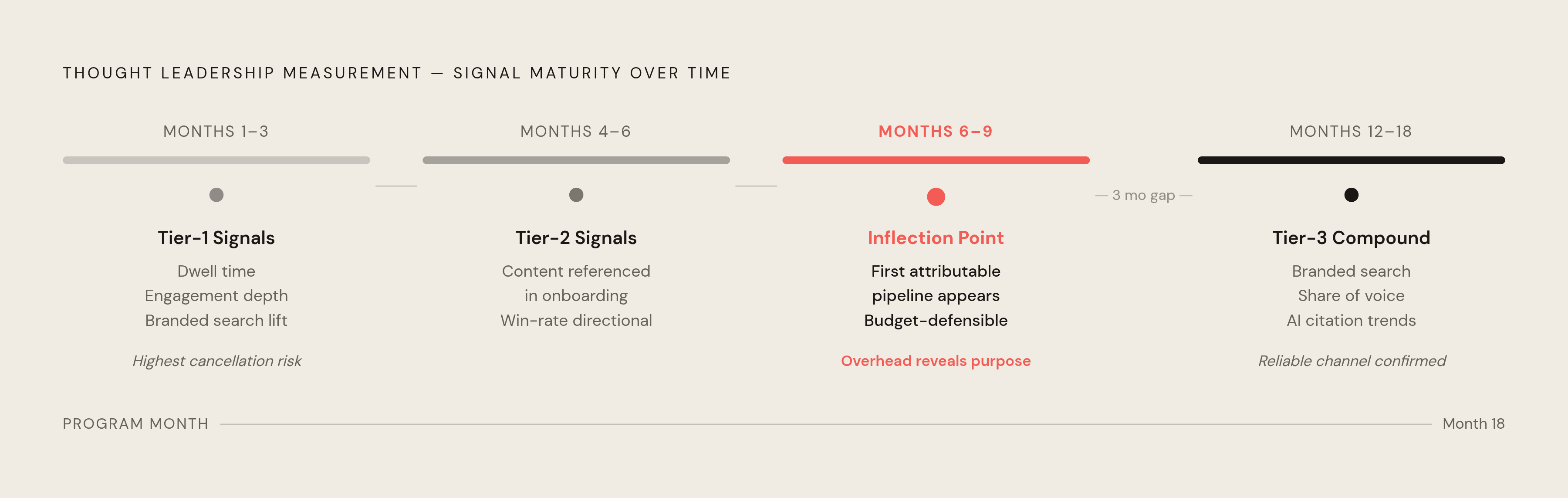
Months one through three are the most politically vulnerable period for any program. Only Tier-1 signals are moving: dwell time, content engagement depth, early branded search lift. Pipeline influence is accumulating but not yet visible. The temptation to pull the plug here, or to redirect budget toward something with a cleaner attribution story, is real and predictable.
Months four through six: the first Tier-2 signals emerge. Onboarding conversations begin returning content references with enough regularity to constitute a pattern. Win-rate comparisons start showing a directional difference between engaged and non-engaged prospects. Sales cycle data begins separating along the same dimension. This is when the discipline of logging onboarding responses from month one starts paying off.
Months six through nine: the first clearly attributable pipeline appears. The Tier-2 attribution record becomes meaningful enough to defend in a budget conversation, with actual deal examples behind it. This is the inflection point where the measurement program earns organizational credibility, and where everything that looked like overhead in months one through three reveals its purpose.
Months twelve through eighteen: Tier-3 compound signals become readable. Branded search volume, share of voice, and AI citation rates show directional trends that confirm the program is functioning as a reliable, durable channel. Unlike paid media, which stops generating return the moment spend stops, thought leadership accumulates. Content published in month three is still shaping buyer perceptions in month fifteen. That asymmetry is the entire argument for the asset class, and it only becomes visible if you've been measuring long enough to see the curve.
The 46% of global C-suite executives in the IBM IBV research who said thought leadership helped drive greater revenue growth in their organizations were measuring the endpoint of this curve, not a single campaign. Getting from first publication to that result requires building the measurement infrastructure described here, and then holding to the time horizon it demands without flinching when the early numbers look modest.